
Pulp Fiction, 1923 · page 113 of 178
Argosy All-Story Weekly — page 113: what you’re looking at
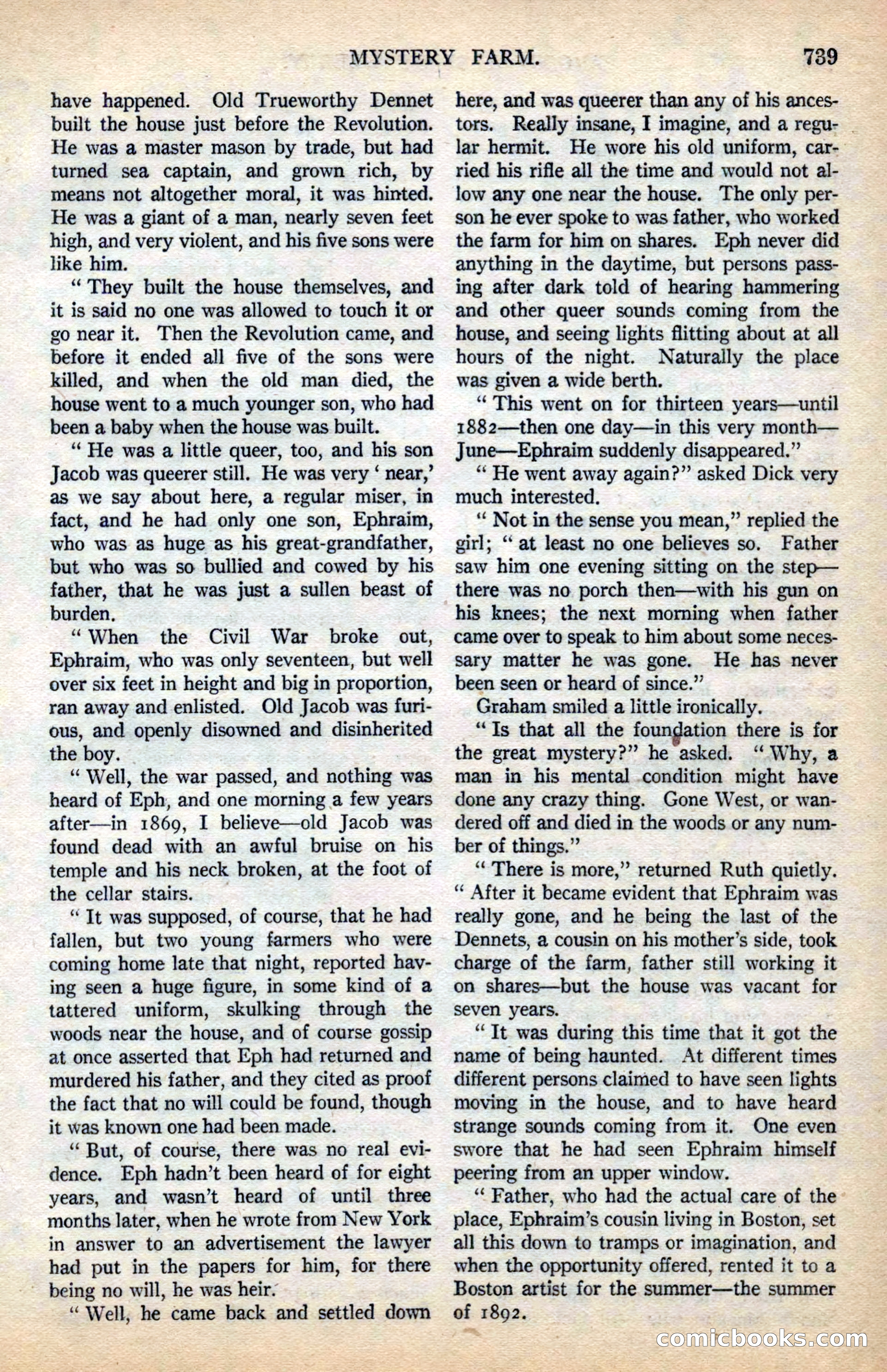
A restored page from Pulp Fiction, 1923. Page through the whole issue in the reader above.
📄 Transcribed text from this page (OCR, searchable)
Machine-transcribed from the original scan — historical spelling and the odd misread are preserved.
MYSTERY FARM. have happened. Old Trueworthy Dennet built the house just before the Revolution. He was a master mason by trade, but had turned sea captain, and grown rich, by means not altogether moral, it was hinted. He was a giant of a man, nearly seven feet high, and very violent, and his five sons were like him. “They built the house themselves, and it is said no one was allowed to touch it or go near it. Then the Revolution came, and before it ended all five of the sons were killed, and when the old man died, the house went to a much younger son, who had been a baby when the house was built. “He was a little queer, too, and his son Jacob was queerer still. He was very ‘ near,’ as we say about here, a regular miser, in fact, and he had only one son, Ephraim, who was as huge as his great-grandfather, but who was so bullied and cowed by his father, that he was just a sullen beast of burden, “When the Civil War broke out, Ephraim, who was only seventeen, but well over six feet in height and big in proportion, ran away and enlisted. Old Jacob was furi- ous, and openly disowned and disinherited the boy. ‘Well, the war passed, and nothing was heard of Eph, and one morning a few years after—in 1869, I believe—old Jacob was found dead with an awful bruise on his temple and his neck broken, at the foot of the cellar stairs. “ Tt was supposed, of course, that he had fallen, but two young farmers who were coming home late that night, reported hav- ing seen a huge figure, in some kind of a tattered uniform, skulking through the woods near the house, and of course gossip at once asserted that Eph had returned and murdered his father, and they cited as proof the fact that no will could be found, though it was known one had been made. ‘“‘ But, of course, there was no real evi- dence. Eph hadn’t been heard of for eight years, and wasn’t heard of until three months later, when he wrote from New York in answer to an advertisement the lawyer had put in the papers for him, for there - being no will, he was heir. ‘Well, he came back and settled down 789 here, and was queerer than any of his ances- tors. Really insane, I imagine, and a regu- _ lar hermit. He wore his old uniform, car- ried his rifle all the time and would not al- low any one near the house. The only per- son he ever spoke to was father, who worked the farm for him on shares. Eph never did anything in the daytime, but persons pass- ing after dark told of hearing hammering and other queer sounds coming from the house, and seeing lights flitting about at all hours of the night. Naturally the place was given a wide berth. “ This went on for thirteen years—until 1882—then one day—in this very month— June—Ephraim suddenly disappeared.” ““ He went away again?” asked Dick very much interested. ‘‘ Not in the sense you mean,” replied the girl; “ at least no one believes so. Father saw him one evening sitting on the step— there was no porch then—with his gun on his knees; the next morning when father came over to speak to him about some neces- sary matter he was gone. He has never been seen or heard of since.” Graham smiled a little ironically. “Is that all the foungation there is for the great mystery?” he asked. ‘‘ Why, a man in his mental condition might have done any crazy thing. Gone West, or wan- dered off and died in the woods or any num- ber of things.” “There is more,” returned Ruth quietly. “ After it became evident that Ephraim was really gone, and he being the last of the Dennets, a cousin on his mother’s side, took charge of the farm, father still working it on shares—but the house was vacant for seven years. “It was during this time that it got the name of being haunted. At different times different persons claimed to have seen lights moving in the house, and to have heard strange sounds coming from it. One even swore that he had seen Ephraim himself peering from an upper window. ‘“‘ Father, who had the actual care of the- place, Ephraim’s cousin living in Boston, set all this down to tramps or imagination, and when the opportunity offered, rented it to a Boston artist for the summer—the summer of 1892. Gomicghooksreom -