
Pulp Fiction, 1923 · page 114 of 178
Argosy All-Story Weekly — page 114: what you’re looking at
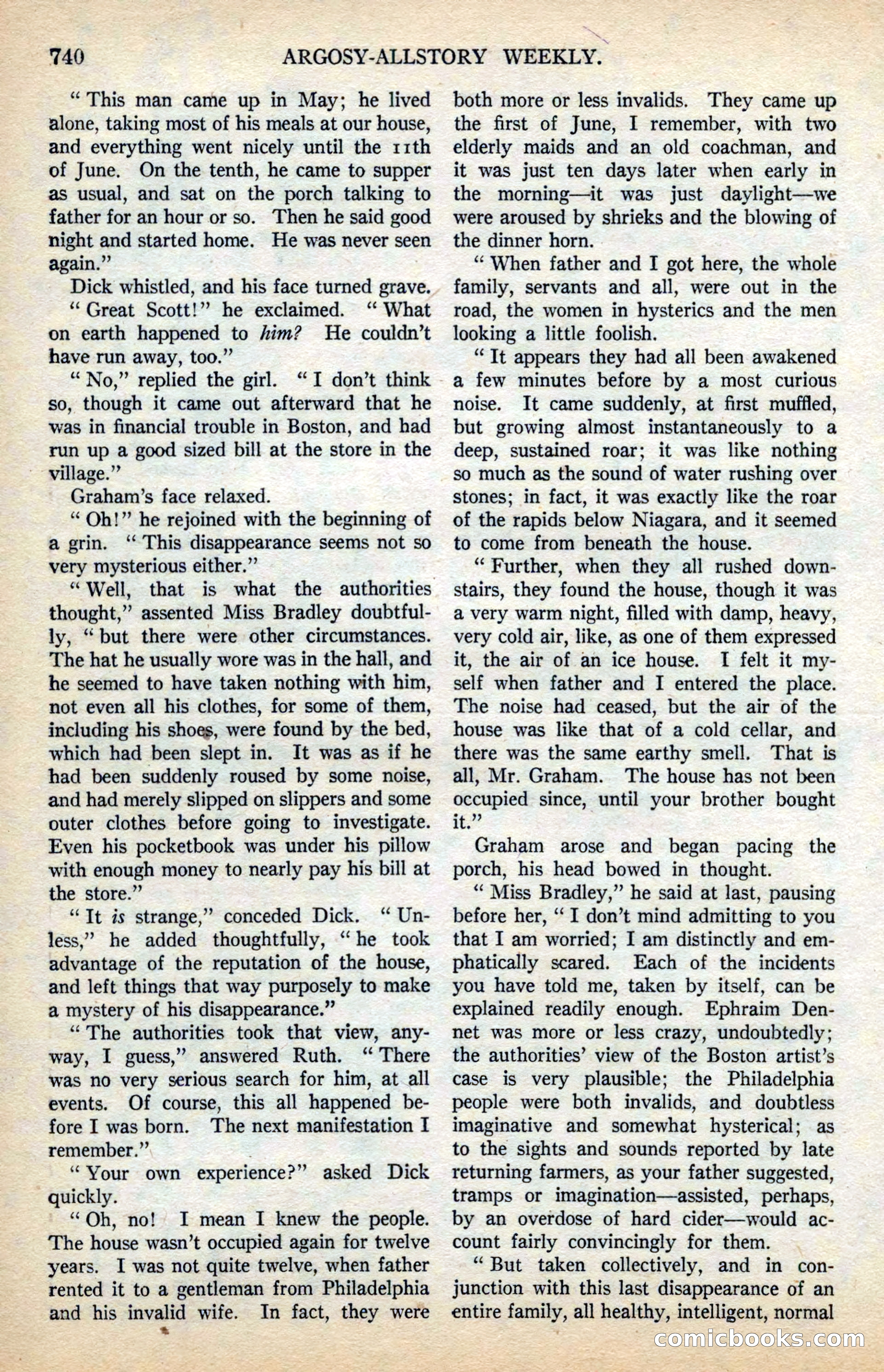
A restored page from Pulp Fiction, 1923. Page through the whole issue in the reader above.
📄 Transcribed text from this page (OCR, searchable)
Machine-transcribed from the original scan — historical spelling and the odd misread are preserved.
740 “This man came up in May; he lived alone, taking most of his meals at our house, and everything went nicely until the 11th of June. On the tenth, he came to supper as usual, and sat on the porch talking to father for an hour or so. Then he said good night and started home. He was never seen again.”’ Dick whistled, and his face turned grave. “Great Scott!” he exclaimed. ‘“ What on earth happened to him? He couldn’t have run away, too.” “No,” replied the girl. “I don’t think so, though it came out afterward that he was in financial trouble in Boston, and had run up a good sized bill at the store in the village.” Graham’s face relaxed. “ Oh!” he rejoined with the beginning of a grin. ‘‘ This disappearance seems not so very mysterious either.” * Well, thought,” assented Miss Bradley doubtful- ly, “ but there were other circumstances. The hat he usually wore was in the hall, and he seemed to have taken nothing with him, not even all his clothes, for some of them, including his shoes, were found by the bed, which had been slept in. It was as if he had been suddenly roused by some noise, and had merely slipped on slippers and some outer clothes before going to investigate. Even his pocketbook was under his pillow with enough money to nearly pay his bill at the store.” “Tt is strange,” conceded Dick. “ Un- less,” he added thoughtfully, “he took advantage of the reputation of the house, and left things that way purposely to make a mystery of his disappearance.” “The authorities took that view, any- way, I guess,” answered Ruth. “ There was no very serious search for him, at all events. Of course, this all happened be- fore I was born. The next manifestation I remember.” 3 “Your own experience?” asked Dick quickly. “Oh, no! I mean I knew the people. The house wasn’t occupied again for twelve years. I was not quite twelve, when father rented it to a gentleman from Philadelphia and his invalid wife. In fact, they were & that is what the authorities ARGOSY-ALLSTORY WEEKLY. both more or less invalids. They came up the first of June, I remember, with two elderly maids and an old coachman, and it was just ten days later when early in the morning—it was just daylight—we were aroused by shrieks and the blowing of the dinner horn. “When father and I got here, the whole family, servants and all, were out in the road, the women in hysterics and the men looking a little foolish. “It appears they had all been awakened a few minutes before by a most curious noise. It came suddenly, at first muffled, but growing almost instantaneously to a deep, sustained roar; it was like nothing so much as the sound of water rushing over stones; in fact, it was exactly like the roar of the rapids below Niagara, and it seemed to come from beneath the house. “Further, when they all rushed down- stairs, they found the house, though it was a very warm night, filled with damp, heavy, very cold air, like, as one of them expressed it, the air of an ice house. [ felt it my- self when father and I entered the place. The noise had ceased, but the air of the house was like that of a cold cellar, and there was the same earthy smell. That is all, Mr. Graham. The house has not been occupied since, until your brother bought it;” Graham arose and began pacing the porch, his head bowed in thought. ““ Miss Bradley,” he said at last, pausing before her, “‘ I don’t mind admitting to you that I am worried; I am distinctly and em- phatically scared. Each of the incidents you have told me, taken by itself, can be explained readily enough. Ephraim Den- net was more or less crazy, undoubtedly; the authorities’ view of the Boston artist’s case is very plausible; the Philadelphia people were both invalids, and doubtless imaginative and somewhat hysterical; as to the sights and sounds reported by late returning farmers, as your father suggested, tramps or imagination—assisted, perhaps, by an overdose of hard cider—would ac- count fairly convincingly for them. “ But taken collectively, and in con- junction with this last disappearance of an entire family, all healthy, intelligent, normal = Gomichbooks co