
Pulp Fiction, 1923 · page 165 of 178
Argosy All-Story Weekly — page 165: what you’re looking at
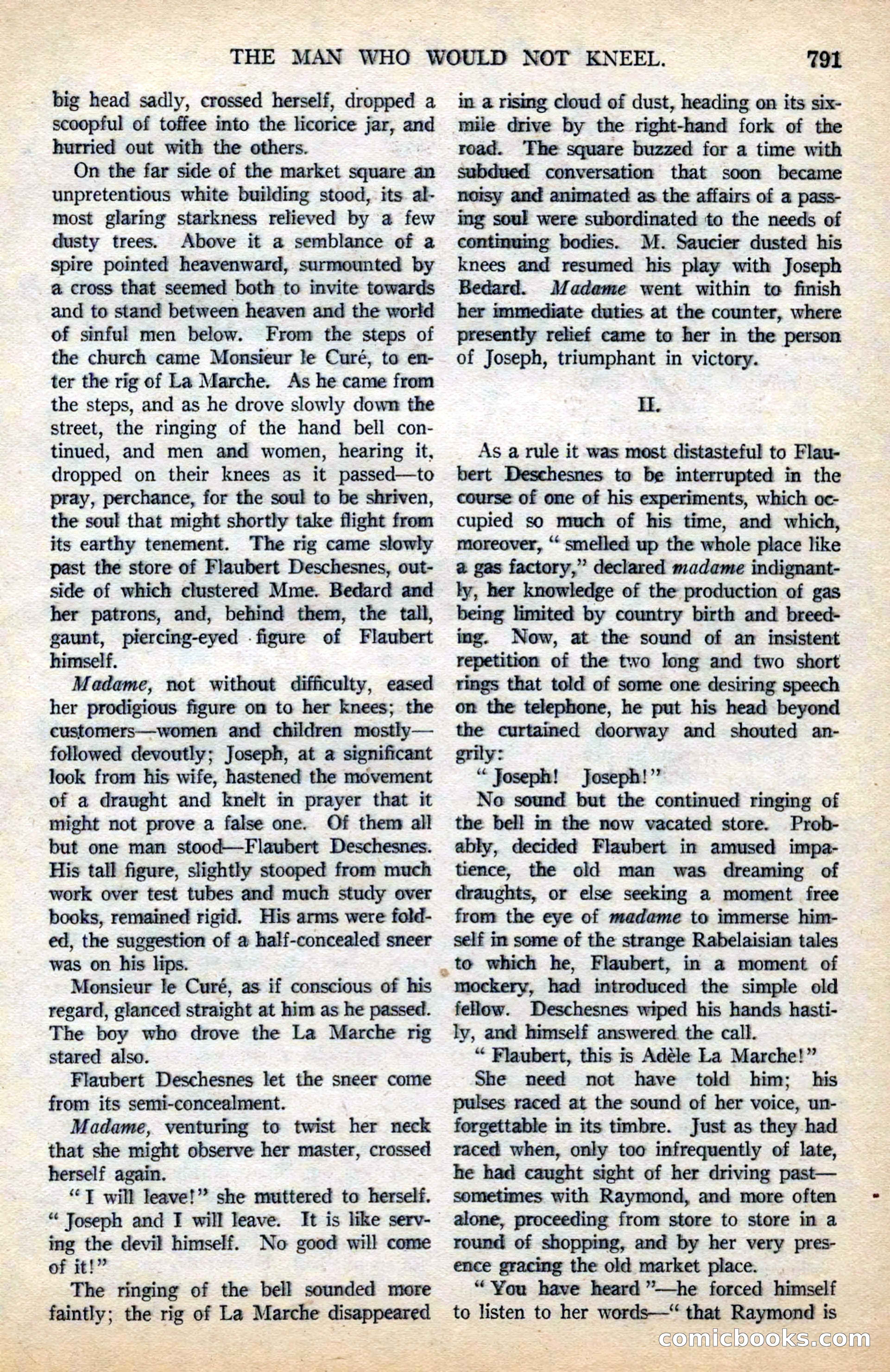
A restored page from Pulp Fiction, 1923. Page through the whole issue in the reader above.
📄 Transcribed text from this page (OCR, searchable)
Machine-transcribed from the original scan — historical spelling and the odd misread are preserved.
THE MAN WHO WOULD NOT KNEEL. _ big head sadly, crossed herself, dropped a scoopful of toffee into the licorice jar, and hurried out with the others. : On the far side of the market square an unpretentious white building stood, its al- most glaring starkness relieved by a few dusty trees. Above it a semblance of a spire pointed heavenward, surmounted by a cross that seemed both to invite towards and to stand between heaven and the world of sinful men below. From the steps of the church came Monsieur le Curé, to en- ter the rig of La Marche. As he came from the steps, and as he drove slowly down the street, the ringing of the hand bell con- tinued, and men and women, hearing it, dropped on their knees as it passed—to pray, perchance, for the soul to be shriven, the soul that might shortly take flight from its earthy tenement. The rig came slowly past the store of Flaubert Deschesnes, out- side of which clustered Mme. Bedard and her patrons, and, behind them, the tall, gaunt, piercing-eyed -figure of Flaubert himself. Madame, not without difficulty, eased her prodigious figure om to her knees; the customers—women and children mostly— followed devoutly; Joseph, at a significant look from his wife, hastened the movement of a draught and knelt in prayer that it might not prove a false one. Of them all but one man stood—Flaubert Deschesnes. His tall figure, slightly stooped from much work over test tubes and much study over books, remained rigid. His arms were fold- ed, the suggestion of a half-concealed sneer was on his lips. Monsieur le Curé, as if conscious of his regard, glanced straight at him as he passed. The boy who drove the La Marche rig stared also. Flaubert Deschesnes let the sneer come from its semi-concealment. Madame, venturing to twist her neck that she might observe her master, crossed herself again. “‘T will leave!” she muttered to herself. “ Joseph and I will leave. It is like serv- ing the devil himself. No good will come of it!” The ringing of the bell sounded more faintly; the rig of La Marche disappeared oe 791 im a rising cloud of dust, heading on its six- mile drive by the right-hand fork of the road. ‘The square buzzed for a time with subdued conversation that soon became noisy and animated as the affairs of a pass- ing soul were subordinated to the needs of knees and resumed his play with Joseph Bedard. Madame went within to finish her immediate duties at the counter, where presently relief came to her in the person of Joseph, triumphant in victory. Ik. As a rule it was most distasteful to Flau- bert Deschesnes to be interrupted in the course of one of his experiments, which oc- cupied so much of his time, and which, moreover, “ smelled up the whole place like @ gas factory,” declared madame indignant- ly, her knowledge of the production of gas being limited by country birth and breed- ing. Now, at the sound of an insistent repetition of the two long and two short rings that told of some one desiring speech on the telephone, he put his head beyond the curtained doorway and shouted an- y: No sound but the continued ringing of the bell in the now vacated store. Prob- ably, decided Flaubert in amused impa- tience, the old man was dreaming of draughts, or else seeking a moment free from the eye of madame to immerse him- self in some of the strange Rabelaisian tales to which he, Flaubert, in a moment of mockery, had introduced the simple old fellow. Deschesnes wiped his hands hasti- ly, and himself answered. the call. “‘ Flaubert, this is Adéle La Marche!” She need not have told him; his pulses raced at the sound of her voice, un- forgettable in its timbre. Just as they had raced when, only too infrequently of late, he had caught sight of her driving past— sometimes with Raymond, and more often alone, proceeding from store to store in a round of shoppimg, and by her very pres- ence gracing the old market place. | “You have heard ”—he forced himself to listen to her w “that Raymond is ; COMME OOS €om