
Pulp Fiction, 1923 · page 166 of 178
Argosy All-Story Weekly — page 166: what you’re looking at
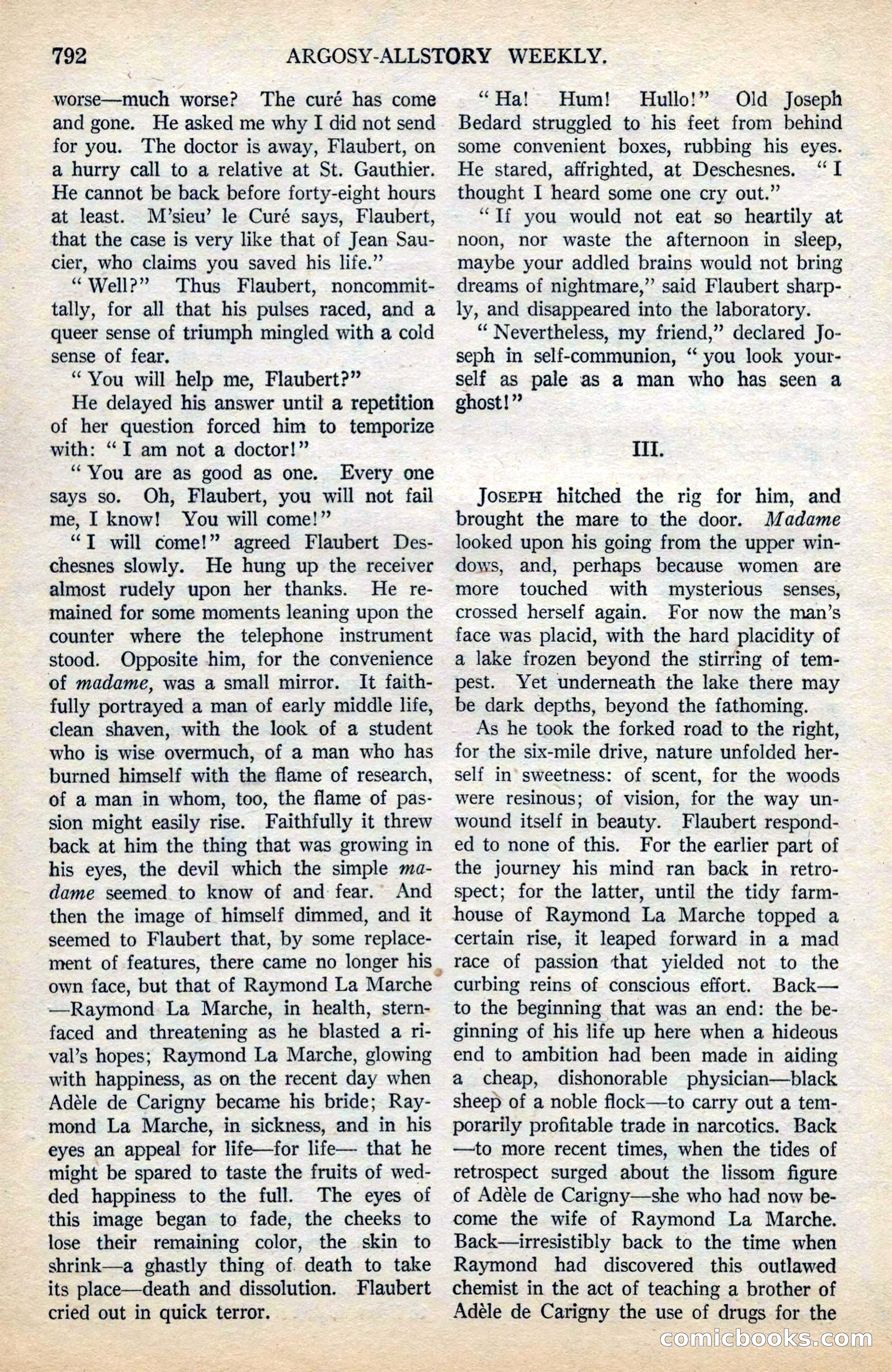
A restored page from Pulp Fiction, 1923. Page through the whole issue in the reader above.
📄 Transcribed text from this page (OCR, searchable)
Machine-transcribed from the original scan — historical spelling and the odd misread are preserved.
792 worse—much worse? The curé has come and gone. He asked me why I did not send for you. The doctor is away, Flaubert, on a hurry call to a relative at St. Gauthier. He cannot be back before forty-eight hours at least. M’sieu’ le Curé says, Flaubert, that the case is very like that of Jean Sau- cier, who claims you saved his life.” “Well?” Thus Flaubert, noncommit- tally, for all that his pulses raced, and a queer sense of triumph mingled with a cold sense of fear. | “You will help me, Flaubert?” He delayed his answer until a repetition of her question forced him to temporize with: “I am not a doctor!” “You are as good as one. Every one says so. Oh, Flaubert, you will not fail me, I know! You will come!” “TI will come!” agreed Flaubert Des- chesnes slowly. He hung up the receiver almost rudely upon her thanks. He re- mained for some moments leaning upon the counter where the telephone instrument stood. Opposite him, for the convenience of madame, was a small mirror. It faith- fully portrayed a man of early middle life, clean shaven, with the look of a student who is wise overmuch, of a man who has burned himself with the flame of research, of a man in whom, too, the flame of pas- sion might easily rise. Faithfully it threw back at him the thing that was growing in his eyes, the devil which the simple ma- dame seemed to know of and fear. And then the image of himself dimmed, and it seemed to Flaubert that, by some replace- ment of features, there came no longer his | own face, but that of Raymond La Marche —Raymond La Marche, in health, stern- faced and threatening as he blasted a ri- val’s hopes; Raymond La Marche, glowing with happiness, as on the recent day when Adéle de Carigny became his bride; Ray- mond La Marche, in sickness, and in his eyes an appeal for life—for life— that he might be spared to taste the fruits of wed- ded happiness to the full. The eyes of this image began to fade, the cheeks to lose their remaining color, the skin to shrink—a ghastly thing of death to take its place—death and dissolution. Flaubert cried out in quick terror. ARGOSY-ALLSTORY WEEKLY. “Ha! Hum! Hullo!” Old Joseph Bedard struggled to his feet from behind some convenient boxes, rubbing his eyes. He stared, affrighted, at Deschesnes. “I thought I heard some one cry out.” ‘If you would not eat so heartily at noon, nor waste the afternoon in sleep, maybe your addled brains would not bring dreams of nightmare,” said Flaubert sharp- ly, and disappeared into the laboratory. “ Nevertheless, my friend,” declared Jo- seph in self-communion, “ you look your- self as pale as a man who has seen a ghost!” II. JosepH hitched the rig for him, and brought the mare to the door. Madame looked upon his going from the upper win- dows, and, perhaps because women are more touched with mysterious senses, crossed herself again. For now the man’s face was placid, with the hard placidity of a lake frozen beyond the stirring of tem- pest. Yet underneath the lake there may be dark depths, beyond the fathoming. As he took the forked road to the right, for the six-mile drive, nature unfolded her- self in sweetness: of scent, for the woods were resinous; of vision, for the way un- wound itself in beauty. Flaubert respond- — ed to none of this. For the earlier part of the journey his mind ran back in retro- spect; for the latter, until the tidy farm- house of Raymond La Marche topped a certain rise, it leaped forward in a mad race of passion that yielded not to the curbing reins of conscious effort. Back— to the beginning that was an end: the be- ginning of his life up here when a hideous end to ambition had been made in aiding a cheap, dishonorable physician—black sheep of a noble flock—to carry out a tem- porarily profitable trade in narcotics. Back —to more recent times, when the tides of retrospect surged about the lissom figure of Adéle de Carigny—she who had now be- come the wife of Raymond La Marche. Back—irresistibly back to the time when Raymond had discovered this outlawed chemist in the act of teaching a brother of Adéle de Carigny the use of drugs for the COMME NOO Sine)