
Pulp Fiction, 1923 · page 167 of 178
Argosy All-Story Weekly — page 167: what you’re looking at
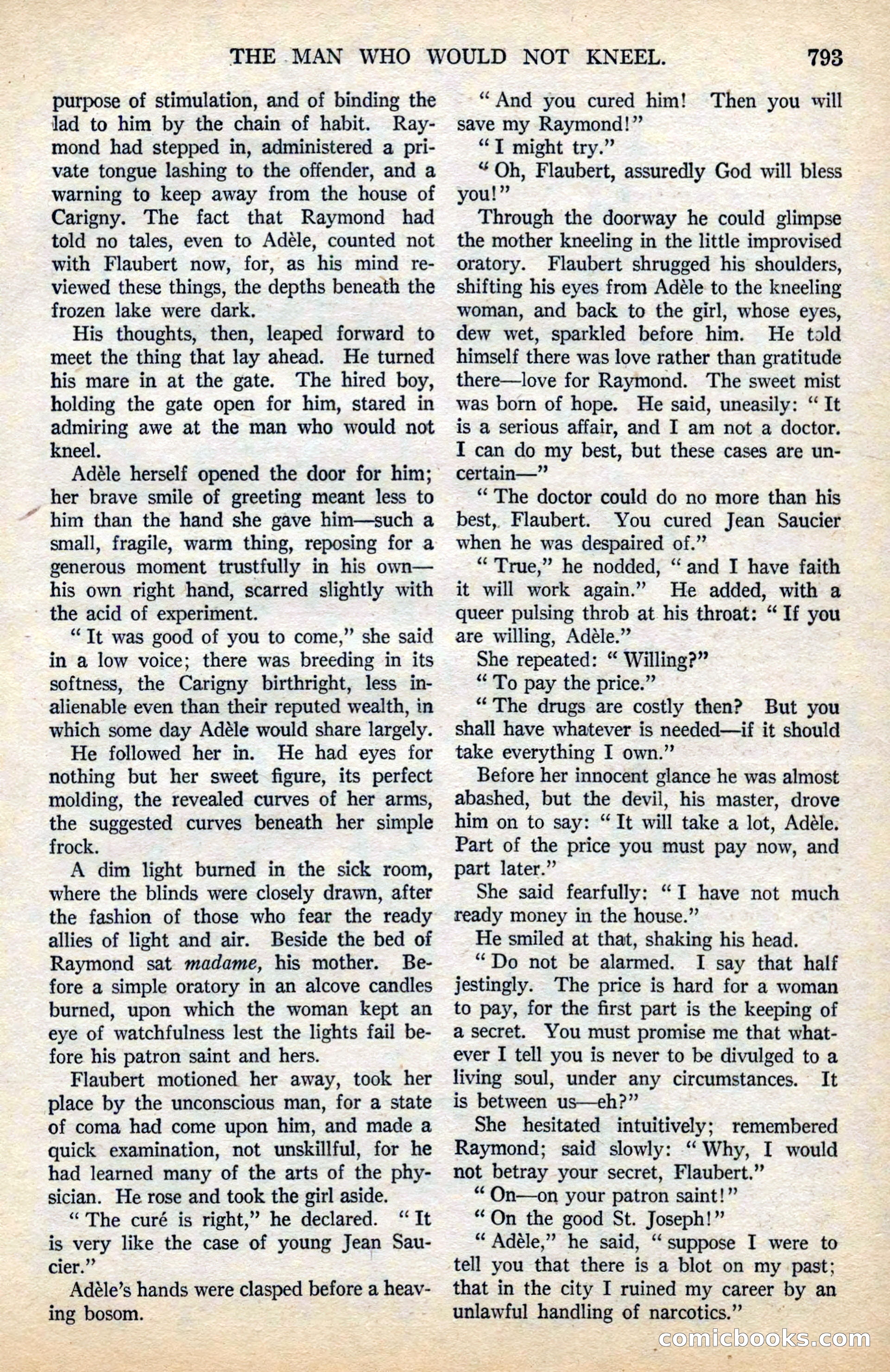
A restored page from Pulp Fiction, 1923. Page through the whole issue in the reader above.
📄 Transcribed text from this page (OCR, searchable)
Machine-transcribed from the original scan — historical spelling and the odd misread are preserved.
THE .MAN WHO WOULD NOT KNEEL. purpose of stimulation, and of binding the lad to him by the chain of habit. Ray- mond had stepped in, administered a pri- vate tongue lashing to the offender, and a warning to keep away from the house of Carigny. The fact that Raymond had told no tales, even to Adele, counted not with Flaubert now, for, as his mind re- viewed these things, the depths beneath the frozen lake were dark. His thoughts, then, leaped forward to meet the thing that lay ahead. He turned his mare in at the gate. The hired boy, holding the gate open for him, stared in admiring awe at the man who would not kneel. Adéle herself opened the door for him; her brave smile of greeting meant less to ' him than the hand she gave him—such a small, fragile, warm thing, reposing for a generous moment trustfully in his own— his own right hand, scarred slightly with - the acid of experiment. “It was good of you to come,” she said in a low voice; there was breeding in its softness, the Carigny birthright, less in- alienable even than their reputed wealth, in which some day Adéle would share largely. He followed her in. He had eyes for nothing but her sweet figure, its perfect molding, the revealed curves of her arms, the suggested curves beneath her simple frock. A dim light burned in the sick room, where the blinds were closely drawn, after the fashion of those who fear the ready allies of light and air. Beside the bed of Raymond sat madame, his mother. Be- fore a simple oratory in an alcove candles burned, upon which the woman kept an eye of watchfulness lest the lights fail be- fore his patron saint and hers. Flaubert motioned her away, took her place by the unconscious man, for a state of coma had come upon him, and made a quick examination, not unskillful, for he had learned many of the arts of the phy- sician. He rose and took the girl aside. “The curé is right,” he declared. “ It is very like the case of young Jean Sau- cier.”’ Adéle’s hands were clasped before a heav- ing bosom. 193 “And you cured him! Then you will save my Raymond!” “T might try.” “Oh, Flaubert, assuredly God will bless you!” Through the doorway he could glimpse the mother kneeling in the little improvised oratory. Flaubert shrugged his shoulders, shifting his eyes from Adéle to the kneeling woman, and back to the girl, whose eyes, dew wet, sparkled before him. He told himself there was love rather than gratitude there—love for Raymond. The sweet mist was born of hope. He said, uneasily: “ It is a serious affair, and I am not a doctor. I can do my best, but these cases are un- certain—” “The doctor could do no more than his best, Flaubert. You cured Jean Saucier when he was despaired of.” “True,” he nodded, “‘ and I have faith it will work again.” He added, with a queer pulsing throb at his throat: “If you are willing, Adéle.” She repeated: “ Willing?” “To pay the price.” “The drugs are costly then? But you shall have whatever is needed—if it should take everything I own.” Before her innocent glance he was almost abashed, but the devil, his master, drove him on to say: “It will take a lot, Adéle. Part of the price you must pay now, and part later.” She said fearfully: “I have not much ready money in the house.” He smiled at that, shaking his head. “Do not be alarmed. I say that half jestingly. The price is hard for a woman to pay, for the first part is the keeping of a secret. You must promise me that what- ever I tell you is never to be divulged to a living soul, under any circumstances. It is between us—eh?” She hesitated intuitively; remembered Raymond; said slowly: “Why, I would not betray your secret, Flaubert.” ** On—on your patron saint!” “On the good St. Joseph!” “ Adéle,” he said, “suppose I were to tell you that there is a blot on my past; that in the city I ruined my career by an unlawful handling of narcotics.” COMME IOOKS (E@)