
Pulp Fiction, 1923 · page 171 of 178
Argosy All-Story Weekly — page 171: what you’re looking at
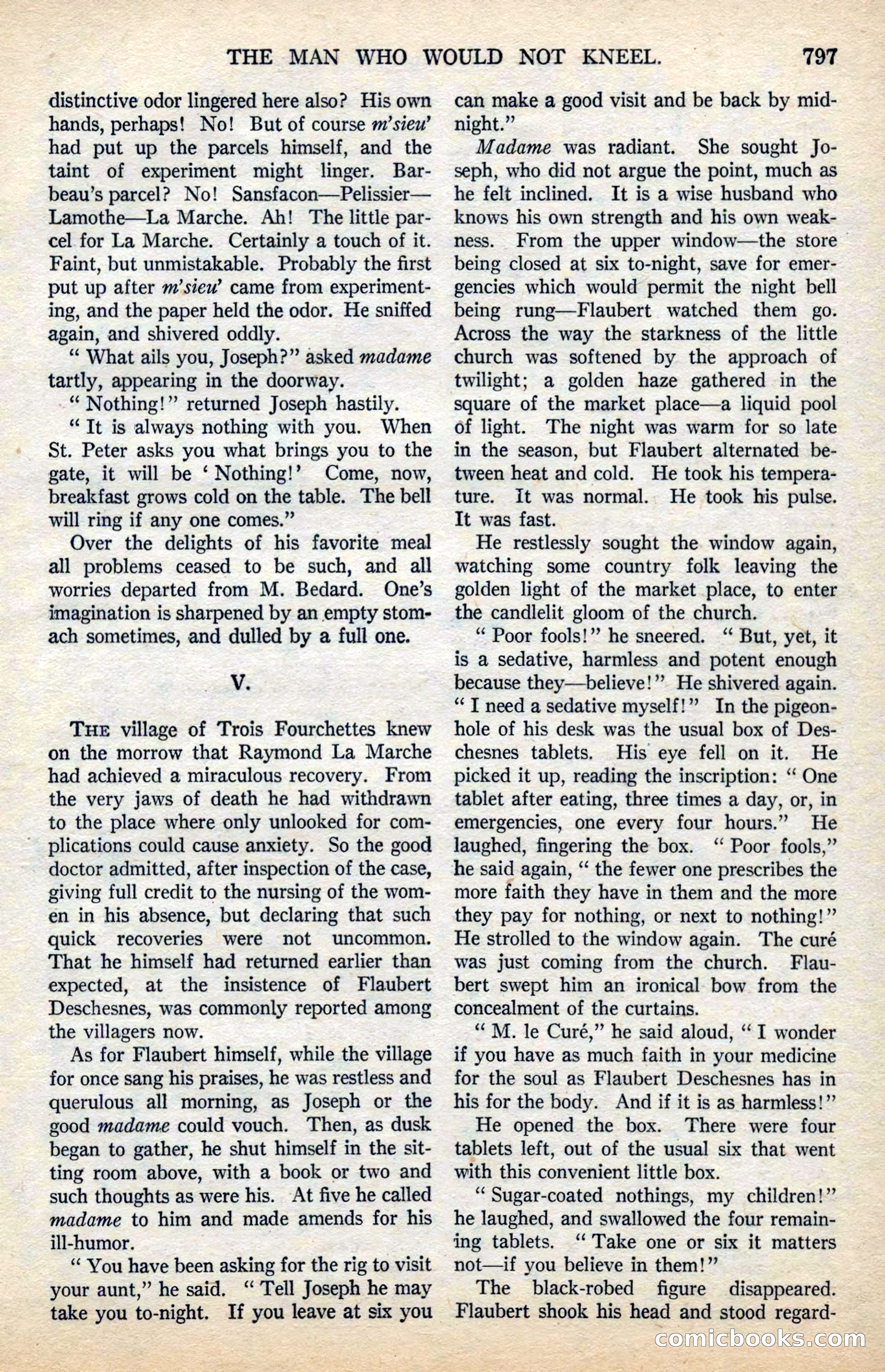
A restored page from Pulp Fiction, 1923. Page through the whole issue in the reader above.
📄 Transcribed text from this page (OCR, searchable)
Machine-transcribed from the original scan — historical spelling and the odd misread are preserved.
THE MAN WHO WOULD NOT KNEEL. distinctive odor lingered here also? His own hands, perhaps! No! But of course m’sieu’ had put up the parcels himself, and the taint of experiment might linger. Bar- beau’s parcel? No! Sansfacon—Pelissier— Lamothe—La Marche. Ah! The little par- cel for La Marche. Certainly a touch of it. Faint, but unmistakable. Probably the first put up after m’siew came from experiment- ing, and the paper held the odor. He sniffed again, and shivered oddly. “ What ails you, Joseph?” asked madame tartly, appearing in the doorway. “ Nothing!” returned Joseph hastily. “Tt is always nothing with you. When St. Peter asks you what brings you to the gate, it will be ‘ Nothing!’ Come, now, breakfast grows cold on the table. The bell will ring if any one comes.” Over the delights of his favorite meal all problems ceased to be such, and all worries departed from M. Bedard. One’s imagination is sharpened by an empty stom- ach sometimes, and dulled by a full one. V. Tue village of Trois Fourchettes knew on the morrow that Raymond La Marche had achieved a miraculous recovery. From the very jaws of death he had withdrawn to the place where only unlooked for com- plications could cause anxiety. So the good doctor admitted, after inspection of the case, giving full credit to the nursing of the wom- en in his absence, but declaring that such quick recoveries were not uncommon. That he himself had returned earlier than expected, at the insistence of Flaubert Deschesnes, was commonly reported among the villagers now. As for Flaubert himself, while the village for once sang his praises, he was restless and querulous all morning, as Joseph or the good madame could vouch. Then, as dusk began to gather, he shut himself in the sit- ting room above, with a book or two and such thoughts as were his. At five he called madame to him and made amends for his ill-humor. “You have been asking for the rig to visit your aunt,” he said. ‘“ Tell Joseph he may take you to-night. If you leave at six you T9T can make a good visit and be back by mid- night.” Madame was radiant. She sought Jo- seph, who did not argue the point, much as he felt inclined. It is a wise husband who knows his own strength and his own weak- ness. From the upper window—the store being closed at six to-night, save for emer- gencies which would permit the night bell being rung—Flaubert watched them go. Across the way the starkness of the little church was softened by the approach of twilight; a golden haze gathered in the square of the market place—a liquid pool of light. The night was warm for so late in the season, but Flaubert alternated be- tween heat and cold. He took his tempera- ture. it was normal. He took his pulse. It was fast. He restlessly sought the window again, watching some country folk leaving the golden light of the market place, to enter the candlelit gloom of the church. “Poor fools!” he sneered. ‘ But, yet, it is a sedative, harmless and potent enough because they—believe!”’ He shivered again. “‘T need a sedative myself!” In the pigeon- hole of his desk was the usual box of Des- chesnes tablets. His eye fell on it. He picked it up, reading the inscription: ‘‘ One tablet after eating, three times a day, or, in emergencies, one every four hours.” He laughed, fingering the box. ‘“ Poor fools,” he said again, ‘“‘ the fewer one prescribes the more faith they have in them and the more they pay for nothing, or next to nothing!”’ He strolled to the window again. The curé was just coming from the church. Flau- bert swept him an ironical bow from the concealment of the curtains. ““'M. le Curé,” he said aloud, “ I wonder if you have as much faith in your medicine for the soul as Flaubert Deschesnes has in his for the body. And if it is as harmless!” He opened the box. There were four tablets left, out of the usual six that went with this convenient little box. ‘‘ Sugar-coated nothings, my children!” he laughed, and swallowed the four remain- ing tablets. ‘“‘ Take one or six it matters not—if you believe in them!” The black-robed figure disappeared. Flaubert shook his head and stood regard- COMIC DOOKS EO