
Pulp Fiction, 1923 · page 172 of 178
Argosy All-Story Weekly — page 172: what you’re looking at
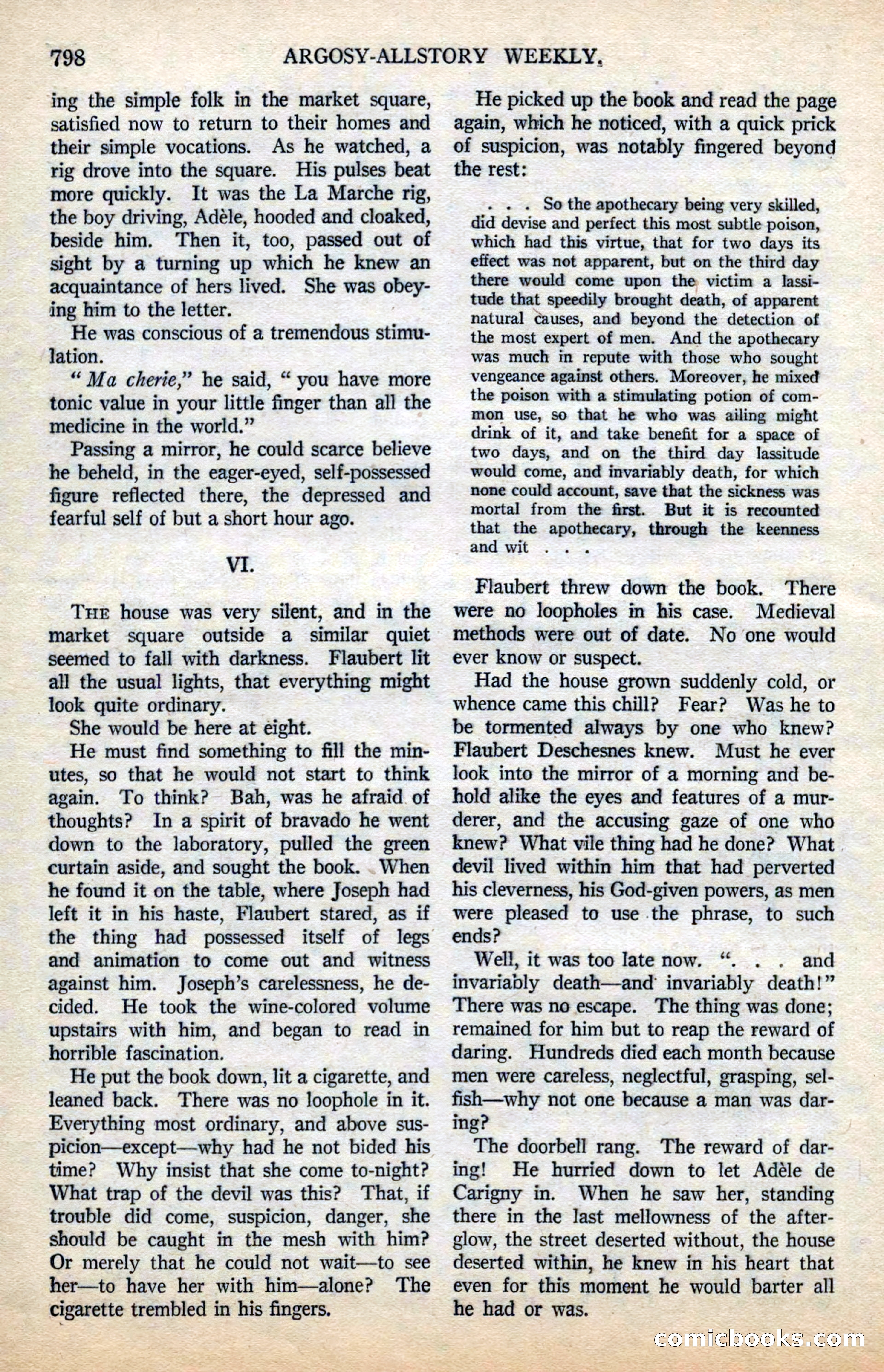
A restored page from Pulp Fiction, 1923. Page through the whole issue in the reader above.
📄 Transcribed text from this page (OCR, searchable)
Machine-transcribed from the original scan — historical spelling and the odd misread are preserved.
798 ing the simple folk in the market square, satisfied now to return to their homes and their simple vocations. As he watched, a rig drove into the square. His pulses beat more quickly. It was the La Marche rig, the boy driving, Adéle, hooded and cloaked, beside him. ‘Then it, too, passed out of sight by a turning up which he knew an acquaintance of hers lived. She was obey- ing him to the letter. He was conscious of a tremendous stimu- lation. “ Ma cherie,’ he said, “ you have more tonic value in your little finger than all the medicine in the world.” Passing a mirror, he could scarce believe he beheld, in the eager-eyed, self-possessed figure reflected there, the depressed and fearful self of but a short hour ago. VI. Tue house was very silent, and in the market square outside a similar quiet seemed to fall with darkness. Flaubert lit all the usual lights, that everything might look quite ordinary. She would be here at eight. He must find something to fill the min- utes, so that he would not start to think again. To think? Bah, was he afraid of thoughts? In a spirit of bravado he went down to the laboratory, pulled the green curtain aside, and sought the book. . When he found it on the table, where Joseph had left it in his haste, Flaubert stared, as if the thing had possessed itself of legs and animation to come out and witness against him. Joseph’s carelessness, he de- cided. He took the wine-colored volume upstairs with him, and began to read in horrible fascination. He put the book down, lit a cigarette, and leaned back. There was no loophole in it. Everything most ordinary, and above sus- picion—except—why had he not bided his time? Why insist that she come to-night? What trap of the devil was this? That, if trouble did come, suspicion, danger, she should be caught in the mesh with him? Or merely that he could not wait—to see her—to have her with him—alone? The cigarette trembled in his fingers. ARGOSY-ALLSTORY WEEKLY. He picked up the book and read the page again, which he noticed, with a quick prick of suspicion, was notably fingered beyond the rest: ; . So the apothecary being very skilled, did devise and perfect this most subtle poison, which had this virtue, that for two days its effect was not apparent, but on the third day there would come upon the victim a lassi- tude that speedily brought death, of apparent natural causes, and beyond the detection of the most expert of men. And the apothecary was much in repute with those who sought vengeance against others. Moreover, he mixed the poison with a stimulating potion of com- mon use, so that he who was ailing might drink of it, and take benefit for a space of two days, and on the third day lassitude would come, and invariably death, for which none could account, save that the sickness was mortal from the first. But it is recounted that the apothecary, through the keenness and wit ==... Flaubert threw down the book. ‘There were no loopholes in his case. Medieval methods were out of date. No one would ever know or suspect. Had the house grown suddenly cold, or whence came this chill? Fear? Was he to be tormented always by one who knew? Flaubert Deschesnes knew. Must he ever look into the mirror of a morning and be- hold alike the eyes and features of a mur- derer, and the accusing gaze of one who knew? What vile thing had he done? What. devil lived within him that had perverted his cleverness, his God-given powers, as men were pleased to use the phrase, to such ends? Well, it was too late now. “. and invariably death—and invariably death!” There was no escape. The thing was done; remained for him but to reap the reward of daring. Hundreds died each month because men were careless, neglectful, grasping, sel- fish—why not one because a man was dar- ing? The doorbell rang. The reward of dar- ing! He hurried down to let Adéle de Carigny in. When he saw her, standing there in the last mellowness of the after- glow, the street deserted without, the house deserted within, he knew in his heart that even for this moment he would barter all he had or was. Eomiicdooks co