
Pulp Fiction, 1923 · page 173 of 178
Argosy All-Story Weekly — page 173: what you’re looking at
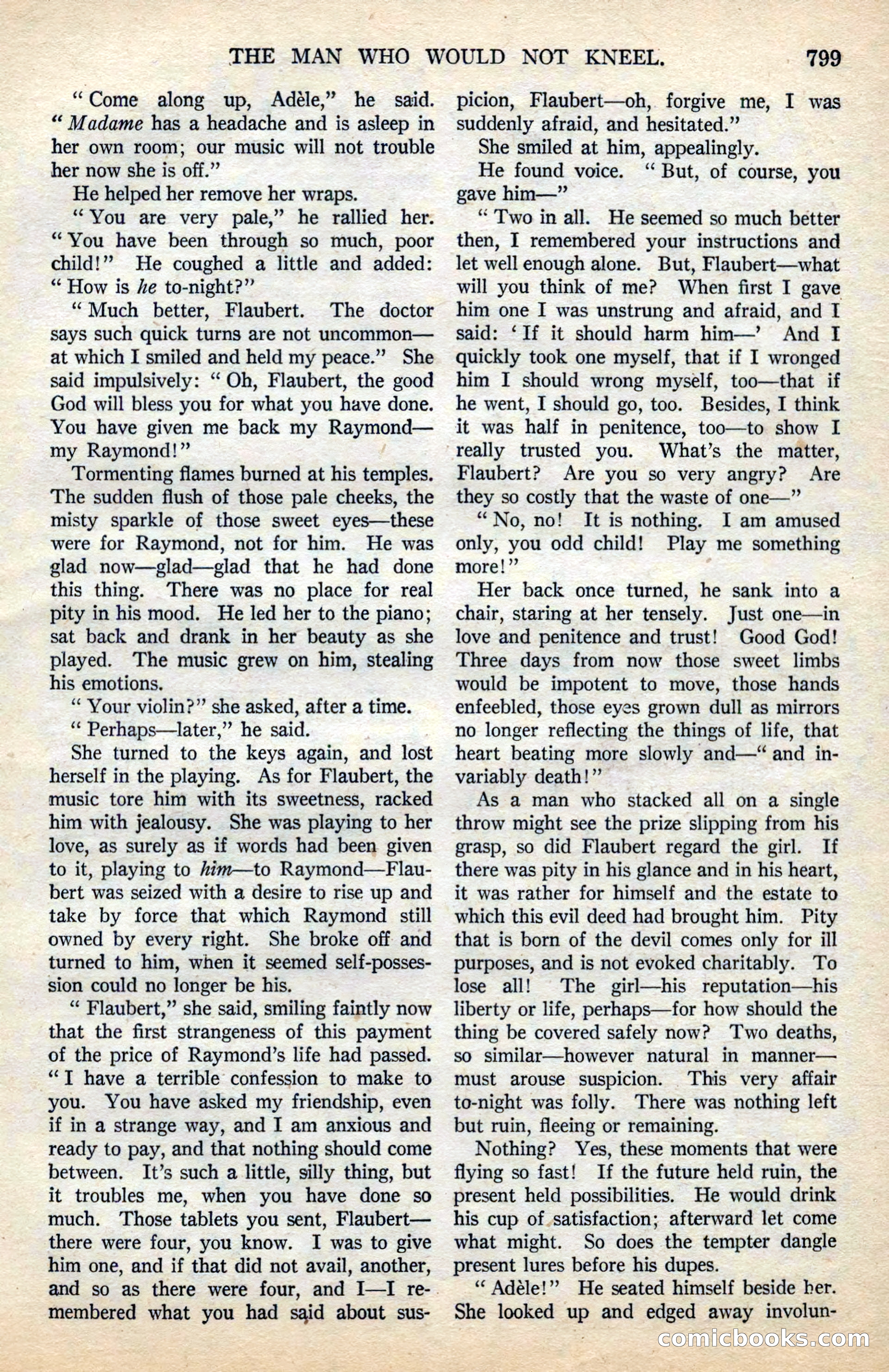
A restored page from Pulp Fiction, 1923. Page through the whole issue in the reader above.
📄 Transcribed text from this page (OCR, searchable)
Machine-transcribed from the original scan — historical spelling and the odd misread are preserved.
THE MAN WHO WOULD NOT KNEEL., “Come along up, Adele,” he said. ““ Madame has a headache and is asleep in her own room; our music will not trouble her now she is off.” He helped her remove her wraps. “You are very pale,” he rallied her. “You have been through so much, poor child!” He coughed a little and added: * How is ve to-night?” ““Much better, Flaubert. The doctor says such quick turns are not uncommon— at which I smiled and held my peace.” She said impulsively: “ Oh, Flaubert, the good God will bless you for what you have done. You have given me back my Raymond— my Raymond!” Tormenting flames burned at his temples. The sudden flush of those pale cheeks, the misty sparkle of those sweet eyes—these were for Raymond, not for him. He was glad now—glad—glad that he had done this thing. There was no place for real pity in his mood. He led her to the piano; sat back and drank in her beauty as she played. The music grew on him, stealing his emotions, “Your violin?” she asked, after a time. “* Perhaps—later,” he said. She turned to the keys again, and lost herself in the playing. As for Flaubert, the music tore him with its sweetness, racked him with jealousy. She was playing to her love, as surely as if words had been given to it, playing to him—to Raymond—Flau- bert was seized with a desire to rise up and take by force that which Raymond still owned by every right. She broke off and turned to him, when it seemed self-posses- sion could no longer be his. “ Flaubert,” she said, smiling faintly now that the first strangeness of this payment of the price of Raymond’s life had passed. “IT have a terrible confession to make to you. You have asked my friendship, even if in a strange way, and I am anxious and ready to pay, and that nothing should come between. It’s such a little, silly thing, but it troubles me, when you have done so much. Those tablets you sent, Flaubert— there were four, you know. I was to give him one, and if that did not avail, another, and so as there were four, and I—TI re-. membered what you had said about sus- 799 picion, Flaubert—oh, forgive me, I was suddenly afraid, and hesitated.” She smiled at him, appealingly. He found voice. ‘ But, of course, you gave him—” “Two in all. He seemed so much better then, I remembered your instructions and let well enough alone. But, Flaubert—what will you think of me? When first I gave him one I was unstrung and afraid, and I said: ‘If it should harm him—’ And I quickly took one myself, that if I wronged him I should wrong myself, too—that if he went, I should go, too. Besides, I think it was half in penitence, too—to show I really trusted you. What’s the matter, Flaubert? Are you so very angry? Are they so costly that the waste of one—” “No, no! It is nothing. I am amused only, you odd child! Play me something more!” Her back once turned, he sank into a_ chair, staring at her tensely. Just one—in love and penitence and trust! Good God! Three days from now those sweet limbs would be impotent to move, those hands enfeebled, those eyes grown dull as mirrors no longer reflecting the things of life, that heart beating more slowly and—* and in- variably death!” As a man who stacked all on a single throw might see the prize slipping from his grasp, so did Flaubert regard the girl. If there was pity in his glance and in his heart, it was rather for himself and the estate to which this evil deed had brought him. Pity that is born of the devil comes only for ill purposes, and is not evoked charitably. To lose all! The girl—his reputation—his liberty or life, perhaps—for how should the thing be covered safely now? ‘Two deaths, so similar—however natural in manner— must arouse suspicion. This very affair to-night was folly. There was nothing left but ruin, fleeing or remaining. Nothing? Yes, these moments that were flying so fast! If the future held ruin, the present held possibilities. He would drink his cup of.satisfaction; afterward let come what might. So does the tempter dangle present lures before his dupes. ‘“‘ Adéle!”” He seated himself beside her. She looked up and edged away involun- COMNIELIOOL<Sx(EO) im