
Pulp Fiction, 1924 · page 166 of 172
Argosy All-Story Weekly, April 19, 1924 — page 166: what you’re looking at
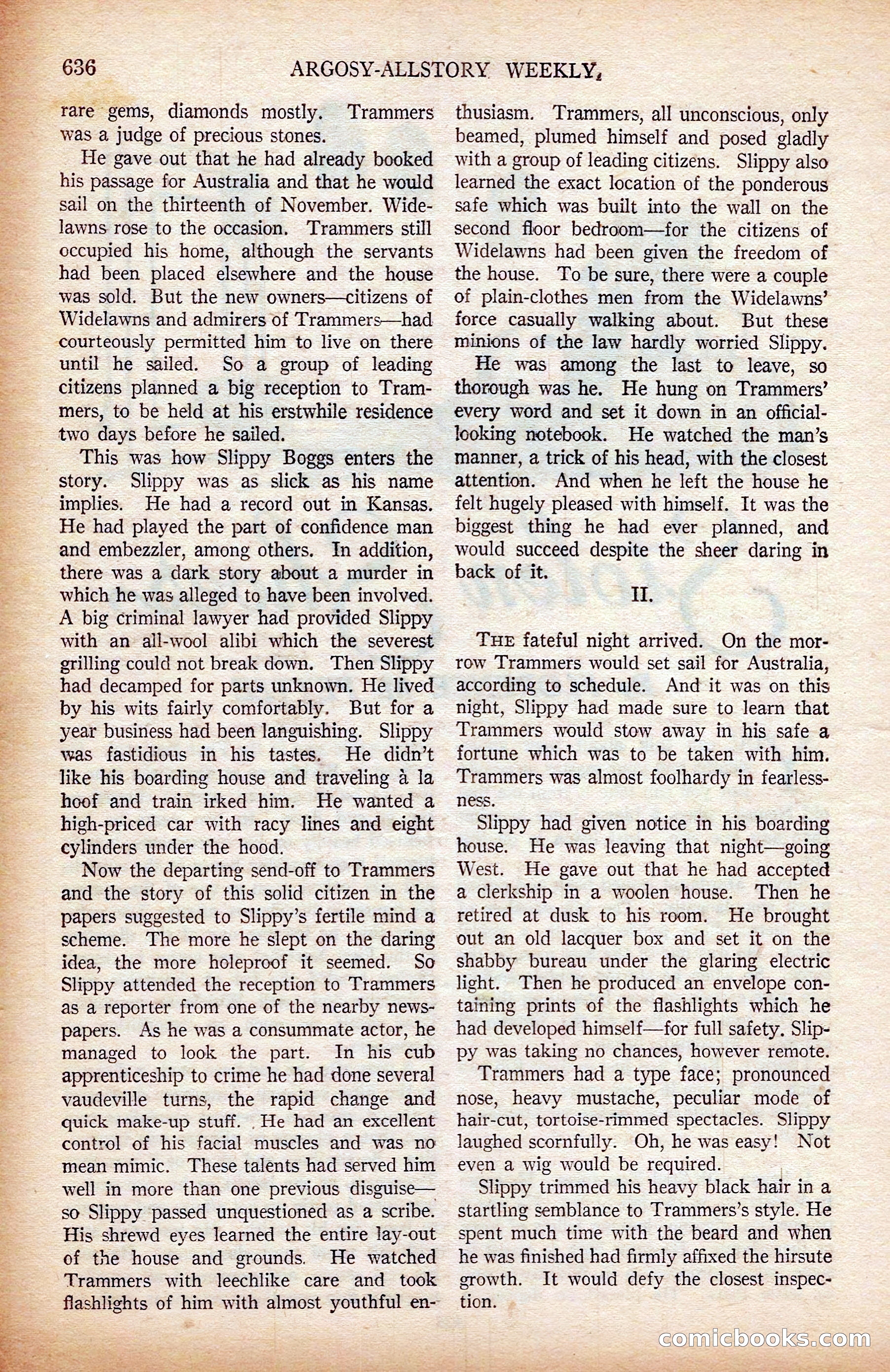
A restored page from Pulp Fiction, 1924. Page through the whole issue in the reader above.
📄 Transcribed text from this page (OCR, searchable)
Machine-transcribed from the original scan — historical spelling and the odd misread are preserved.
’ a ae By 2 636 rare gems, diamonds mostly. Trammers was a judge of precious stones. He gave out that he had already booked his passage for Australia and that he would sail on the thirteenth of November. Wide- lawns rose to the occasion, Trammers still occupied his home, although the servants had been placed elsewhere and the house was sold. But the new owners—citizens of Widelawns and admirers of Trammers—had courteously permitted him to live on there until he sailed. So a group of leading citizens planned a big reception to Tram- mers, to be held at his erstwhile residence two days before he sailed. This was how Slippy Boggs enters the story. Slippy was as slick as his name implies. He had a record out in Kansas. He had played the part of confidence man and embezzler, among others. In addition, there was a dark story about a murder in which he was alleged to have been involved. A big criminal lawyer had provided Slippy with an all-wool alibi which the severest grilling could not break down. Then Slippy had decamped for parts unknown. He lived by his wits fairly comfortably. But for a year business had been languishing. Slippy was fastidious in his tastes. He didn’t like his boarding house and traveling a la hoof and train irked him. He wanted a high-priced car with racy lines and eight cylinders under the hood. Now the departing send-off to Trammers and the story of this solid citizen in the papers suggested to Slippy’s fertile mind a scheme. The more he slept on the daring idea, the more holeproof it seemed. So Slippy attended the reception to Trammers as a reporter from one of the nearby news- papers. As he was a consummate actor, he managed to look the part. In his cub apprenticeship to crime he had done several vaudeville turns, the rapid change and quick make-up stuff. .He had an excellent control of his facial muscles and was no mean mimic. These talents had served him well in more than one previous disguise— so Slippy passed unquestioned as a “Scribe. His shrewd eyes learned the entire lay-out of the house and grounds. He watched Trammers with leechlike care and took flashlights of him with almost youthful en- ARGOSY-ALLSTORY WEEKLY, thusiasm. Trammers, all unconscious, only beamed, plumed himself and posed gladly with a group of leading citizens. Slippy also learned the exact location of the ponderous safe which was built into the wall on the second floor bedroom—for the citizens of Widelawns had been given the freedom of the house. To be sure, there were a couple of plain-clothes men from the Widelawns’ force casually walking about. But these minions of the law hardly worried Slippy. He was among the last to leave, so thorough was he. He hung on Trammers’ every word and set it down in an official- looking notebook. He watched the man’s manner, a trick of his head, with the closest attention. And when he left the house he felt hugely pleased with himself. It was the biggest thing he had ever planned, and would succeed despite the sheer daring in back of it. II. THE fateful night arrived. On the mor- row Trammers would set sail for Australia, according to schedule. And it was on this night, Slippy had made sure to learn that Trammers would stow away in his safe a fortune which was to be taken with him. ‘Trammers was almost foolhardy in fearless- ness. Slippy had given notice in his boarding house. He was leaving that night—going West. He gave out that he had accepted a clerkship in a woolen house. Then he retired at dusk to his room. He brought out an old lacquer box and set it on the shabby bureau under the glaring electric light. Then he produced an envelope con- taining prints of the flashlights which he had developed himself—for full safety. Slip- py was taking no chances, however remote. Trammers had a type face; pronounced nose, heavy mustache, peculiar mode of hair-cut, tortoise-rimmed spectacles. Slippy laughed scornfully. Oh, he was easy! Not even a wig would be required. Slippy trimmed his heavy black hair i in a startling semblance to Trammers’s style. He spent much time with the beard and when he was finished had firmly affixed the hirsute srowth. It would defy the closest inspec- tion. oO Eomichbooks co