
Pulp Fiction, 1924 · page 143 of 176
Argosy All-Story Weekly — page 143: what you’re looking at
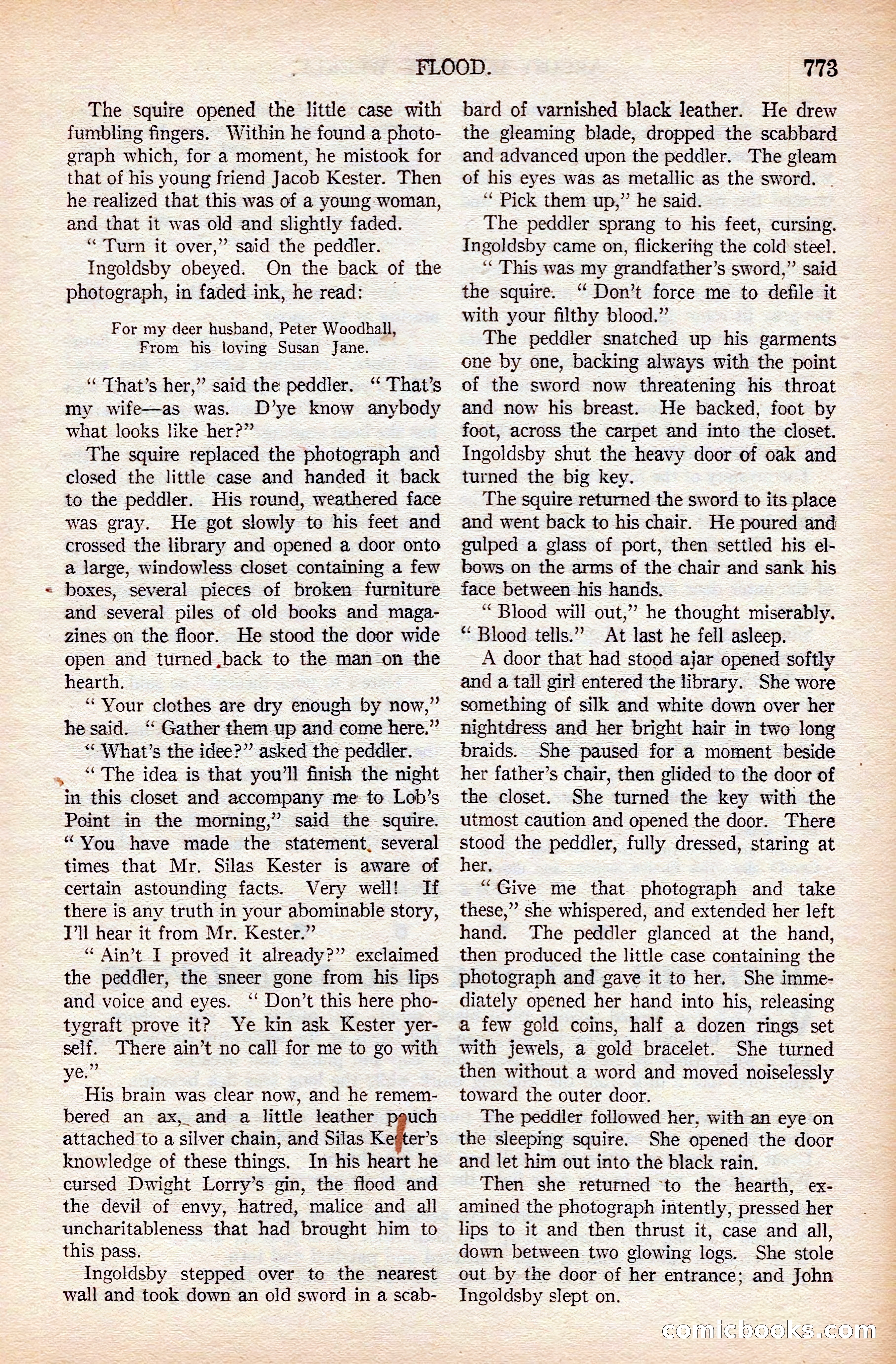
A restored page from Pulp Fiction, 1924. Page through the whole issue in the reader above.
📄 Transcribed text from this page (OCR, searchable)
Machine-transcribed from the original scan — historical spelling and the odd misread are preserved.
FLOOD. The squire opened the little case with fumbling fingers. Within he found a photo- graph which, for a moment, he mistook for that of his young friend Jacob Kester. Then he realized that this was of a young woman, and that it was old and slightly faded. “Turn it over,” said the peddler. Ingoldsby obeyed. On the back of the photograph, in faded ink, he read: For my deer husband, Peter Woodhall, From his loving Susan Jane. “ That’s her,” said the peddler. ‘“ That’s my wife—as was. D’ye know anybody what looks like her?” The squire replaced the photograph and closed the little case and handed it back to the peddler. His round, weathered face was gray. He got slowly to his feet and crossed the library and opened a door onto a large, windowless closet containing a few » boxes, several pieces of broken furniture and several piles of old books and maga- zines on the floor. He stood the door wide open and turned back to the man on the hearth. “Your clothes are dry enough by now,” he said. ‘ Gather them up and come here.” “What’s the idee?” asked the peddler. “The idea is that you'll finish the night in this closet and accompany me to Lob’s Point in the morning,” said the squire. “You have made the statement. several times that Mr. Silas Kester is aware of certain astounding facts. Very well! If there is any truth in your abominable story, J’ll hear it from Mr. Kester.” “ Ain’t I proved it already?” exclaimed the peddler, the sneer gone from his lips and voice and eyes. ‘‘ Don’t this here pho- tygraft prove it? Ye kin ask Kester yer- self. There ain’t no call for me to go with Vex" His brain was clear now, and he remem- bered an ax, and a little leather pguch attached to a silver chain, and Silas Ke¢ter’s knowledge of these things. In his heart he cursed Dwight Lorry’s gin, the flood and the devil of envy, hatred, malice and all uncharitableness that had brought him to this pass. Ingoldsby stepped over te the nearest wall and took down an old sword in a scab- 773 bard of varnished black leather. He drew the gleaming blade, dropped the scabbard and advanced upon the peddler. The gleam of his eyes was as metallic as the sword. . “ Pick them up,” he said. The peddler sprang to his feet, cursing. Ingoldsby came on, flickering the cold steel. ‘This was my grandfather’s sword,” said the squire. “ Don’t force me to defile it with your filthy blood.” The peddler snatched up his garments one by one, backing always with the point of the sword now threatening his throat and now his breast. He backed, foot by foot, across the carpet and into the closet. Ingoldsby shut the heavy door of oak and turned the big key. The squire returned the sword to its place and went back to his chair. He poured and gulped a glass of port, then settled his el- bows on the arms of the chair and sank his face between his hands. “Blood will out,” he thought miserably. “Blood tells.” At last he fell asleep. A door that had stood ajar opened softly and a tall girl entered the library. She wore something of silk and white down over her nightdress and her bright hair in two long braids. She paused for a moment beside her father’s chair, then glided to the door of the closet. She turned the key with the utmost caution and opened the door. There stood the peddler, fully dressed, staring at her. “Give me that photograph and take these,” she whispered, and extended her left hand. The peddler glanced at the hand, then produced the little case containing the photograph and gave it to her. She imme- diately opened her hand into his, releasing a few gold coins, half a dozen rings set with jewels, a gold bracelet. She turned then without a word and moved noiselessly toward the outer door. The peddler followed her, with an eye on the sleeping squire. She opened the door and let him out into the black rain. Then she returned ‘to the hearth, ex- amined the photograph intently, pressed her lips to it and then thrust it, case and all, down between two glowing logs. She stole out by the door of her entrance; and John Ingoldsby slept on. oO COMMiclooOokKks (S@)