
Pulp Fiction, 1924 · page 144 of 176
Argosy All-Story Weekly — page 144: what you’re looking at
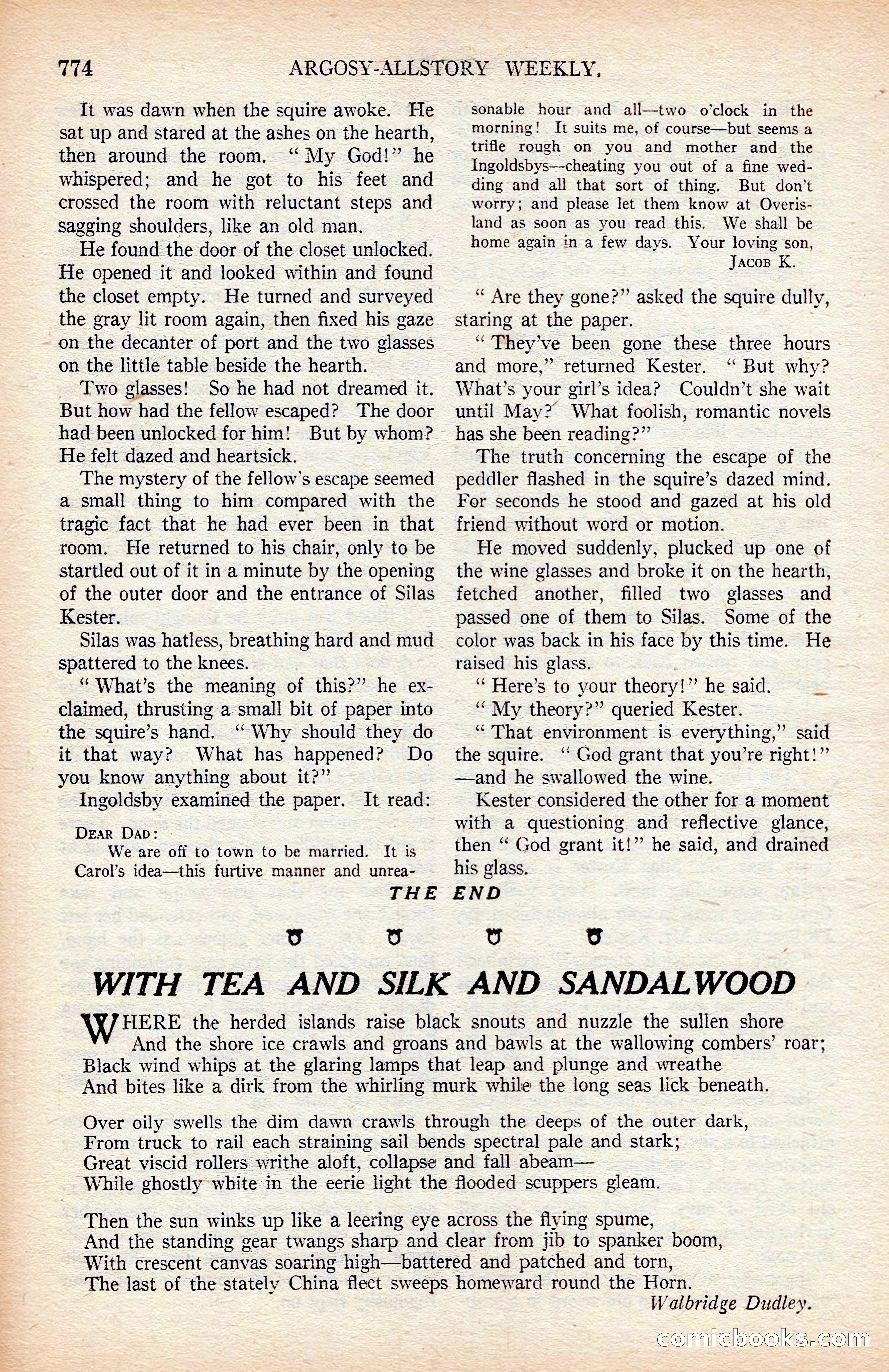
A restored page from Pulp Fiction, 1924. Page through the whole issue in the reader above.
📄 Transcribed text from this page (OCR, searchable)
Machine-transcribed from the original scan — historical spelling and the odd misread are preserved.
774 It was dawn when the squire awoke. He sat up and stared at the ashes on the hearth, then around the room. ‘“‘ My God!” he whispered; and he got to his feet and crossed the room with reluctant steps and sagging shoulders, like an old man. He found the door of the closet unlocked. He opened it and looked within and found the closet empty. He turned and surveyed the gray lit room again, then fixed his gaze on the decanter of port and the two glasses on the little table beside the hearth. _ Two glasses! So he had not dreamed it. But how had the fellow escaped? The door had been unlocked for him! But by whom? He felt dazed and heartsick. The mystery of the fellow’s escape seemed a small thing to him compared with the tragic fact that he had ever been in that room. He returned to his chair, only to be startled out of it in a minute by the opening of the outer door and the entrance of Silas Kester. Silas was hatless, breathing hard and mud spattered to the knees. ‘“ What’s the meaning of this?” he ex- claimed, thrusting a small bit of paper into the squire’s hand. ‘‘ Why should they do it that way? What has happened? Do you know anything about it?” Ingoldsby examined the paper. It read: Dear Dap: 3 We are off to town to be married. It is Carol’s idea—this furtive manner and unrea- THE Le] u ARGOSY-ALLSTORY WEEKLY, sonable hour and all—two o'clock in the morning! It suits me, of course—but seems a trifle rough on you and mother and the Ingoldsbys—cheating you out of a fine wed- ding and all that sort of thing. But don’t worry; and please let them know at Overis- land as soon as you read this. We shall be home again in a few days. Your loving son, Jacos K. “ Are they gone?” asked the squire dully, staring at the paper. “They’ve been gone these three hours and more,” returned Kester. ‘“‘ But why? What’s your girl’s idea? Couldn’t she wait until May? What foolish, romantic novels has she been reading?” The truth concerning the escape of the peddler flashed in the squire’s dazed mind. For seconds he stood and gazed at his old friend without word or motion. He moved suddenly, plucked up one of the wine glasses and broke it on the hearth, fetched another, filled two glasses and passed one of them to Silas. Some of the color was back in his face by this time. He raised his glass. ‘“ Here’s to your theory!” he said. “My theory?” queried Kester. “ That environment is everything,” said the squire. ‘“ God grant that you’re right!” —and he swallowed the wine. Kester considered the other for a moment with a questioning and reflective glance, then “ God grant it!”’ he said, and drained his glass. END Lo} Lo} WITH TEA AND SILK AND SANDALWOOD HERE the herded islands raise black snouts and nuzzle the sullen shore And the shore ice crawls and groans and bawls at the wallowing combers’ roar; Black wind whips at the glaring lamps that leap and plunge and wreathe And bites like a dirk from the whirling murk while the long seas lick beneath. Over oily swells the dim dawn crawls through the deeps of the outer dark, From truck to rail each straining sail bends spectral pale and stark; Great viscid rollers writhe aloft, collapse and fall abeam— While ghostly white in the eerie light the flooded scuppers gleam. Then the sun winks up like a leering eye across the flying spume, And the standing gear twangs sharp and clear from jib to spanker boom, With crescent canvas soaring high—-battered and patched and torn, The last of the stately China fleet sweeps homeward round the Horn. Walbridge Dudley. COMME DOO KS (S@)