
Pulp Fiction, 1924 · page 145 of 168
Argosy All-Story Weekly — page 145: what you’re looking at
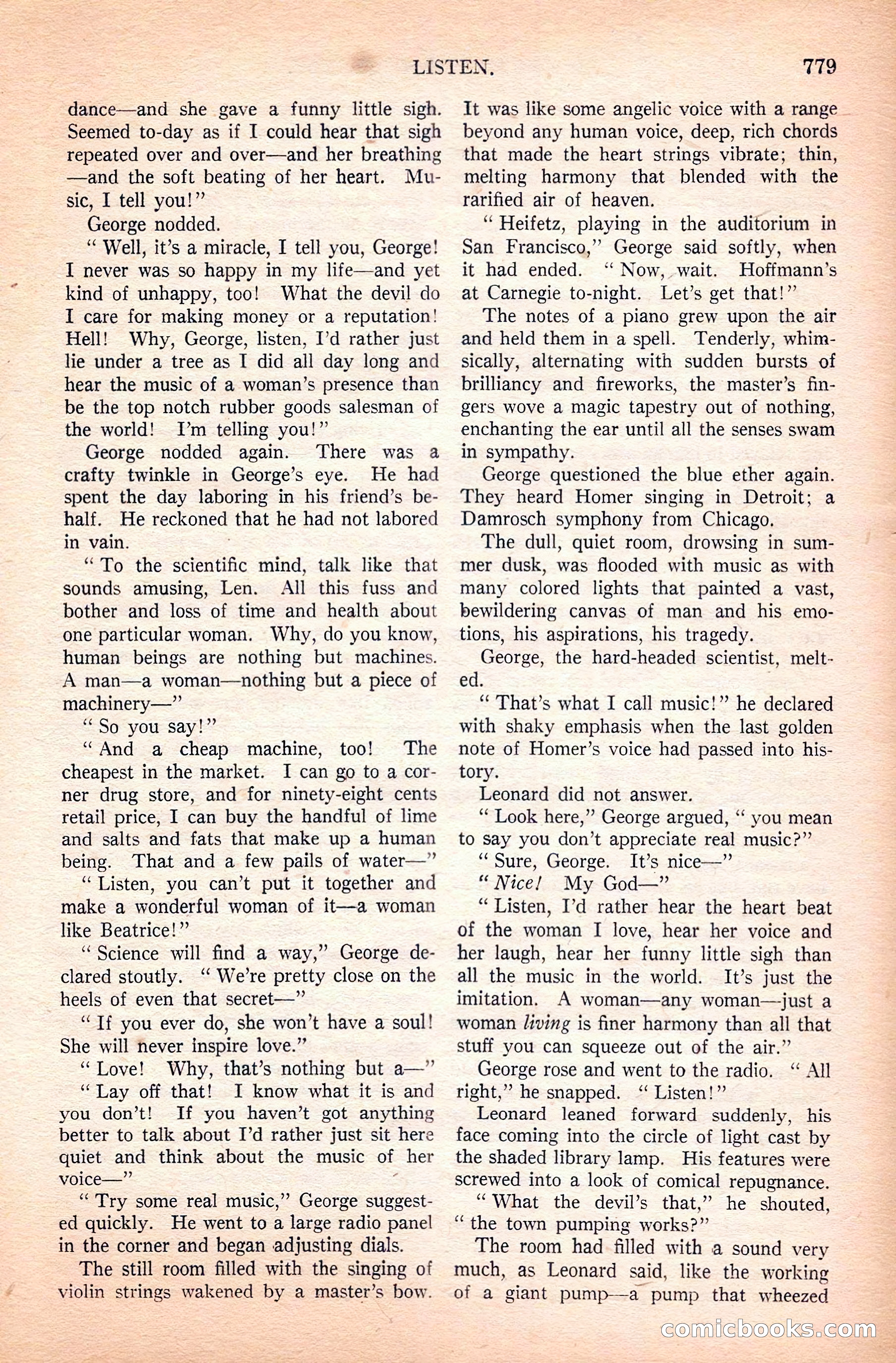
A restored page from Pulp Fiction, 1924. Page through the whole issue in the reader above.
📄 Transcribed text from this page (OCR, searchable)
Machine-transcribed from the original scan — historical spelling and the odd misread are preserved.
LISTEN, dance—and she gave a funny little sigh. Seemed to-day as if I could hear that sigh repeated over and over—and her breathing —and the soft beating of her heart. Mu- sic, I tell you!” George nodded. ‘“ Well, it’s a miracle, I tell you, George! IT never was so happy in my life—and yet kind of unhappy, too! What the devil do I care for making money or a reputation! Hell! Why, George, listen, I’d rather just lie under a tree as I did all day long and hear the music of a woman’s presence than be the top notch rubber goods salesman of the world! I’m telling you!” George nodded again. There was a crafty twinkle in George’s eye. He had spent the day laboring in his friend’s be- half. He reckoned that he had not labored in vain. “To the scientific mind, talk like that sounds amusing, Len. All this fuss and bother and loss of time and health about one particular woman. Why, do you know, human beings are nothing but machines. A man—a woman—nothing but a piece of machinery—”’ “So you say!” “And a cheap machine, too! The cheapest in the market. I can go to a cor- ner drug store, and for ninety-eight cents retail price, I can buy the handful of lime and salts and fats that make up a human being. That and a few pails of water—” “Listen, you can’t put it together and make a wonderful woman of it—a woman like Beatrice!” “Science will find a way,” George de- clared stoutly. ‘‘ We’re pretty close on the heels of even that secret—” “Tf you ever do, she won’t have a soul! She will never inspire love.” “Love! Why, that’s nothing but a—”’ ‘Lay off that! I know what it is and you don’t! If you haven’t got anything better to talk about I’d rather just sit here quiet and think about the music of her voice—”’ 3 “Try some real music,” George suggest- ed quickly. He went to a large radio panel in the corner and began adjusting dials. The still room filled with the singing of violin strings wakened by a master’s bow. 779 It was like some angelic voice with a range beyond any human voice, deep, rich chords that made the heart strings vibrate; thin, melting harmony that blended with the rarified air of heaven. “ Heifetz, playing in the auditorium in San Francisco,’ George said softly, when it had ended. ‘‘ Now, wait. Hoffmann’s at Carnegie to-night. Let’s get that!” The notes of a piano grew upon the air and held them in a spell. Tenderly, whim- sically, alternating with sudden bursts of brilliancy and fireworks, the master’s fin- gers wove a magic tapestry out of nothing, enchanting the ear until all the senses swam in sympathy. George questioned the blue ether again. They heard Homer singing in Detroit; a Damrosch symphony from Chicago. The dull, quiet room, drowsing in sum- mer dusk, was flooded with music as with many colored lights that painted a vast, bewildering canvas of man and his emo- tions, his aspirations, his tragedy. George, the hard-headed scientist, melt- ed. “That’s what I call music!” he declared with shaky emphasis when the last golden note of Homer’s voice had passed into his- tory. Leonard did not answer. ‘“ Look here,” George argued, “‘ you mean to say you don’t appreciate real music?” “Sure, George. It’s nice—” “Nice! My God—” “Listen, I’d rather hear the heart beat of the woman I love, hear her voice and her laugh, hear her funny little sigh than all the music in the world. It’s just the imitation. A woman—any woman—just a woman /iving is finer harmony than all that stuff you can squeeze out of the air.” George rose and went to the radio. “ All right,” he snapped. “ Listen!” Leonard leaned forward suddenly, his face coming into the circle of light cast by the shaded library lamp. His features were screwed into a look of comical repugnance. “What the devil’s that,” he shouted, “the town pumping works?” The room had filled with a sound very much, as Leonard said, like the working of a giant pump—a pump that wheezed oO COMMicloOokKs (S@)