
Pulp Fiction, 1924 · page 146 of 168
Argosy All-Story Weekly — page 146: what you’re looking at
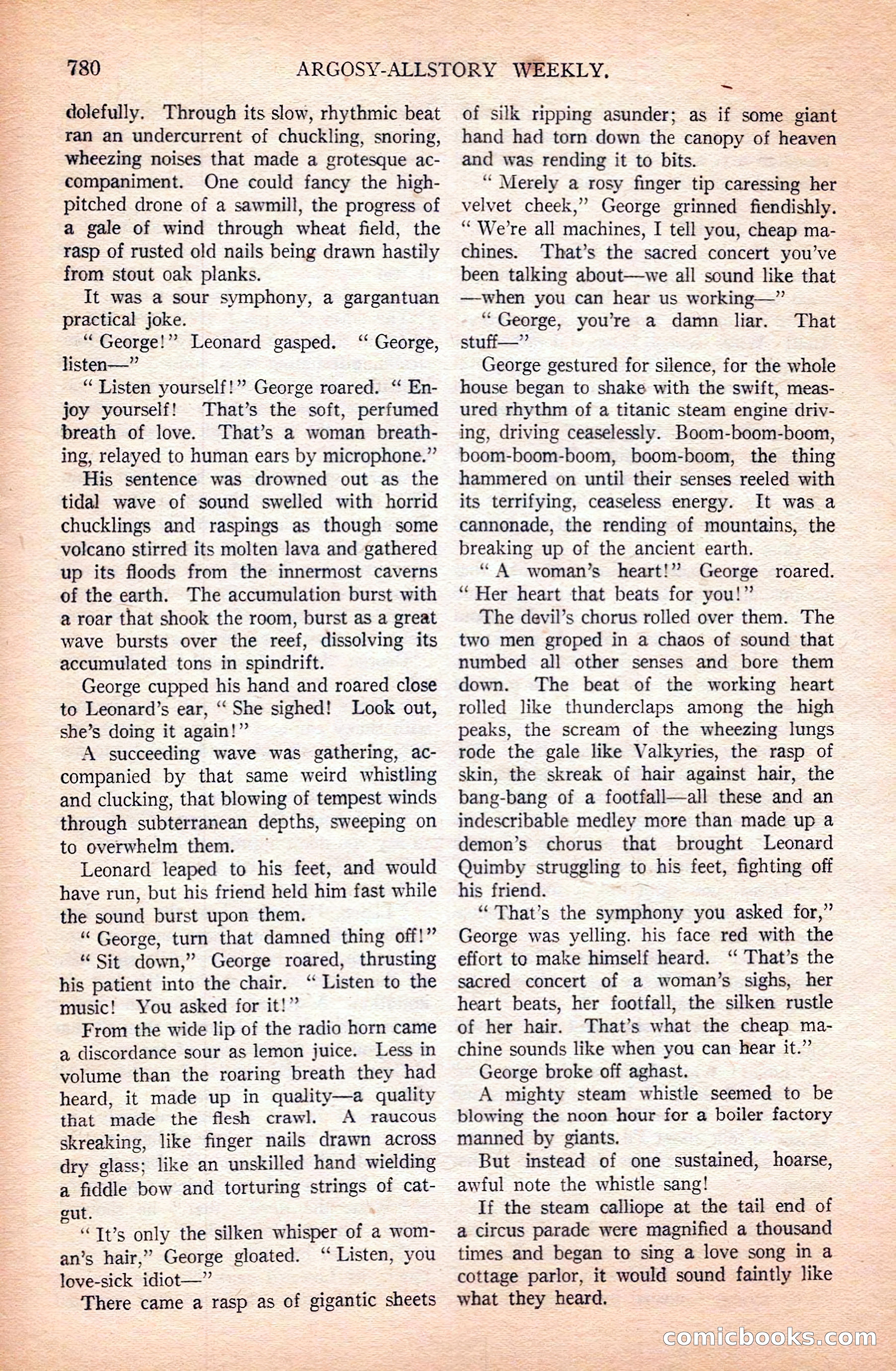
A restored page from Pulp Fiction, 1924. Page through the whole issue in the reader above.
📄 Transcribed text from this page (OCR, searchable)
Machine-transcribed from the original scan — historical spelling and the odd misread are preserved.
’ "3 ver ¢ ° ¢ “ 780 dolefully. Through its slow, rhythmic beat ran an undercurrent of chuckling, snoring, wheezing noises that made a grotesque ac- companiment. One could fancy the high- pitched drone of a sawmill, the progress of a gale of wind through wheat field, the rasp of rusted old nails being drawn hastily from stout oak planks. It was a sour symphony, a gargantuan practical joke. “George!” Leonard gasped. listen—” “ Listen yourself!” George roared. “‘ En- joy yourself! That’s the soft, perfumed breath of love. That’s a woman breath- ing, relayed to human ears by microphone.” His sentence was drowned out as the tidal wave of sound swelled with horrid chucklings and raspings as though some volcano stirred its molten lava and gathered up its floods from the innermost caverns of the earth. The accumulation burst with a roar that shook the room, burst as a great wave bursts over the reef, dissolving its accumulated tons in spindrift. George cupped his hand and roared close to Leonard’s ear, “‘ She sighed! Look out, she’s doing it again!” A succeeding wave was gathering, ac- companied by that same weird whistling and clucking, that blowing of tempest winds through subterranean depths, sweeping on to overwhelm them. Leonard leaped to his feet, and would have run, but his friend held him fast while the sound burst upon them. “George, turn that damned thing off!” “ Sit down,” George roared, thrusting his patient into the chair. “Listen to the music! You asked for it!” From the wide lip of the radio horn came a, discordance sour as lemon juice. Less in volume than the roaring breath they had heard, it made up in quality—a quality that made the flesh crawl. A raucous skreaking, like finger nails drawn across dry glass; like an unskilled hand wielding a fiddle bow and torturing strings of cat- gut. : “Tt’s only the silken whisper of a wom- an’s hair,” George gloated. “ Listen, you love-sick idiot—” There came a rasp as of gigantic sheets ““ George, ARGOSY-ALLSTORY WEEKLY. = of silk ripping asunder; as if some giant hand had torn down the canopy of heaven and was rending it to bits. ‘* Merely a rosy finger tip caressing her velvet cheek,”’ George grinned fiendishly. ‘We're all machines, I tell you, cheap ma- chines. That’s the sacred concert you’ve been talking about—we all sound like that —when you can hear us working—” “ George, you’re a damn _ liar. stuff—” George gestured for silence, for the whole house began to shake with the swift, meas- . ured rhythm of a titanic steam engine driv- ing, driving ceaselessly. Boom-boom-boom, boom-boom-boom, boom-boom, the thing hammered on until their senses reeled with its terrifying, ceaseless energy. It was a cannonade, the rending of mountains, the breaking up of the ancient earth. “A woman’s heart!” George roared. “Her heart that beats for you!” The devil’s chorus rolled over them. The two men groped in a chaos of sound that numbed all other senses and bore them down. The beat of the working heart rolled like thunderclaps among the high peaks, the scream of the wheezing lungs rode the gale like Valkyries, the rasp of skin, the skreak of hair against hair, the bang-bang of a footfall—all these and an indescribable medley more than made up a demon’s chorus that brought Leonard Quimby struggling to his feet, fighting off his friend. “That’s the symphony you asked for,” George was yelling. his face red with the effort to make himself heard. ‘ That’s the sacred concert of a woman’s sighs, her heart beats, her footfall, the silken rustle of her hair. That’s what the cheap ma- chine sounds like when you can hear it.” George broke off aghast. A mighty steam whistle seemed to be blowing the noon hour for a boiler factory manned by giants. But instead of one sustained, hoarse, awful note the whistle sang! If the steam calliope at the tail end of a circus parade were magnified a thousand times and began to sing a love song in a cottage parlor, it would sound faintly like what they heard. That oO Eomichbooks:co