
Pulp Fiction, 1924 · page 147 of 168
Argosy All-Story Weekly — page 147: what you’re looking at
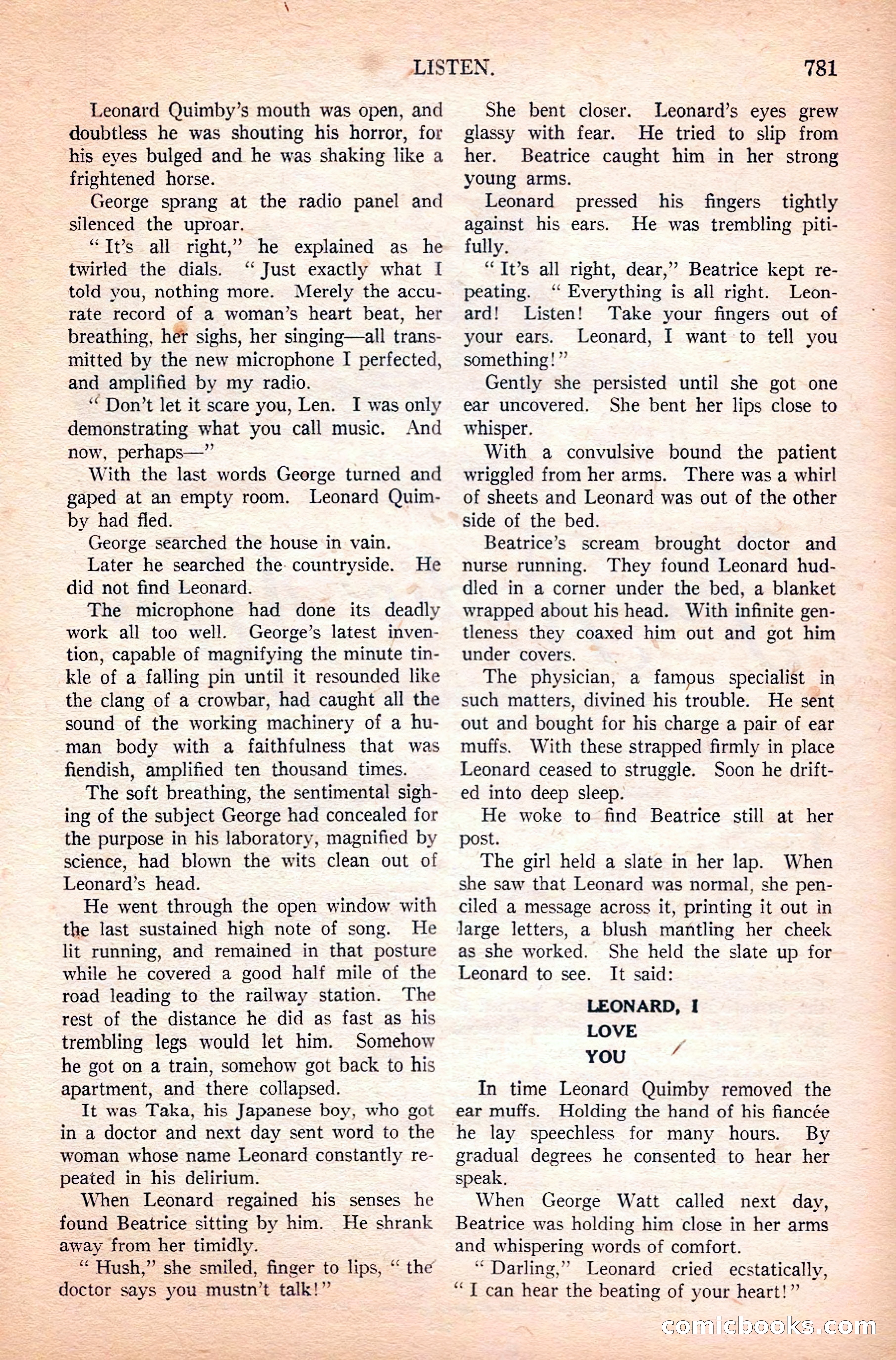
A restored page from Pulp Fiction, 1924. Page through the whole issue in the reader above.
📄 Transcribed text from this page (OCR, searchable)
Machine-transcribed from the original scan — historical spelling and the odd misread are preserved.
LISTEN. Leonard Quimby’s mouth was open, and doubtless he was shouting his horror, for his eves bulged and he was shaking like a frightened horse. George sprang at the radio panel and silenced the uproar. “Tt’s all right,’ he explained as he twirled the dials. “‘ Just exactly what I told you, nothing more. Merely the accu- rate record of a woman’s heart beat, her breathing, her sighs, her singing—all trans- mitted by the new microphone I perfected, and amplified by my radio. “Don’t let it scare you, Len. I was only demonstrating what you call music. And now, perhaps—”’ With the last words George turned and gaped at an empty room. Leonard Quim- by had fled. George searched the house in vain. Later he searched the: countryside. did not find Leonard. The microphone had done its deadly work all too well. George’s latest inven- tion, capable of magnifying the minute tin- kle of a falling pin until it resounded like the clang of a crowbar, had caught all the sound of the working machinery of a hu- man body with a faithfulness that was fiendish, amplified ten thousand times. The soft breathing, the sentimental sigh- ing of the subject George had concealed for the purpose in his laboratory, magnified by science, had blown the wits clean out of Leonard’s head. He went through the open window with the last sustained high note of song. He lit running, and remained in that posture while he covered a good half mile of the road leading to the railway station. The rest of the distance he did as fast as his trembling legs would let him. Somehow he got on a train, somehow got back to his apartment, and there collapsed. It was Taka, his Japanese boy, who got in a doctor and next day sent word to the woman whose name Leonard constantly re- peated in his delirium. When Leonard regained his senses he found Beatrice sitting by him. He shrank away from her timidly. “Hush,” she smiled, finger to lips, “ the doctor says you mustn’t talk!” He 781 She bent closer. Leonard’s eyes grew glassy with fear. He tried to slip from her. Beatrice caught him in her strong young arms. Leonard pressed his fingers tightly against his ears. He was trembling piti- fully. “It’s all right, dear,’ Beatrice kept re- peating. “ Everything is all right. Leon- ard! Listen! Take your fingers out of your ears. Leonard, I want to tell you something!” Gently she persisted until she got one ear uncovered. She bent her lips close to whisper. With a convulsive bound the patient wriggled from her arms. There was a whirl of sheets and Leonard was out of the other side of the bed. Beatrice’s scream brought doctor and nurse running. They found Leonard hud- died in a corner under the bed, a blanket wrapped about his head. With infinite gen- tleness they coaxed him out and got him under covers. The physician, a famous specialist in such matters, divined his trouble. He sent out and bought for his charge a pair of ear muffs. With these strapped firmly in place Leonard ceased to struggle. Soon he drift- ed into deep sleep. He woke to find Beatrice still at her post. The girl held a slate in her lap. When she saw that Leonard was normal, she pen- ciled a message across it, printing it out in large letters, a blush mantling her cheek as she worked. She held the slate up for Leonard to see. It said: LEONARD, I LOVE | YOU 3 In time Leonard Quimby removed the ear muffs. Holding the hand of his fiancée he lay speechless for many hours. By gradual degrees he consented to hear her speak, When George Watt called next day, Beatrice was holding him close in her arms and whispering words of comfort. “Darling,” Leonard cried ecstatically, “I can hear the beating of your heart!” oO COMIGDOOKS (S@)