
Pulp Fiction, 1924 · page 95 of 168
Argosy All-Story Weekly — page 95: what you’re looking at
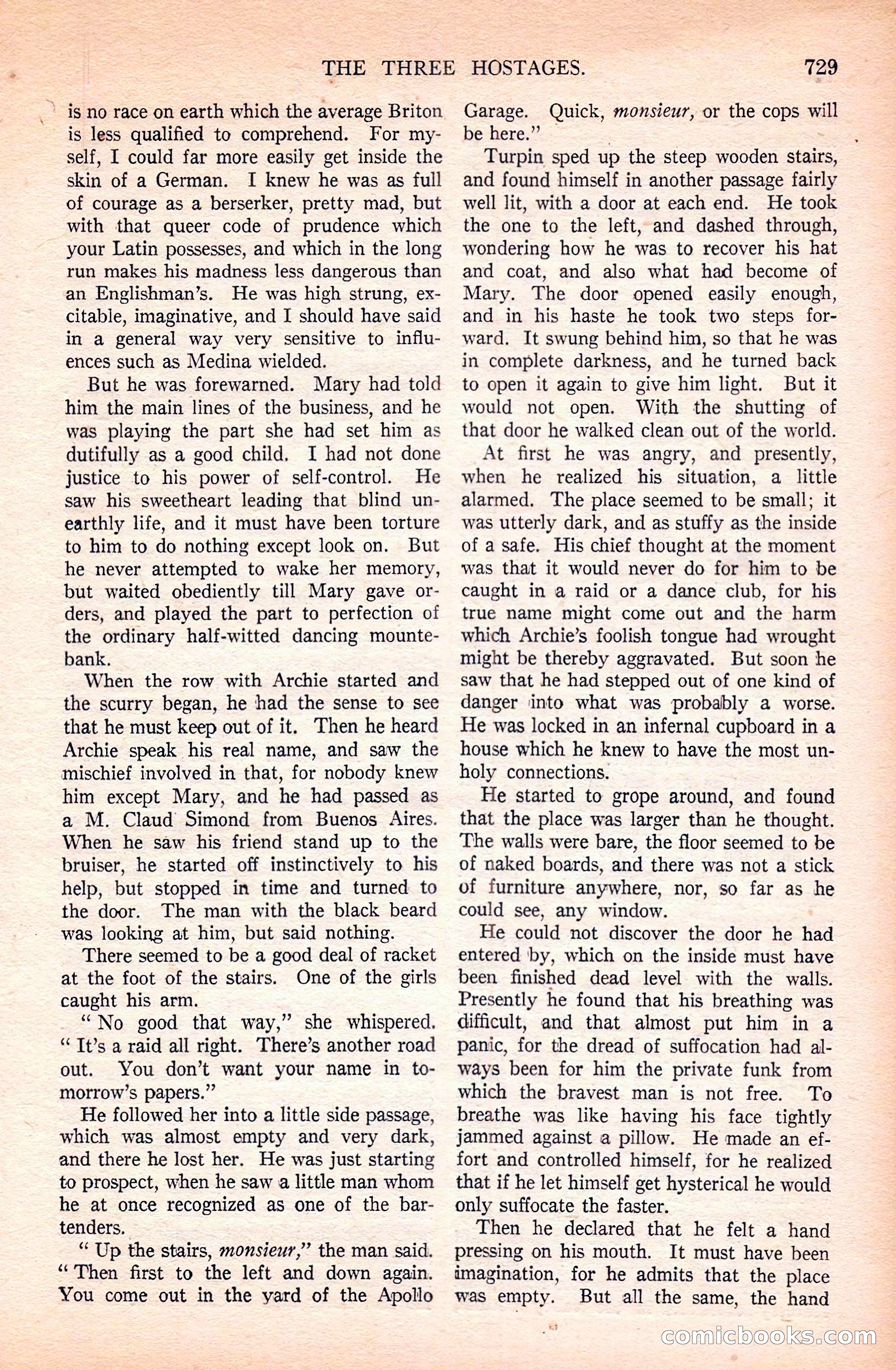
A restored page from Pulp Fiction, 1924. Page through the whole issue in the reader above.
📄 Transcribed text from this page (OCR, searchable)
Machine-transcribed from the original scan — historical spelling and the odd misread are preserved.
THE THREE HOSTAGES. _’ is no race on earth which the average Briton is less qualified to comprehend. For my- self, I could far more easily get inside the skin of a German. I knew he was as full of courage as a berserker, pretty mad, but with that queer code of prudence which your Latin possesses, and which in the long run makes his madness less dangerous than an Englishman’s. He was high strung, ex- citable, imaginative, and I should have said in a general way very sensitive to influ- ences such as Medina wielded. But he was forewarned. Mary had told him the main lines of the business, and he was playing the part she had set him as dutifully as a good child. I had not done justice to his power of self-control. He saw his sweetheart leading that blind un- earthly life, and it must have been torture to him to do nothing except look on. But he never attempted to wake her memory, but waited obediently till Mary gave or- ders, and played the part to perfection of the ordinary half-witted dancing mounte- bank, When the row with Archie started and the scurry began, he had the sense to see that he must keep out of it. Then he heard Archie speak his real name, and saw the mischief involved in that, for nobody knew him except Mary, and he had passed as a M. Claud Simond from Buenos Aires. When he saw his friend stand up to the bruiser, he started off instinctively to his help, but stopped in time and turned to the door. The man with the black beard was looking at him, but said nothing. There seemed to be a good deal of racket at the foot of the stairs. One of the girls caught his arm. “No good that way,’ she whispered. “ Tt’s a raid all right. There’s another road out. You don’t want your name in to- morrow’s papers.” He followed her into a little side passage, which was almost empty and very dark, and there he lost her. He was just starting to prospect, when he saw a little man whom he at once recognized as one of the bar- tenders. “Up the stairs, monsieur,” the man said. “Then first to the left and down again. You come out in the yard of the Apollo 729 Garage. Quick, monsieur, or the cops will be here.” | | Turpin sped up the steep wooden stairs, and found himself in another passage fairly well lit, with a door at each end. He took the one to the left, and dashed through, wondering how he was to recover his hat and coat, and also what had become of Mary. The door opened easily enough, and in his haste he took two steps for- ward. It swung behind him, so that he was in complete darkness, and he turned back to open it again to give him light. But it would not open. With the shutting of that door he walked clean out of the world. At first he was angry, and presently, when he realized his situation, a little alarmed. The place seemed to be small; it was utterly dark, and as stuffy as the inside of a safe. His chief thought at the moment was that it would never do for him to be caught in a raid or a dance club, for his true name might come out and the harm which Archie’s foolish tongue had wrought might be thereby aggravated. But soon he saw that he had stepped out of one kind of danger into what was probably a worse. He was locked in an infernal cupboard in a house which he knew to have the most un- holy connections. He started to grope around, and found that the place was larger than he thought. The walls were bare, the floor seemed to be of naked boards, and there was not a stick of furniture anywhere, nor, so far as he could see, any window. He could not discover the door he had entered ‘by, which on the inside must have been finished dead level with the walls. Presently he found that his breathing was difficult, and that almost put him in a panic, for the dread of suffocation had al- ways been for him the private funk from which the bravest man is not free. To breathe was like having his face tightly jammed against a pillow. He made an ef- fort and controlled himself, for he realized that if he let himself get hysterical he would only suffocate the faster. Then he declared that he felt a hand pressing on his mouth. It must have been imagination, for he admits that the place was empty. But all the same, the hand oO eonnichbooks (C@