
Pulp Fiction, 1924 · page 96 of 168
Argosy All-Story Weekly — page 96: what you’re looking at
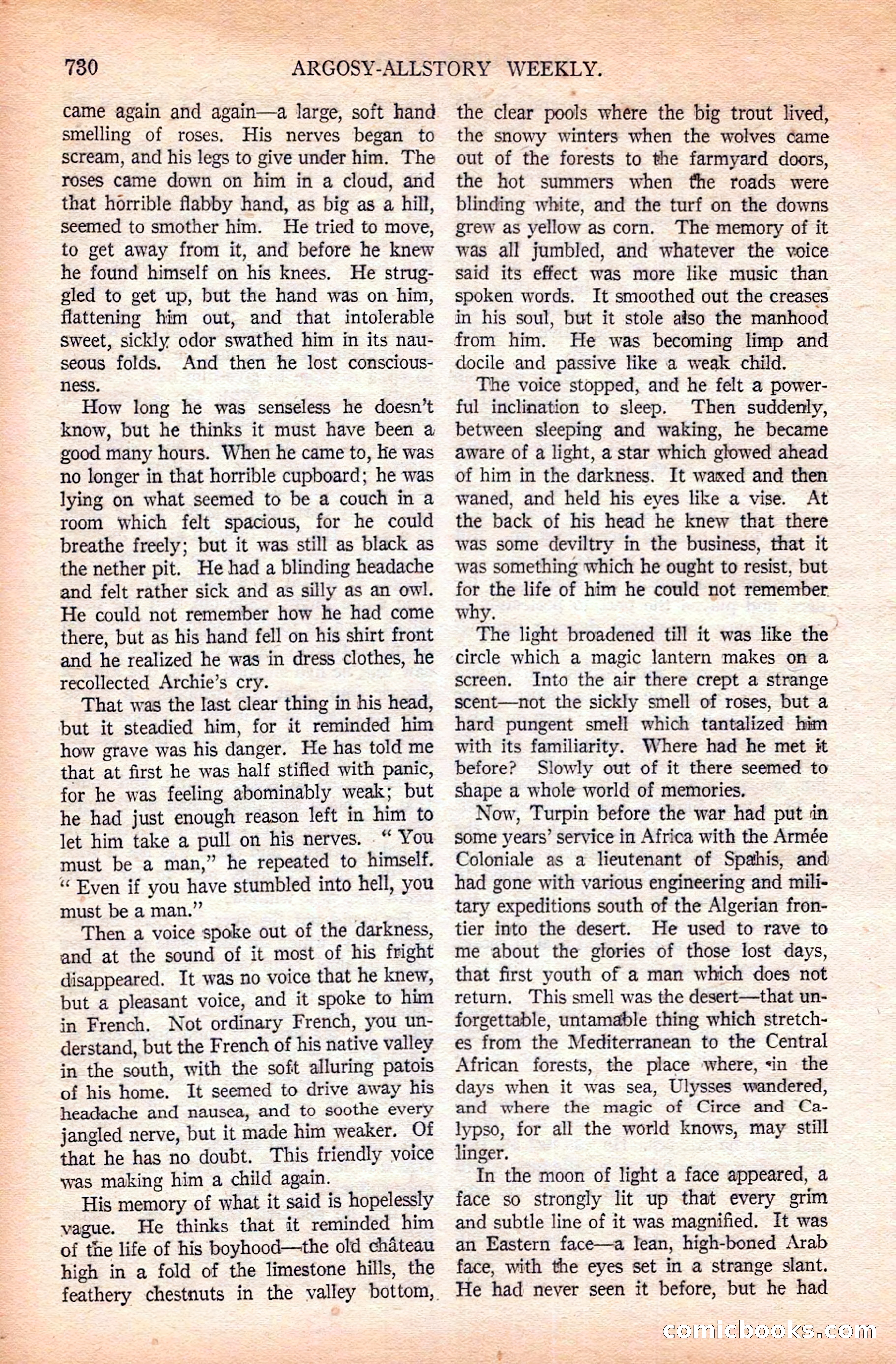
A restored page from Pulp Fiction, 1924. Page through the whole issue in the reader above.
📄 Transcribed text from this page (OCR, searchable)
Machine-transcribed from the original scan — historical spelling and the odd misread are preserved.
7380 came again and again—a large, soft hand smelling of roses. His nerves began to scream, and his legs to give under him. The roses came down on him in a cloud, and that horrible flabby hand, as big as a hill, seemed to smother him. He tried to move, to get away from it, and before he knew he found himself on his knees. He strug- gled to get up, but the hand was on him, flattening him out, and that intolerable sweet, sickly odor swathed him in its nau- seous folds. And then he lost conscious- ness. How long he was senseless he doesn’t know, but he thinks it must have been a good many hours. When he came to, le was no longer in that horrible cupboard; he was lying on what seemed to be a couch in a room which felt spacious, for he could breathe freely; but it was still as black as the nether pit. He had a blinding headache and felt rather sick and as silly as an owl. He could not remember how he had come there, but as his hand fell on his shirt front and he realized he was in dress clothes, he recollected Archie’s cry. That was the last clear thing in his head, but it steadied him, for it reminded him how grave was his danger. He has told me that at first he was half stifled with panic, for he was feeling abominably weak; but he had just enough reason left in him to let him take a pull on his nerves. “ You must be a man,” he repeated to himself. “ Even if you have stumbled into hell, you must be a man.” | Then a voice spoke out of the darkness, and at the sound of it most of his fright disappeared. It was no voice that he knew, but a pleasant voice, and it spoke to him in French. Not ordinary French, you un- derstand, but the French of his native valley in the south, with the soft alluring patois of his home. It seemed to drive away his headache and nausea, and to soothe every jangled nerve, but it made him weaker, Of that he has no doubt. This friendly voice was making him a child again. His memory of what it said is hopelessly vague. He thinks that it reminded him of the life of his boyhood—the old chateau high in a fold of the limestone hills, the feathery chestnuts in the valley bottom, ARGOSY-ALLSTORY WEEKLY. the clear pools where the big trout lived, the snowy winters when the wolves came out of the forests to the farmyard doors, the hot summers when the roads were blinding white, and the turf on the downs grew as yellow as corn. The memory of it was all jumbled, and whatever the voice said its effect was more like music than spoken words. It smoothed out the creases in his soul, but it stole also the manhood from him. He was becoming limp and docile and passive like a weak child. The voice stopped, and he felt a power- ful inclination to sleep. Then suddenly, between sleeping and waking, he became aware of a light, a star which glowed ahead of him in the darkness. It waxed and then waned, and held his eyes like a vise. At the back of his head he knew that there was some deviltry in the business, that it was something which he ought to resist, but for the life of him he could not remember why. The light broadened till it was like the circle which a magic lantern makes on a screen. Into the air there crept a strange scent—not the sickly smell of roses, but a hard pungent smell which tantalized him with its familiarity. Where had he met it before? Slowly out of it there seemed to shape a whole world of memories. Now, Turpin before the war had put in some years’ service in Africa with the Armée Coloniale as a lieutenant of Spahis, and had gone with various engineering and mili- tary expeditions south of the Algerian fron- tier into the desert. He used to rave to me about the glories of those lost days, that first youth of a man which does not return. This smell was the desert—that un- forgettable, untamable thing which stretch- es from the Mediterranean to the Central African forests, the place where, <in the days when it was sea, Ulysses wandered, and where the magic of Circe and Ca- lypso, for all the world knows, may still linger. In the moon of light a face appeared, a face so strongly lit up that every grim and subtle line of it was magnified. It was an Eastern face—a lean, high-boned Arab face, with the eyes set in a strange slant. He had never seen it before, but he had oO Comichbooksrtco