
Pulp Fiction, 1924 · page 132 of 180
Argosy All-Story Weekly — page 132: what you’re looking at
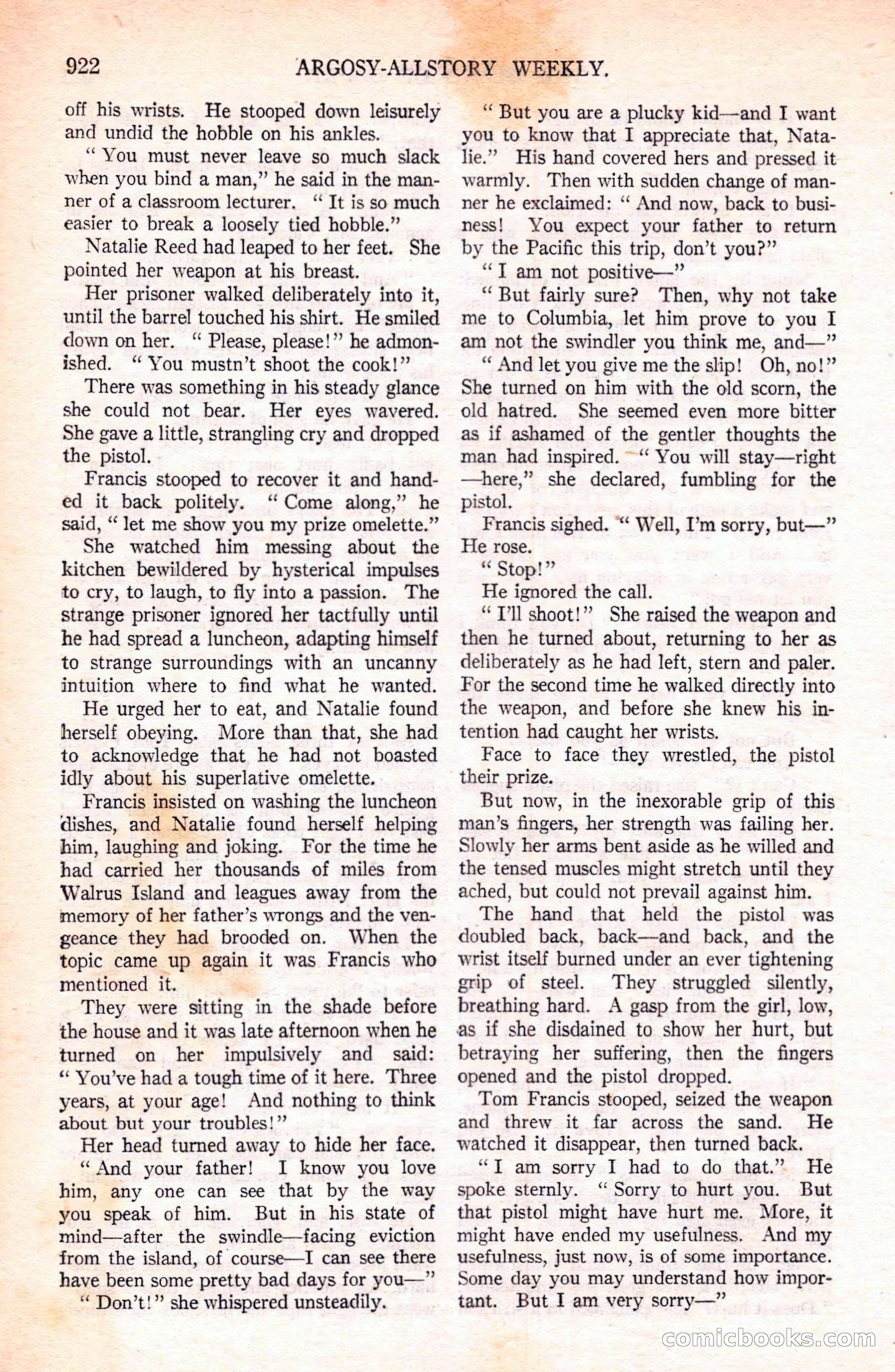
A restored page from Pulp Fiction, 1924. Page through the whole issue in the reader above.
📄 Transcribed text from this page (OCR, searchable)
Machine-transcribed from the original scan — historical spelling and the odd misread are preserved.
922 off his wrists. He stooped down leisurely and undid the hobble on his ankles. ‘You must never leave so much slack when you bind a man,” he said in the man- ner of a classroom lecturer. ‘ It is so much easier to break a loosely tied hobble.” Natalie Reed had leaped to her feet. She pointed her weapon at his breast. Her prisoner walked deliberately into it, until the barrel touched his shirt. He smiled down on her. “ Please, please!” he admon- ished. ‘“ You mustn’t shoot the cook!” There was something in his steady glance she could not bear. Her eyes wavered. She gave a little, strangling cry and dropped the pistol. Francis stooped to recover it and hand- ed it back politely. ‘“‘ Come along,” he said, “ let me show you my prize omelette.” She watched him messing about the kitchen bewildered by hysterical impulses to cry, to laugh, to fly into a passion. The strange prisoner ignored her tactfully until he had spread a luncheon, adapting himself to strange surroundings with an uncanny intuition where to find what he wanted. He urged her to eat, and Natalie found herself obeying. More than that, she had to acknowledge that he had not boasted idly about his superlative omelette. Francis insisted on washing the luncheon dishes, and Natalie found herself helping him, laughing and joking. For the time he had carried her thousands of miles from Walrus Island and leagues away from the memory of her father’s wrongs and the ven- geance they had brooded on. When the topic came up again it was Francis who mentioned it. They were sitting in the shade before the house and it was late afternoon when he turned on her impulsively and_ said: “‘ Vou’ve had a tough time of it here. Three years, at your age! And nothing to think about but your troubles!” Her head turned away to hide her face. “ And your father! I know you love him, any one can see that by the way you speak of him. But in his state of mind—after the swindle—facing eviction from the island, of course—I can see there have been some pretty bad days for you—” ‘“‘ Don’t!” she whispered unsteadily. } = ey oo eee > Pen en ee ~ — 4 a i SSS = a as - a ee ee Tn wif ARGOSY-ALLSTORY WEEKLY. ‘But you are a plucky kid—and I want you to know that I appreciate that, Nata- lie.” His hand covered hers and pressed it warmly. Then with sudden change of man- ner he exclaimed: ‘“‘ And now, back to busi- ness! You expect your father to return by the Pacific this trip, don’t you?” “JT am not positive—” “But fairly sure? Then, why not take me to Columbia, let him prove to you I am not the swindler you think me, and—” ** And let you give me the slip! Oh, no!” She turned on him with the old scorn, the old hatred. She seemed even more bitter as if ashamed of the gentler thoughts the man had inspired. ~“‘ You will stay—right —here,” she declared, fumbling for the pistol. Francis sighed. “‘ Well, I’m sorry, but—” He rose. He ignored the call. ‘‘ T’'ll shoot!” She raised the weapon and then he turned about, returning to her as deliberately as he had left, stern and paler. For the second time he walked directly into the weapon, and before she knew his in- tention had caught her wrists. Face to face they wrestled, the pistol their prize. But now, in the inexorable grip of this man’s fingers, her strength was failing her. Slowly her arms bent aside as he willed and the tensed muscles might stretch until they ached, but could not prevail against him. The hand that held the pistol was doubled back, back—and back, and the wrist itself burned under an ever tightening grip of steel. They struggled silently, breathing hard. A gasp from the girl, low, as if she disdained to show her hurt, but betraying her suffering, then the fingers opened and the pistol dropped. Tom Francis stooped, seized the weapon and threw it far across the sand. He watched it disappear, then turned back. “I am sorry I had to do that.” He spoke sternly. “Sorry to hurt you. But that pistol might have hurt me. More, it might have ended my usefulness. And my usefulness, just now, is of some importance. Some day you may understand how impor- tant. But I am very sorry—” oO CoOmiclbooks.€© inn