
Pulp Fiction, 1924 · page 137 of 180
Argosy All-Story Weekly — page 137: what you’re looking at
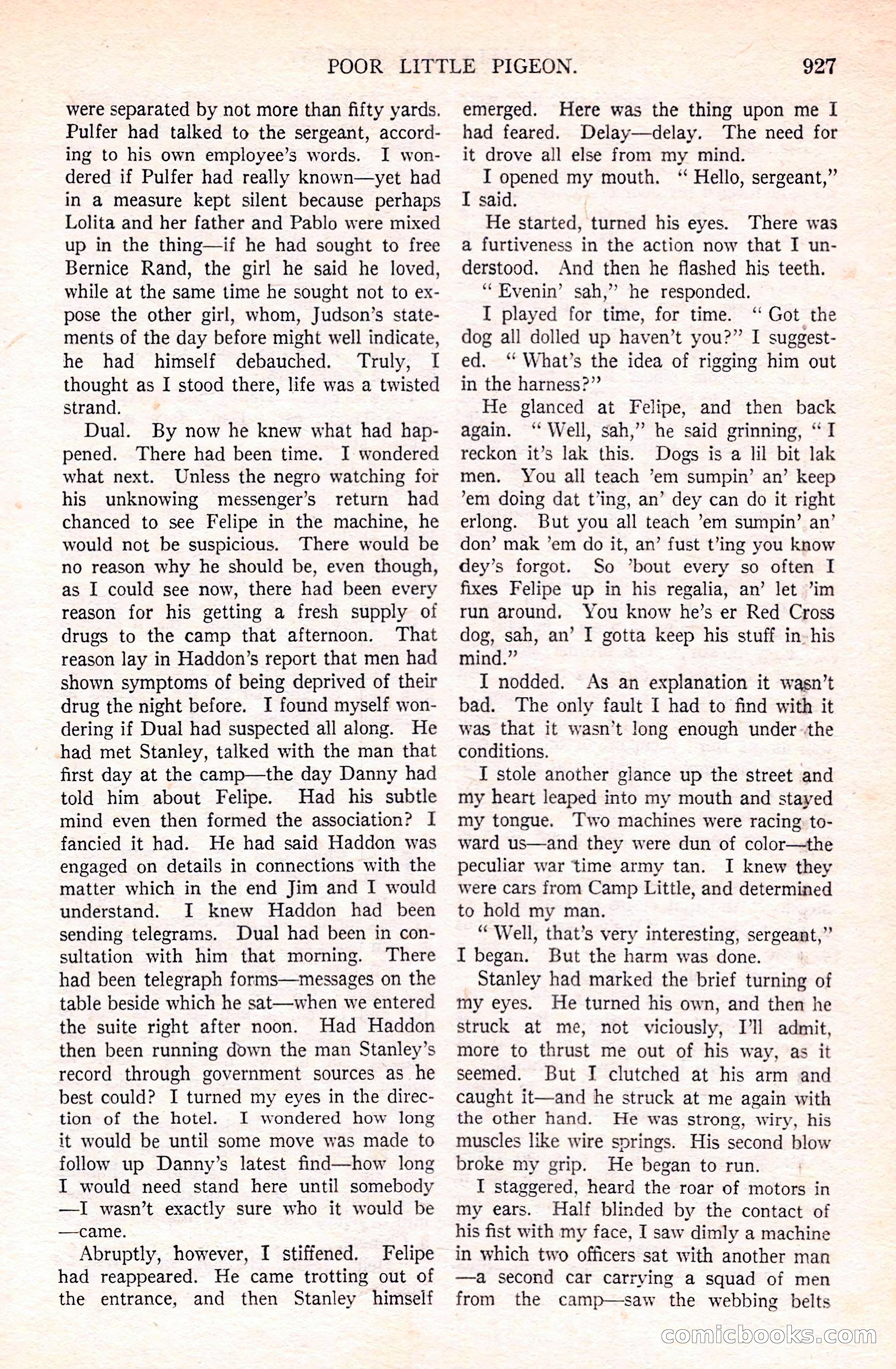
A restored page from Pulp Fiction, 1924. Page through the whole issue in the reader above.
📄 Transcribed text from this page (OCR, searchable)
Machine-transcribed from the original scan — historical spelling and the odd misread are preserved.
POOR LITTLE PIGEON. were separated by not more than fifty yards. Pulfer had talked to the sergeant, accord- ing to his own employee’s words. I won- dered if Pulfer had really known—yet had in a measure kept silent because perhaps Lolita and her father and Pablo were mixed up in the thing—if he had sought to free Bernice Rand, the girl he said he loved, while at the same time he sought not to ex- pose the other girl, whom, Judson’s state- ments of the day before might well indicate, he had himself debauched. Truly, I thought as I stood there, life was a twisted strand. Dual. By now he knew what had hap- pened. There had been time. I wondered what next. Unless the negro watching for his unknowing messenger’s return had chanced to see Felipe in the machine, he would not be suspicious. There would be no reason why he should be, even though, as I could see now, there had been every reason for his getting a fresh supply of drugs to the camp that afternoon. That reason lay in Haddon’s report that men had shown symptoms of being deprived of their drug the night before. I found myself won- dering if Dual had suspected all along. He had met Stanley, talked with the man that first day at the camp—the day Danny had told him about Felipe. Had his subtle mind even then formed the association? I fancied it had. He had said Haddon was engaged on details in connections with the matter which in the end Jim and I would understand. I knew Haddon had been sending telegrams. Dual had been in con- sultation with him that morning. There had been telegraph forms—messages on the table beside which he sat—when we entered the suite right after noon. Had Haddon then been running down the man Stanley’s record through government sources as he best could? I turned my eyes in the direc- tion of the hotel. I wondered how long it would be until some move was made to follow up Danny’s latest find—how long I would need stand here until somebody —I wasn’t exactly sure who it would be —came. Abruptly, however, I stiffened. Felipe had reappeared. He came trotting out of the entrance, and then Stanley himself 927 emerged. Here was the thing upon me I had feared. Delay—delay. The need for it drove all else from my mind. I opened my mouth. “ Hello, sergeant,” I said. He started, turned his eyes. There was a furtiveness in the action now that I un- derstood. And then he flashed his teeth. ‘““Evenin’ sah,” he responded. I played for time, for time. ‘‘ Got the dog all dolled up haven’t you?” I suggest- ed. ‘ What’s the idea of rigging him out in the harness?” He glanced at Felipe, and then back again. ‘ Well, sah,” he said grinning, “I reckon it’s lak this. Dogs is a lil bit lak men. You all teach ’em sumpin’ an’ keep ‘em doing dat t’ing, an’ dey can do it right erlong. But you all teach ’em sumpin’ an’ don’ mak ’em do it, an’ fust t’ing you know dey’s forgot. So *bout every so often I fixes Felipe up in his regalia, an’ let ’im run around. You know he’s er Red Cross dog, sah, an’ I gotta keep his stuff in. his mind.” I nodded. As an explanation it wasn’t bad. The only fault I had to find with it was that it wasn’t long enough under -the conditions. [ stole another glance up the street and my heart leaped into my mouth and stayed my tongue. Two machines were racing to- ward us—and they were dun of color—the peculiar war time army tan. I knew they were cars from Camp Little, and determined to hold my man. “Well, that’s very interesting, sergeant,”’ I began. But the harm was done. Stanley had marked the brief turning of my eyes. He turned his own, and then he struck at me, not viciously, I’ll admit, more to thrust me out of his way, as it seemed. But JI clutched at his arm and caught it—and he struck at me again with the other hand. He was strong, wiry, his muscles like wire springs. His second blow broke my grip. He began to run. I staggered, heard the roar of motors in my ears. Half blinded by the contact of his fist with my face, I saw dimly a machine in which two officers sat with another man —a second car carrying a squad of men from the camp—saw the webbing belts Oo CoOmiclbOokS. C@