
Pulp Fiction, 1924 · page 27 of 180
Argosy All-Story Weekly — page 27: what you’re looking at
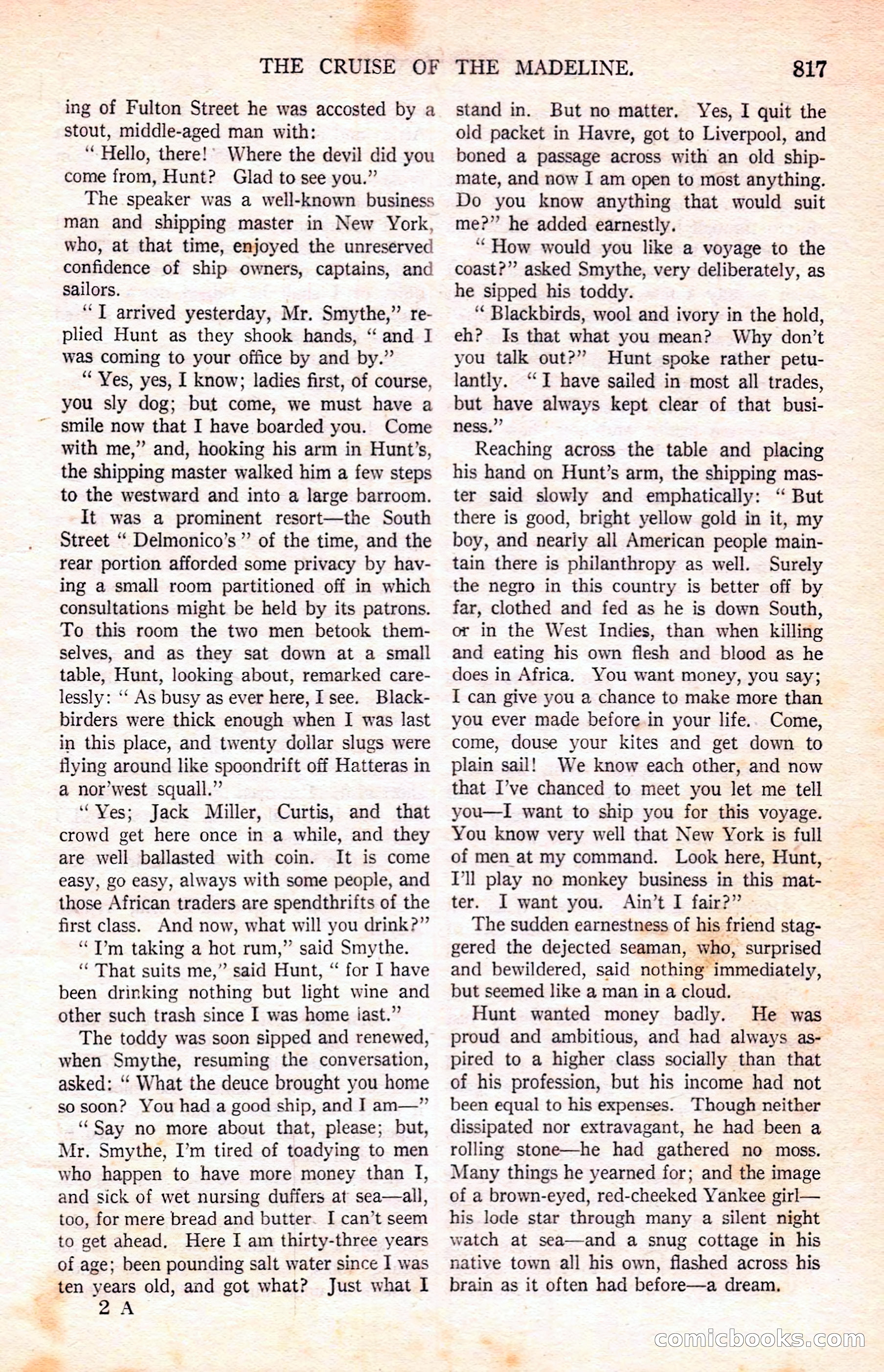
A restored page from Pulp Fiction, 1924. Page through the whole issue in the reader above.
📄 Transcribed text from this page (OCR, searchable)
Machine-transcribed from the original scan — historical spelling and the odd misread are preserved.
THE CRUISE OF ing of Fulton Street he was accosted by a stout, middle-aged man with: ‘“ Hello, there!’ Where the devil did you come from, Hunt? Glad to see you.” The speaker was a well-known business man and shipping master in New York, who, at that time, enjoyed the unreserved confidence of ship owners, captains, and sailors. “T arrived yesterday, Mr. Smythe,” re- plied Hunt as they shook hands, “and I was coming to your office by and by.” “Yes, yes, I know; ladies first, of course, you sly dog; but come, we must have a smile now that I have boarded you. Come with me,” and, hooking his arm in Hunt’s, the shipping master walked him a few steps to the westward and into a large barroom. It was a prominent resort—the South Street ‘“‘ Delmonico’s ” of the time, and the rear portion afforded some privacy by hav- ing a small room partitioned off in which consultations might be held by its patrons. To this room the two men betook them- selves, and as they sat down at a small table, Hunt, looking about, remarked care- lessly: ‘“‘ As busy as ever here, I see. Black- birders were thick enough when I was last in this place, and twenty dollar slugs were flying around like spoondrift off Hatteras in a nor’west squall.” “Yes; Jack Miller, Curtis, and that crowd get here once in a while, and they are well ballasted with coin. It is come easy, go easy, always with some people, and those African traders are spendthrifts of the first class. And now, what will you drink?” ‘“T’m taking a hot rum,” said Smythe. ‘“ That suits me,” said Hunt, “ for I have been drinking nothing but light wine and other such trash since I was home iast.” The toddy was soon sipped and renewed, when Smythe, resuming the conversation, asked: “ What the deuce brought you home so soon? You had a good ship, and I am—” ‘Say no more about that, please; but, Mr. Smythe, I’m tired of toadying to men who happen to have more money than I, and sick of wet nursing duffers at sea—all, too, for mere bread and butter. I can’t seem to get ahead, Here I am thirty-three years of age; been pounding salt water since I was ten years old, and got what? Just what I 2A THE MADELINE. 317 stand in. But no matter. Yes, I quit the old packet in Havre, got to Liverpool, and boned a passage across with an old ship- mate, and now I am open to most anything. Do you know anything that would suit me?” he added earnestly. ‘How would you like a voyage to the coast?” asked Smythe, very deliberately, as he sipped his toddy. ‘‘ Blackbirds, wool and ivory in the hold, eh? Is that what you mean? Why don’t you talk out?” Hunt spoke rather petu- lantly. “I have sailed in most all trades, but have always kept clear of that busi- ness.”’ Reaching across the table and placing his hand on Hunt’s arm, the shipping mas- ter said slowly and emphatically: “ But there is good, bright yellow gold in it, my boy, and nearly all American people main- tain there is philanthropy as well. Surely the negro in this country is better off by far, clothed and fed as he is down South, or in the West Indies, than when killing and eating his own flesh and blood as he does in Africa. You want money, you say; I can give you a chance to make more than you ever made before in your life.. Come, come, douse your kites and get down to plain sail! We know each other, and now that I’ve chanced to meet you let me tell you—I want to ship you for this voyage. You know very well that New York is full of men at my command. Look here, Hunt, I'll play no monkey business in this mat- ter. I want you. Ain’t I fair?” The sudden earnestness of his friend stag- gered the dejected seaman, who, surprised and bewildered, said nothing immediately, but seemed like a man in a cloud. Hunt wanted money badly. He was proud and ambitious, and had always as- pired to a higher class socially than that of his profession, but his income had not been equal to his expenses. Though neither dissipated nor extravagant, he had been a rolling stone—he had gathered no moss. Many things he yearned for; and the image of a brown-eyed, red-cheeked Yankee girl— his lode star through many a silent night watch at sea—and a snug cottage in his native town all his own, flashed across his brain as it often had before—a dream. oO comiclook (©