
Pulp Fiction, 1924 · page 29 of 180
Argosy All-Story Weekly — page 29: what you’re looking at
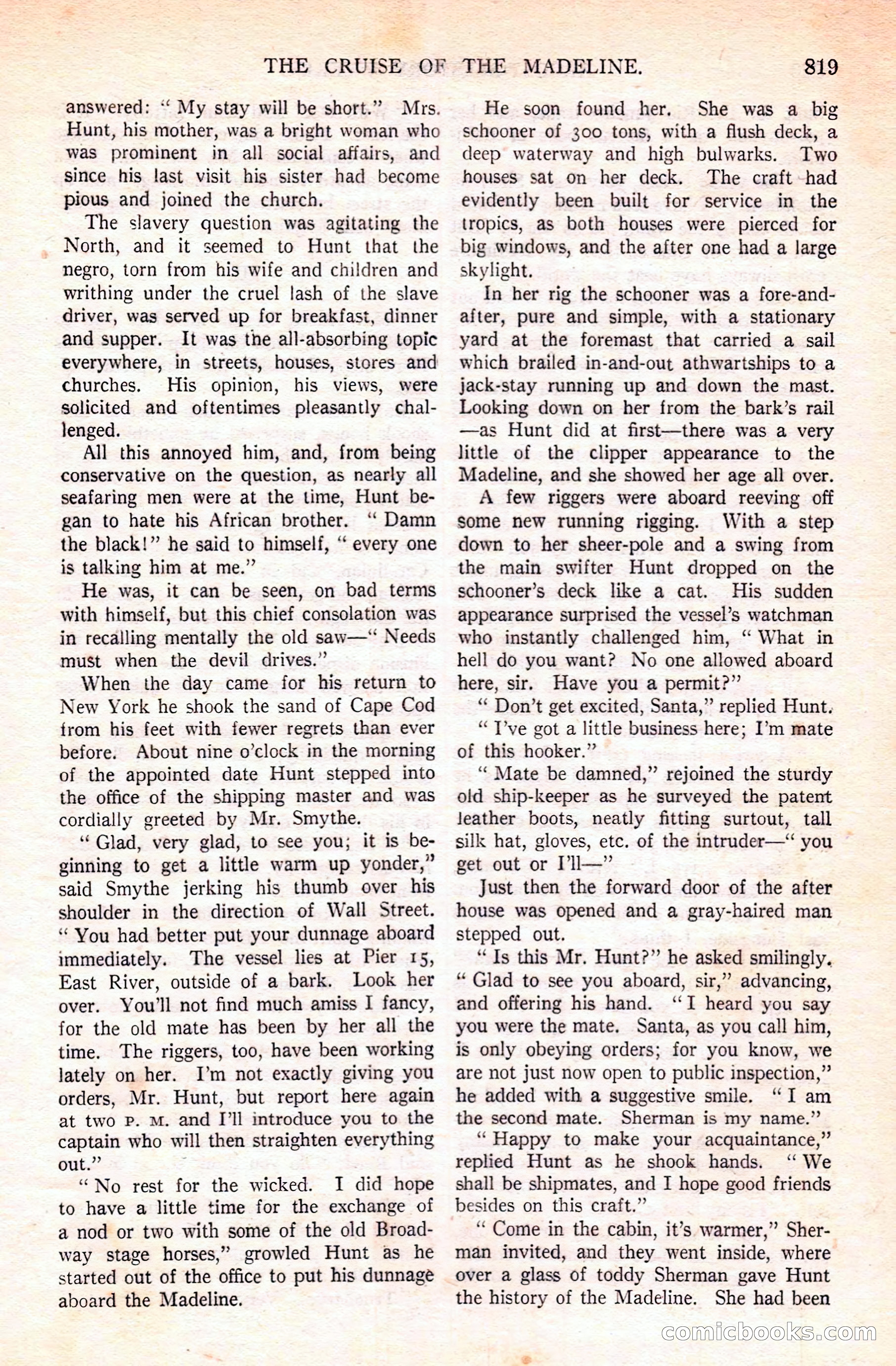
A restored page from Pulp Fiction, 1924. Page through the whole issue in the reader above.
📄 Transcribed text from this page (OCR, searchable)
Machine-transcribed from the original scan — historical spelling and the odd misread are preserved.
THE CRUISE OF answered: “‘ My stay will be short.” Mrs. Hunt, his mother, was a bright woman who was prominent in all social affairs, and since his last visit his sister had become pious and joined the church. The slavery question was agitating the - North, and it seemed to Hunt that the negro, torn from his wife and children and writhing under the cruel lash of the slave driver, was served up for breakfast, dinner and supper. It was the all-absorbing topic everywhere, in streets, houses, stores and churches. His opinion, his views, were solicited and oftentimes pleasantly chal- lenged. All this annoyed him, and, from being conservative on the question, as nearly all seafaring men were at the time, Hunt be- gan to hate his African brother. ‘‘ Damn the black!” he said to himself, “ every one is talking him at me.” He was, it can be seen, on bad terms with himself, but this chief consolation was in recalling mentally the old saw—‘ Needs must when the devil drives.” When the day came for his return to New York he shook the sand of Cape Cod from his feet with fewer regrets than ever before. About nine o’clock in the morning of the appointed date Hunt stepped into the office of the shipping master and was cordially greeted by Mr. Smythe. ‘Glad, very glad, to see you; it is be- ginning to get a little warm up yonder,” said Smythe jerking his thumb over his shoulder in the direction of Wall Street. ‘“ You had better put your dunnage aboard immediately. The vessel lies at Pier 15, East River, outside of a bark. Look her over. You'll not find much amiss I fancy, for the old mate has been by her all the time. The riggers, too, have been working lately on her. I’m not exactly giving you orders, Mr. Hunt, but report here again at two Pp. M. and I’ll introduce you to the captain who will then straighten everything out.” “No rest for the wicked. I did hope to have a little time for the exchange of a nod or two with some of the old Broad- way stage horses,” growled Hunt as he started out of the office to put his dunnage aboard the Madeline. THE MADELINE. 819 He soon found her. She was a big schooner of 300 tons, with a flush deck, a deep waterway and high bulwarks. Two houses sat on her deck. The craft -had evidently been built for service in the tropics, as both houses were pierced for big windows, and the after one had a large skylight. In her rig the schooner was a fore-and- after, pure and simple, with a stationary yard at the foremast that carried a sail which brailed in-and-out athwartships to a jack-stay running up and down the mast. Looking down on her from the bark’s rail —as Hunt did at first—there was a very little of the clipper appearance to the Madeline, and she showed her age all over. A few riggers were aboard reeving off some new running rigging. With a step down to her sheer-pole and a swing from the main swifter Hunt dropped on the schooner’s deck like a cat. His sudden appearance surprised the vessel’s watchman who instantly challenged him, “ What in hell do you want? No one allowed aboard here, sir. Have you a permit?” “ Don’t get excited, Santa,” replied Hunt. “T’ve got a little business here; I’m mate of this hooker.” ‘““ Mate be damned,” rejoined the sturdy old ship-keeper as he surveyed the patent leather boots, neatly fitting surtout, tall silk hat, gloves, etc. of the intruder—“ you get out or [’Il—” Just then the forward door of the after house was opened and a gray-haired man stepped out. “Ts this Mr. Hunt?” he asked smilingly. “ Glad to see you aboard, sir,” advancing, and offering his hand. ‘TI heard you say you were the mate. Santa, as you call him, is only obeying orders; for you know, we are not just now open to public inspection,” he added with a suggestive smile. “I am the second mate. Sherman is my name.” “Happy to make your acquaintance,” replied Hunt as he shook hands. ‘“‘ We shall be shipmates, and I hope good friends besides on this craft.” ‘Come in the cabin, it’s warmer,” Sher- man invited, and they went inside, where over a glass of toddy Sherman gave Hunt the history of the Madeline. She had been CoMmicbooks CO