
Pulp Fiction, 1924 · page 32 of 180
Argosy All-Story Weekly — page 32: what you’re looking at
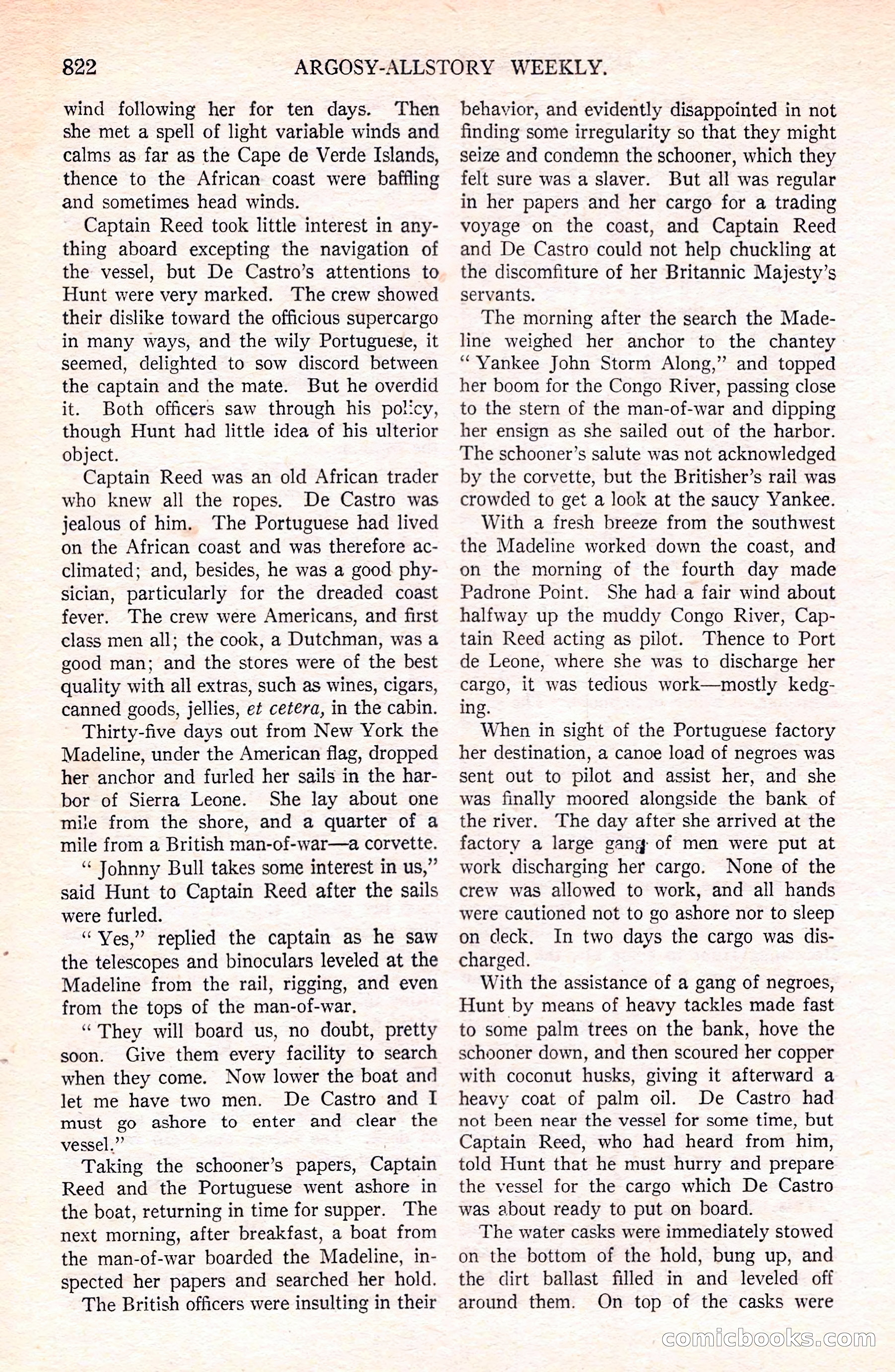
A restored page from Pulp Fiction, 1924. Page through the whole issue in the reader above.
📄 Transcribed text from this page (OCR, searchable)
Machine-transcribed from the original scan — historical spelling and the odd misread are preserved.
822 wind following her for ten days. ‘Then she met a spell of light variable winds and calms as far as the Cape de Verde Islands, thence to the African coast were baffling and sometimes head winds. Captain Reed took little interest in any- thing aboard excepting the navigation of the vessel, but De Castro’s attentions to Hunt were very marked. The crew showed their dislike toward the officious supercargo in many ways, and the wily Portuguese, it seemed, delighted to sow discord between the captain and the mate. But he overdid it. Both officers saw through his policy, though Hunt had little idea of his ulterior object. Captain Reed was an old African trader who knew all the ropes. De Castro was jealous of him. The Portuguese had lived on the African coast and was therefore ac- climated; and, besides, he was a good phy- sician, particularly for the dreaded coast fever. The crew were Americans, and first class men all; the cook, a Dutchman, was a good man; and the stores were of the best quality with all extras, such as wines, cigars, canned goods, jellies, et cetera, in the cabin. Thirty-five days out from New York the Madeline, under the American flag, dropped her anchor and furled her sails in the har- bor of Sierra Leone. She lay about one mile from the shore, and a quarter of a mile from a British man-of-war—a corvette. ‘“ Johnny Bull takes some interest in us,” said Hunt to Captain Reed after the sails were furled. “Ves,” replied the captain as he saw the telescopes and binoculars leveled at the Madeline from the rail, rigging, and even from the tops of the man-of-war, “They will board us, no doubt, pretty soon. Give them every facility to search when they come. Now lower the boat and let me have two men. De Castro and I must go ashore to enter and clear the vessel.” Taking the schooner’s papers, Captain Reed and the Portuguese went ashore in the boat, returning in time for supper. The next morning, after breakfast, a boat from the man-of-war boarded the Madeline, in- spected her papers and searched her hold. The British officers were insulting in their ARGOSY-ALLSTORY WEEKLY. behavior, and evidently disappointed in not finding some irregularity so that they might seize and condemn the schooner, which they felt sure was a slaver. But all was regular in her papers and her cargo for a trading voyage on the coast, and Captain Reed and De Castro could not help chuckling at the discomfiture of her Britannic Majesty’s servants. The morning after the search the Made- line weighed her anchor to the chantey “Yankee John Storm Along,” and topped her boom for the Congo River, passing close to the stern of the man-of-war and dipping her ensign as she sailed out of the harbor. The schooner’s salute was not acknowledged by the corvette, but the Britisher’s rail was crowded to get a look at the saucy Yankee. With a fresh breeze from the southwest the Madeline worked down the coast, and on the morning of the fourth day made Padrone Point. She had a fair wind about halfway up the muddy Congo River, Cap- tain Reed acting as pilot. Thence to Port de Leone, where she was to discharge her cargo, it was tedious work—mostly kedg- ing. When in sight of the Portuguese factory her destination, a canoe load of negroes was sent out to pilot and assist her, and she was finally moored alongside the bank of the river. The day after she arrived at the factory a large gang of men were put at work discharging her cargo. None of the crew was allowed to work, and all hands were cautioned not to go ashore nor to sleep on deck. In two days the cargo was dis- charged. | With the assistance of a gang of negroes, Hunt by means of heavy tackles made fast to some palm trees on the bank, hove the schooner down, and then scoured her copper with coconut husks, giving it afterward a heavy coat of palm oil. De Castro had not been near the vessel for some time, but Captain Reed, who had heard from him, told Hunt that he must hurry and prepare the vessel for the cargo which De Castro was about ready to put on board. The water casks were immediately stowed on the bottom of the hold, bung up, and the dirt ballast filled in and leveled off around them. On top of the casks were oO CoOMmiclbooks.€© inn