
Pulp Fiction, 1924 · page 43 of 180
Argosy All-Story Weekly — page 43: what you’re looking at
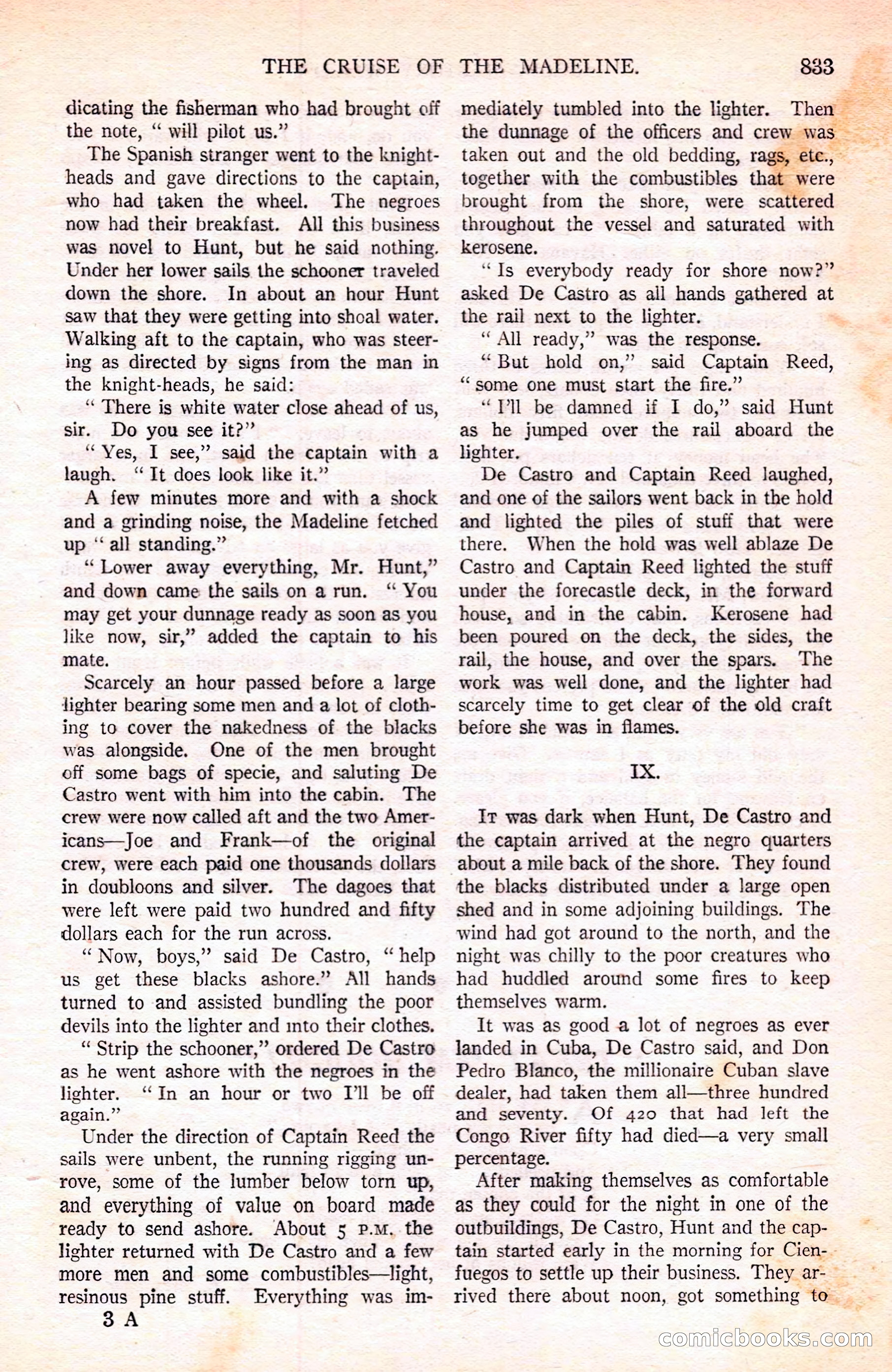
A restored page from Pulp Fiction, 1924. Page through the whole issue in the reader above.
📄 Transcribed text from this page (OCR, searchable)
Machine-transcribed from the original scan — historical spelling and the odd misread are preserved.
-* Then THE CRUISE OF THE MADELINE. a _- ey <= = dicating the fisherman who had brought off mediately tumbled into the lighter. the note, “ will pilot us.” The Spanish stranger went to the knight- heads and gave directions to the captain, who had taken the wheel. The negroes now had their breakfast. All this business was novel to Hunt, but he said nothing. Under her lower sails the schooner traveled down the shore. In about an hour Hunt saw that they were getting into shoal water. Walking aft to the captain, who was steer- ing as directed by signs from the man in the knight-heads, he said: ‘There is white water close ahead of us, sir. Do you see it?” ‘Yes, I see,” said the captain with a laugh. “ It does look like it.” A few minutes more and with a shock and a grinding noise, the Madeline fetched up “all standing.” “Lower away everything, Mr. Hunt,” and down came the sails on arun. “ You may get your dunnage ready as soon as you like now, sir,” added the captain to his mate. Searcely an hour passed before a large lighter bearing some men and a lot of cloth- ing to cover the nakedness of the blacks was alongside. One of the men brought off some bags of specie, and saluting De Castro went with him into the cabin. The crew were now called aft and the two Amer- icans—Joe and Frank—of the original crew, were each paid one thousands dollars in doubloons and silver. The dagoes that were left were paid two hundred and fifty dollars each for the run across. “Now, boys,” said De Castro, “help us get these blacks ashore.” All hands turned to and assisted bundling the poor devils into the lighter and into their clothes. “Strip the schooner,” ordered De Castro as he went ashore with the negroes in the lighter. ‘In an hour or two I'll be off again.” Under the direction of Captain Reed the sails were unbent, the running rigging un- rove, some of the lumber below torn up, and everything of value on board made ready to send ashore. About 5 P.M. the lighter returned with De Castro and a few more men and some combustibles—light, resinous pine stuff. Everything was im- 3A the dunnage of the officers and crew yowas ae taken out and the old bedding, r 5, etc., — together with the combustibles that were brought from the shore, were scatfered throughout the vessel and saturated with kerosene. ‘Is everybody ready for shore now?” asked De Castro as all hands gathered at the rail next to the lighter. ‘All ready,” was the response. “But hold on,” said Captain Reed, “some one must start the fire.” “Tl be damned if I do,” said Hunt as he jumped over the rail aboard the lighter. De Castro and Captain Reed laughed, and one of the sailors went back in the hold and lighted the piles of stuff that were there. When the hold was well ablaze De Castro and Captain Reed lighted the stuff under the forecastle deck, in the forward house, and in the cabin. Kerosene had been poured on the deck, the sides, the rail, the house, and over the spars. The work was well done, and the lighter had scarcely time to get clear of the old craft before she was in flames. IX. It was dark when Hunt, De Castro and the captain arrived at the negro quarters about a mile back of the shore. They found the blacks distributed under a large open shed and in some adjoining buildings. The wind had got around to the north, and the night was chilly to the poor creatures who had huddled around some fires to keep themselves warm. It was as good a lot of negroes as ever landed in Cuba, De Castro said, and Don Pedro Blanco, the millionaire Cuban slave dealer, had taken them all—three hundred and seventy. Of 420 that had left the Congo River fifty had died—a very small percentage. After making themselves as comfortable as they could for the night in one of the outbuildings, De Castro, Hunt and the cap- tain started early in the morning for Cien-~ fuegos to settle up their business. They ar-— rived there about noon, got something to oO COMICLOO S C@