
Pulp Fiction, 1924 · page 47 of 180
Argosy All-Story Weekly — page 47: what you’re looking at
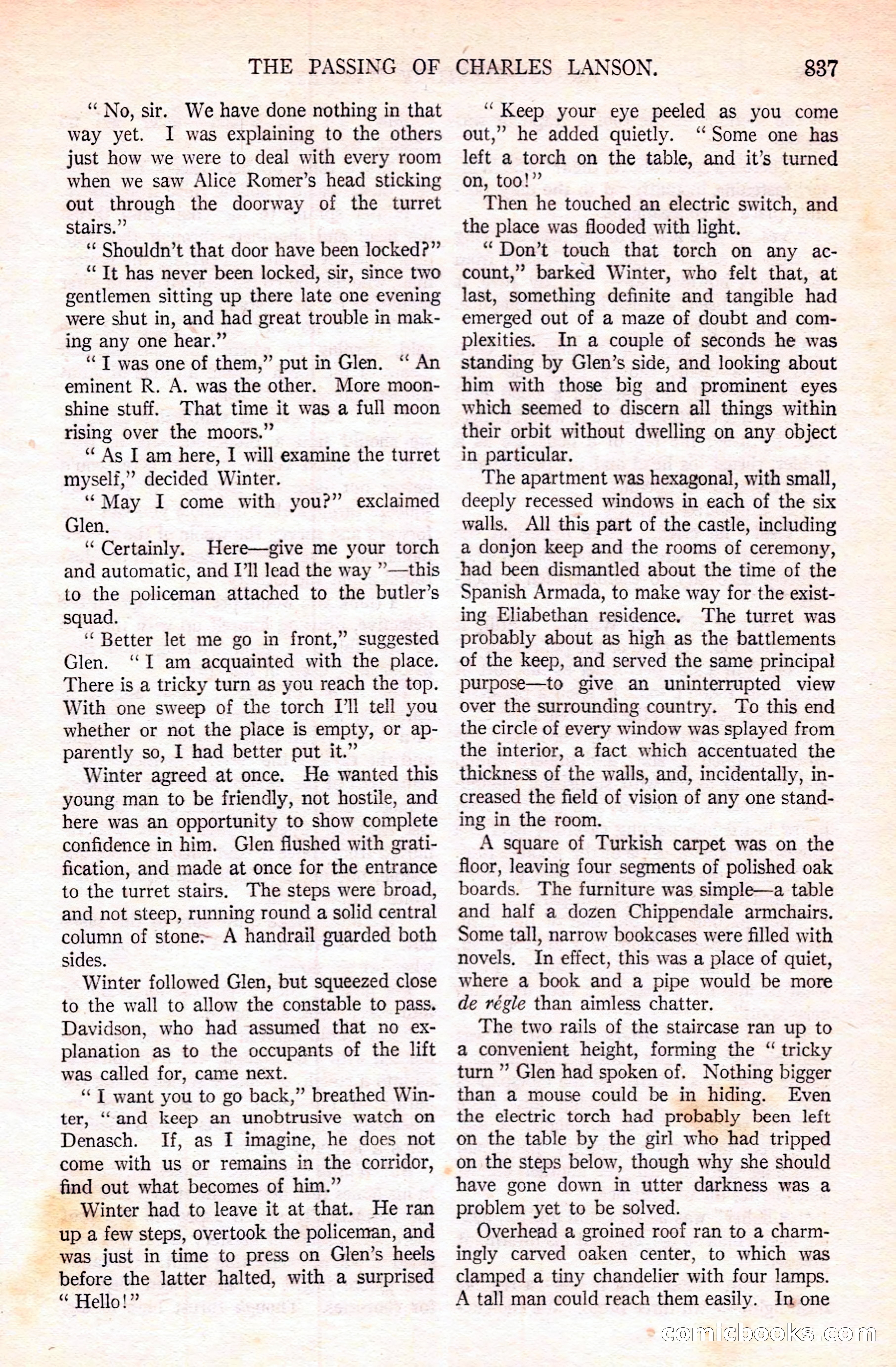
A restored page from Pulp Fiction, 1924. Page through the whole issue in the reader above.
📄 Transcribed text from this page (OCR, searchable)
Machine-transcribed from the original scan — historical spelling and the odd misread are preserved.
THE PASSING OF “No, sir. We have done nothing in that way yet. I was explaining to the others just how we were to deal with every room when we saw Alice Romer’s head sticking out through the doorway of the turret stairs.” ‘‘ Shouldn’t that door have been locked?” “It has never been locked, sir, since two gentlemen sitting up there late one evening were shut in, and had great trouble in mak- ing any one hear.” ‘“T was one of them,” put in Glen. “ An eminent R. A. was the other. More moon- shine stuff. That time it was a full moon rising over the moors.” “ As I am here, I will examine the turret myself,” decided Winter. “May I come with you?” exclaimed Glen. “ Certainly. Here—give me your torch and automatic, and I’ll lead the way ”—this to the policeman attached to the butler’s squad. ‘Better let me go in front,” suggested Glen. ‘I am acquainted with the place. There is a tricky turn as you reach the top. With one sweep of the torch I'll tell you whether or not the place is empty, or ap- parently so, I had better put it.” Winter agreed at once. He wanted this young man to be friendly, not hostile, and here was an opportunity to show complete confidence in him. Glen flushed with grati- fication, and made at once for the entrance to the turret stairs. The steps were broad, and not steep, running round a solid central column of stone~ A handrail guarded both sides. Winter followed Glen, but squeezed close to the wall to allow the constable to pass. Davidson, who had assumed that no ex- planation as to the occupants of the lift was called for, came next. ‘‘T want you to go back,” breathed Win- ter, ‘“and keep an unobtrusive watch on Denasch. If, as I imagine, he does not come with us or remains in the corridor, find out what becomes of him.” _ Winter had to leave it at that. He ran up a few steps, overtook the policeman, and was just in time to press on Glen’s heels before the latter halted, with a surprised “ Hello!” CHARLES LANSON. 837 ‘Keep your eye peeled as you come out,” he added quietly. ‘Some one has left a torch on the table, and it’s turned on, too!” Then he touched an electric switch, and the place was flooded with light. “Don’t touch that torch on any ac- count,” barked Winter, who felt that, at last, something definite and tangible had emerged out of a maze of doubt and com- plexities. In a couple of seconds he was standing by Glen’s side, and looking about him with those big and prominent eyes which seemed to discern all things within their orbit without dwelling on any object in particular. The apartment was hexagonal, with small, deeply recessed windows in each of the six walls. All this part of the castle, including a donjon keep and the rooms of ceremony, had been dismantled about the time of the Spanish Armada, to make way for the exist- ing Eliabethan residence. The turret was probably about as high as the battlements of the keep, and served the same principal purpose—to give an uninterrupted view over the surrounding country. To this end the circle of every window was splayed from the interior, a fact which accentuated the thickness of the walls, and, incidentally, in- creased the field of vision of any one stand- ing in the room. A square of Turkish carpet was on the floor, leaving four segments of polished oak boards. The furniture was simple—a table and half a dozen Chippendale armchairs. Some tall, narrow bookcases were filled with novels. In effect, this was a place of quiet, where a book and a pipe would be more de régle than aimless chatter. The two rails of the staircase ran up to a convenient height, forming the “ tricky turn ” Glen had spoken of. Nothing bigger than a mouse could be in hiding. Even the electric torch had probably been left on the table by the girl who had tripped on the steps below, though why she should have gone down in utter darkness was a problem yet to be solved. Overhead a groined roof ran to a charm- ingly carved oaken center, to which was clamped a tiny chandelier with four lamps. A tall man could reach them easily. In one SS oO COMMCLOO© C©