
Pulp Fiction, 1924 · page 64 of 180
Argosy All-Story Weekly — page 64: what you’re looking at
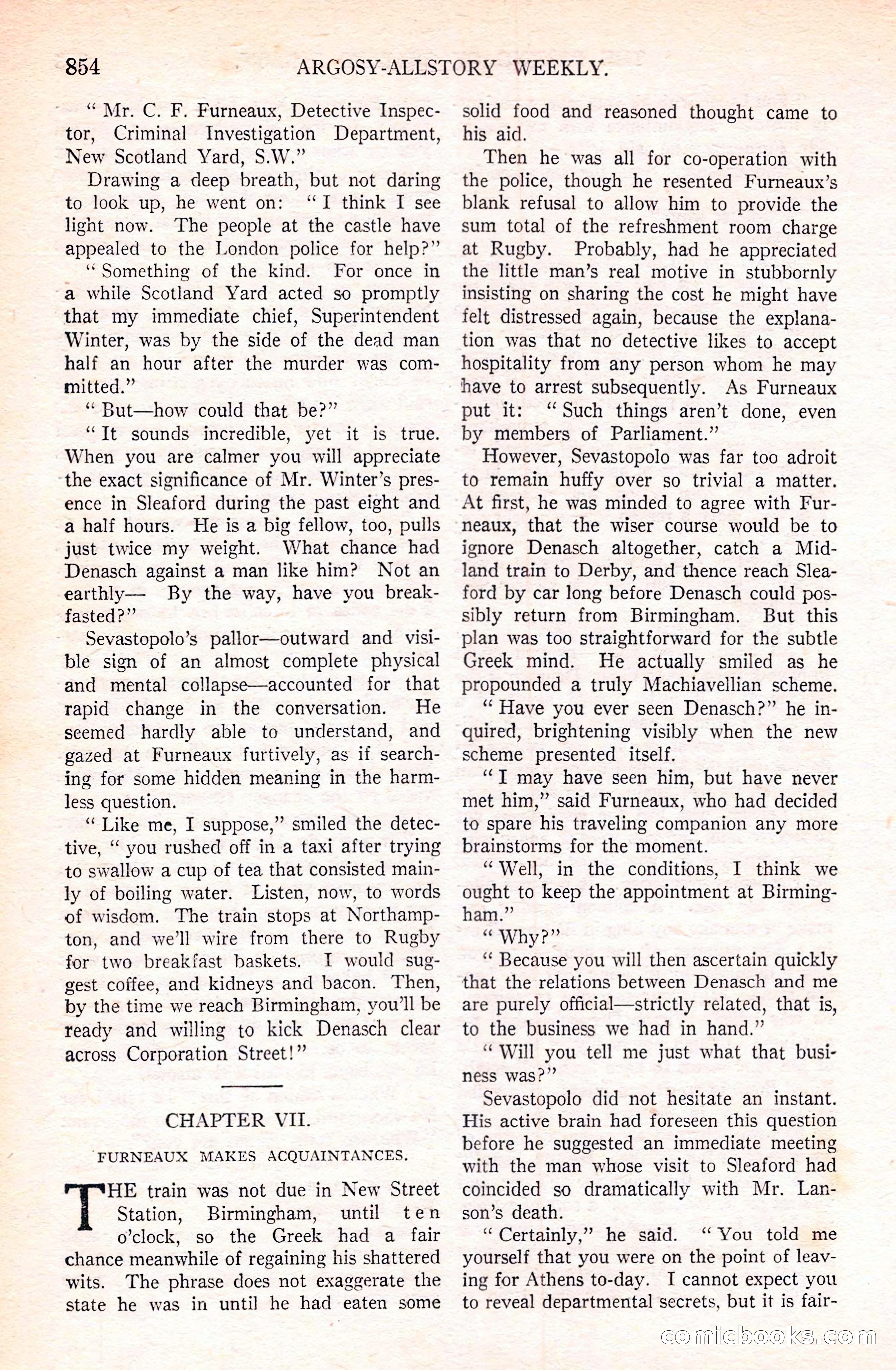
A restored page from Pulp Fiction, 1924. Page through the whole issue in the reader above.
📄 Transcribed text from this page (OCR, searchable)
Machine-transcribed from the original scan — historical spelling and the odd misread are preserved.
854 “Mr. C. F. Furneaux, Detective Inspec- tor, Criminal Investigation Department, New Scotland Yard, S.W.” Drawing a deep breath, but not daring to look up, he went on: ‘I think I see light now. The people at the castle have appealed to the London police for help?” ‘“ Something of the kind. For once in a while Scotland Yard acted so promptly that my immediate chief, Superintendent Winter, was by the side of the dead man half an hour after the murder was com- mitted.” ‘“ But—how could that be?” “Tt sounds incredible, yet it is true. When you are calmer you will appreciate the exact significance of Mr. Winter’s pres- ence in Sleaford during the past eight and a half hours. He is a big fellow, too, pulls just twice my weight. What chance had Denasch against a man like him? Not an earthly— By the way, have you break- fasted?” Sevastopolo’s pallor—outward and _ visi- ble sign of an almost complete physical and mental collapse—accounted for that rapid change in the conversation. He seemed hardly able to understand, and gazed at Furneaux furtively, as if search- ing for some hidden meaning in the harm- less question. ‘Like me, I suppose,”’ smiled the detec- tive, ‘‘ you rushed off in a taxi after trying to swallow a cup of tea that consisted main- ly of boiling water. Listen, now, to words of wisdom. The train stops at Northamp- ton, and we'll wire from there to Rugby for two breakfast baskets. I would sug- gest coffee, and kidneys and bacon. Then, by the time we reach Birmingham, you'll be ready and willing to kick Denasch clear across Corporation Street!” CHAPTER VII. ‘FURNEAUX MAKES ACQUAINTANCES. HE train was not due in New Street Station, Birmingham, until ten o’clock, so the Greek had a fair chance meanwhile of regaining his shattered wits. The phrase does not exaggerate the state he was in until he had eaten some ARGOSY-ALLSTORY WEEKLY. solid food and reasoned thought came to his aid. Then he was all for co-operation with the police, though he resented Furneaux’s blank refusal to allow him to provide the sum total of the refreshment room charge at Rugby. Probably, had he appreciated the little man’s real motive in stubbornly insisting on sharing the cost he might have felt distressed again, because the explana- tion was that no detective likes to accept hospitality from any person whom he may have to arrest subsequently. As Furneaux put it: “Such things aren’t done, even by members of Parliament.” However, Sevastopolo was far too adroit to remain huffy over so trivial a matter. At first, he was minded to agree with Fur- neaux, that the wiser course would be to ignore Denasch altogether, catch a Mid- land train to Derby, and thence reach Slea- ford by car long before Denasch could pos- sibly return from Birmingham. But this plan was too straightforward for the subtle Greek mind. He actually smiled as he propounded a truly Machiavellian scheme. “‘ Have you ever seen Denasch?” he in- quired, brightening visibly when the new scheme presented itself. ‘“T may have seen him, but have never met him,” said Furneaux, who had decided to spare his traveling companion any more brainstorms for the moment. “Well, in the conditions, I think we ought to keep the appointment at Birming- ham.” ce Why?” ‘“* Because you will then ascertain quickly that the relations between Denasch and me are purely official—strictly related, that is, to the business we had in hand.” “Will you tell me just what that busi- ness was?” Sevastopolo did not hesitate an instant. His active brain had foreseen this question before he suggested an immediate meeting with the man whose visit to Sleaford had coincided so dramatically with Mr. Lan- son’s death. “Certainly,” he said. ‘‘ You told me yourself that you were on the point of leav- ing for Athens to-day. I cannot expect you to reveal departmental secrets, but it is fair- COMmiicbooks C©