
Pulp Fiction, 1924 · page 67 of 180
Argosy All-Story Weekly — page 67: what you’re looking at
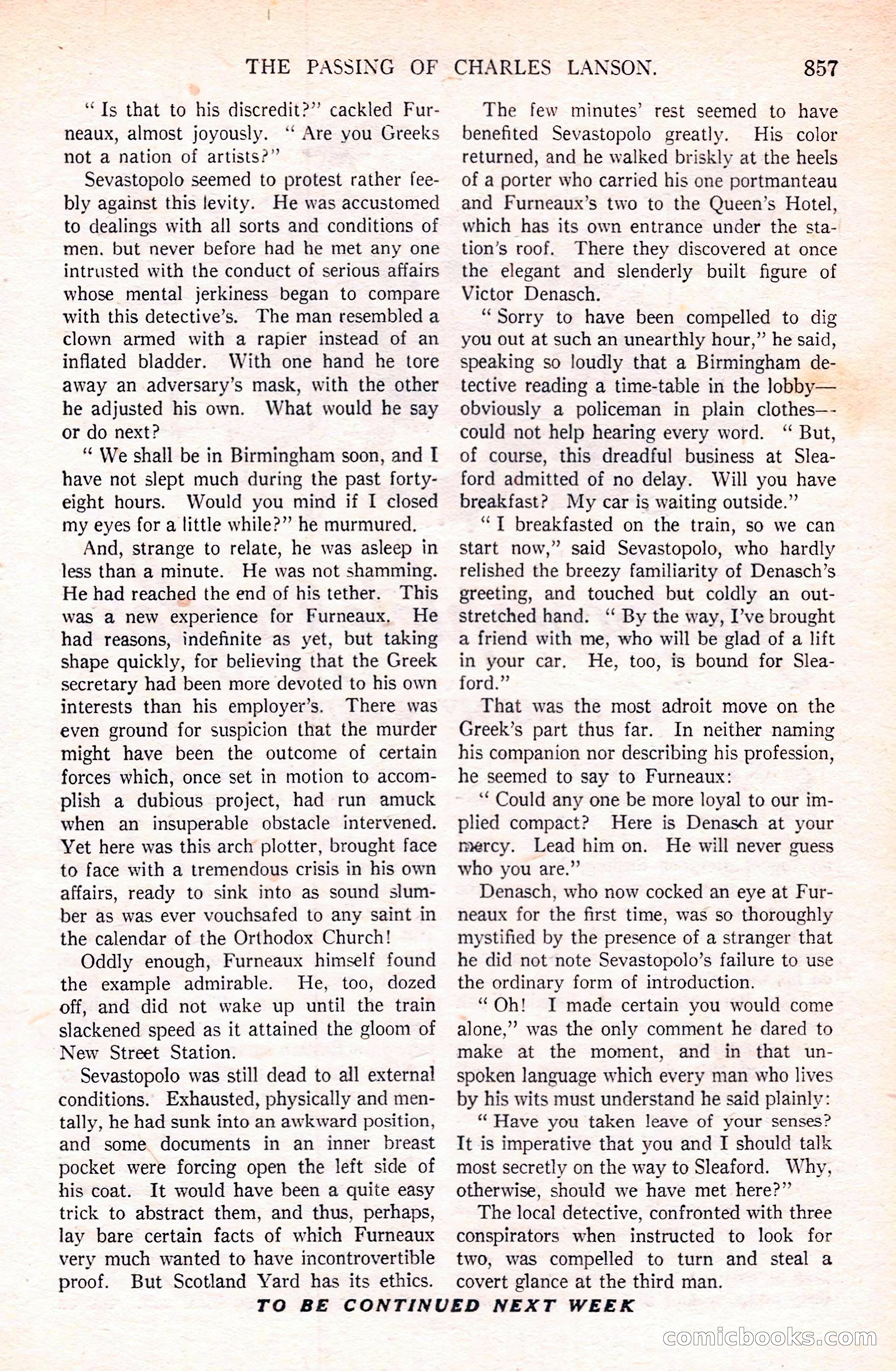
A restored page from Pulp Fiction, 1924. Page through the whole issue in the reader above.
📄 Transcribed text from this page (OCR, searchable)
Machine-transcribed from the original scan — historical spelling and the odd misread are preserved.
THE PASSING OF ‘Ts that to his discredit?” cackled Fur- neaux, almost joyously. “‘ Are you Greeks not a nation of artists?” Sevastopolo seemed to protest rather fee- bly against this levity. He was accustomed to dealings with all sorts and conditions of men. but never before had he met any one intrusted with the conduct of serious affairs whose mental jerkiness began to compare with this detective’s. The man resembled a clown armed with a rapier instead of an inflated bladder. With one hand he tore away an adversary’s mask, with the other he adjusted his own. What would he say or do next? ‘* We shall be in Birmingham soon, and I have not slept much during the past forty- eight hours. Would you mind if I closed my eyes for a little while?” he murmured. And, strange to relate, he was asleep in less than a minute. He was not shamming. He had reached the end of his tether. This was a new experience for Furneaux, He had reasons, indefinite as yet, but taking shape quickly, for believing that the Greek secretary had been more devoted to his own interests than his employer’s. There was even ground for suspicion that the murder might have been the outcome of certain forces which, once set in motion to accom- plish a dubious project, had run amuck when an insuperable obstacle intervened. Yet here was this arch plotter, brought face to face with a tremendous crisis in his own affairs, ready to sink into as sound slum- ber as was ever vouchsafed to any saint in the calendar of the Orthodox Church! Oddly enough, Furneaux himself found the example admirable. He, too, dozed off, and did not wake up until the train slackened speed as it attained the gloom of New Street Station. Sevastopolo was still dead to all external conditions. Exhausted, physically and men- tally, he had sunk into an awkward position, and some documents in an inner breast pocket were forcing open the left side of his coat. It would have been a quite easy trick to abstract them, and thus, perhaps, lay bare certain facts of which Furneaux very much wanted to have incontrovertible proof. But Scotland Yard has its ethics. (CHARLES LANSON, 857 The few minutes’ rest seemed to have benefited Sevastopolo greatly. His color returned, and he walked briskly at the heels of a porter who carried his one portmanteau and Furneaux’s two to the Queen’s Hotel, which has its own entrance under the sta- tion’s roof. There they discovered at once the elegant and slenderly built figure of Victor Denasch. “Sorry to have been compelled to dig you out at such an unearthly hour,” he said, speaking so loudly that a Birmingham de- tective reading a time-table in the lobby— obviously a policeman in plain clothes—- could not help hearing every word. “ But, of course, this dreadful business at Slea- ford admitted of no delay. Will you have breakfast? My car is waiting outside.” “T breakfasted on the train, so we can start now,” said Sevastopolo, who hardly relished the breezy familiarity of Denasch’s greeting, and touched but coldly an out- stretched hand. ‘‘ By the way, I’ve brought a friend with me, who will be glad of a lift in your car. He, too, is bound for Slea- ford.” That was the most adroit move on the Greek’s part thus far. In neither naming his companion nor describing his profession, he seemed to say to Furneaux: ‘‘ Could any one be more loyal to our im- plied compact? Here is Denasch at your mercy. Lead him on. He will never guess who you are.” Denasch, who now cocked an eye at Fur- neaux for the first time, was so thoroughly mystified by the presence of a stranger that he did not note Sevastopolo’s failure to use the ordinary form of introduction. “Oh! I made certain you would come alone,” was the only comment he dared to make at the moment, and in that un- spoken language which every man who lives by his wits must understand he said plainly: “Have you taken leave of your senses? It is imperative that you and I should talk most secretly on the way to Sleaford. Why, otherwise, should we have met here?”’ The local detective, confronted with three conspirators when instructed to look for two, was compelled to turn and steal a covert glance at the third man. TO BE CONTINUED NEXT WEEK oO CoMmiclbooks.€©