
Pulp Fiction, 1924 · page 79 of 180
Argosy All-Story Weekly — page 79: what you’re looking at
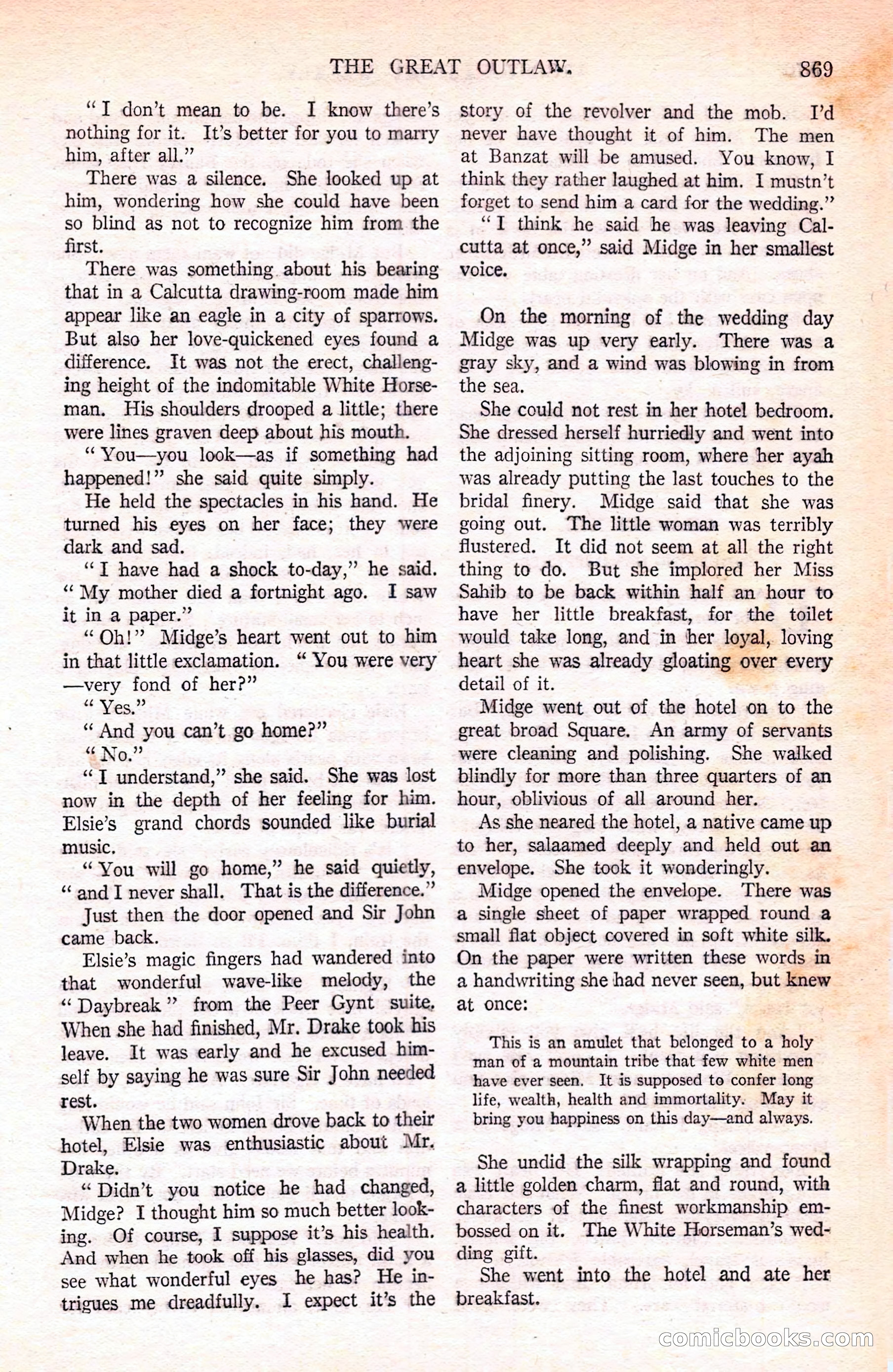
A restored page from Pulp Fiction, 1924. Page through the whole issue in the reader above.
📄 Transcribed text from this page (OCR, searchable)
Machine-transcribed from the original scan — historical spelling and the odd misread are preserved.
THE GREAT OUTLAW, “T don’t mean to be. I know there’s nothing for it. It’s better for you to marry him, after all.” There was a silence. She looked up at him, wondering how she could have been so blind as not to recognize him from the first. There was something about his bearing that in a Calcutta drawing-room made him appear like an eagle in a city of sparrows. But also her love-quickened eyes found a difference. It was not the erect, challeng- ing height of the indomitable White Horse- man. His shoulders drooped a little; there were lines graven deep about his mouth. “You—you look—as if something had happened!” she said quite simply. He held the spectacles in his hand. He turned his eyes on her face; they were dark and sad. ‘‘T have had a shock to-day,” he said. ‘My mother died a fortnight ago. I saw it in a paper.” “Oh!” Midge’s heart went out to him in that little exclamation. “ You were very —very fond of her?” “e Yes.” “ And you can’t go home?” T4 No.” ‘“‘T understand,” she said. She was lost now in the depth of her feeling for him. Elsie’s grand chords sounded like burial music, “Vou will go home,” he said quietly, ‘“‘ and I never shall. That is the difference.” Just then the door opened and Sir John came back. Elsie’s magic fingers had wandered into that wonderful wave-like melody, the “Daybreak” from the Peer Gynt suite, When she had finished, Mr. Drake took his leave. It was early and he excused him- self by saying he was sure Sir John needed rest. When the two women drove back to their hotel, Elsie was enthusiastic about Mr. Drake. “Didn’t you notice he had changed, Midge? I thought him so much better look- ing. Of course, I suppose it’s his health. And when he took off his glasses, did you see what wonderful eyes he has? He in- trigues me dreadfully. I expect it’s the story of the revolver and the mob. Td never have thought it of him. The men at Banzat will be amused. You know, I think they rather laughed at him. I mustn’t forget to send him a card for the wedding.” “I think he said he was leaving Cal- cutta at once,” said Midge in her smallest Voice. On the morning of the wedding day Midge was up very early. There was a gray sky, and a wind was blowing in from the sea. She could not rest in her hotel bedroom. She dressed herself hurriedly and went into the adjoining sitting room, where her ayah was already putting the last touches to the bridal finery. Midge said that she was going out. The little woman was terribly flustered. It did not seem at all the right thing to do. But she implored her Miss Sahib to be back within half an hour to have her little breakfast, for the toilet would take long, and in her loyal, loving heart she was already gloating over every detail of it. Midge went out of the hotel on to the great broad Square. An army of servants were cleaning and polishing. She walked blindly for more than three quarters of an hour, oblivious of all around her. As she neared the hotel, a native came up to her, salaamed deeply and held out an envelope. She took it wonderingly. Midge opened the envelope. There was’ a single sheet of paper wrapped round a small flat object covered in soft white silk. On the paper were written these words in | a handwriting she had never seen, but knew at once: This is an amulet that belonged to a holy man of a mountain tribe that few white men have ever seen. It is supposed to confer long life, wealth, health and immortality. May it bring you happiness on this day—and always. She undid the silk wrapping and found a little golden charm, flat and round, with characters of the finest workmanship em- bossed on it. The White Horseman’s wed- ding gift. 3 She went into the hotel and ate her breakfast. COMmiclbooks COL