
Pulp Fiction, 1927 · page 11 of 168
Argosy All-Story Weekly, February 12, 1927 — page 11: what you’re looking at
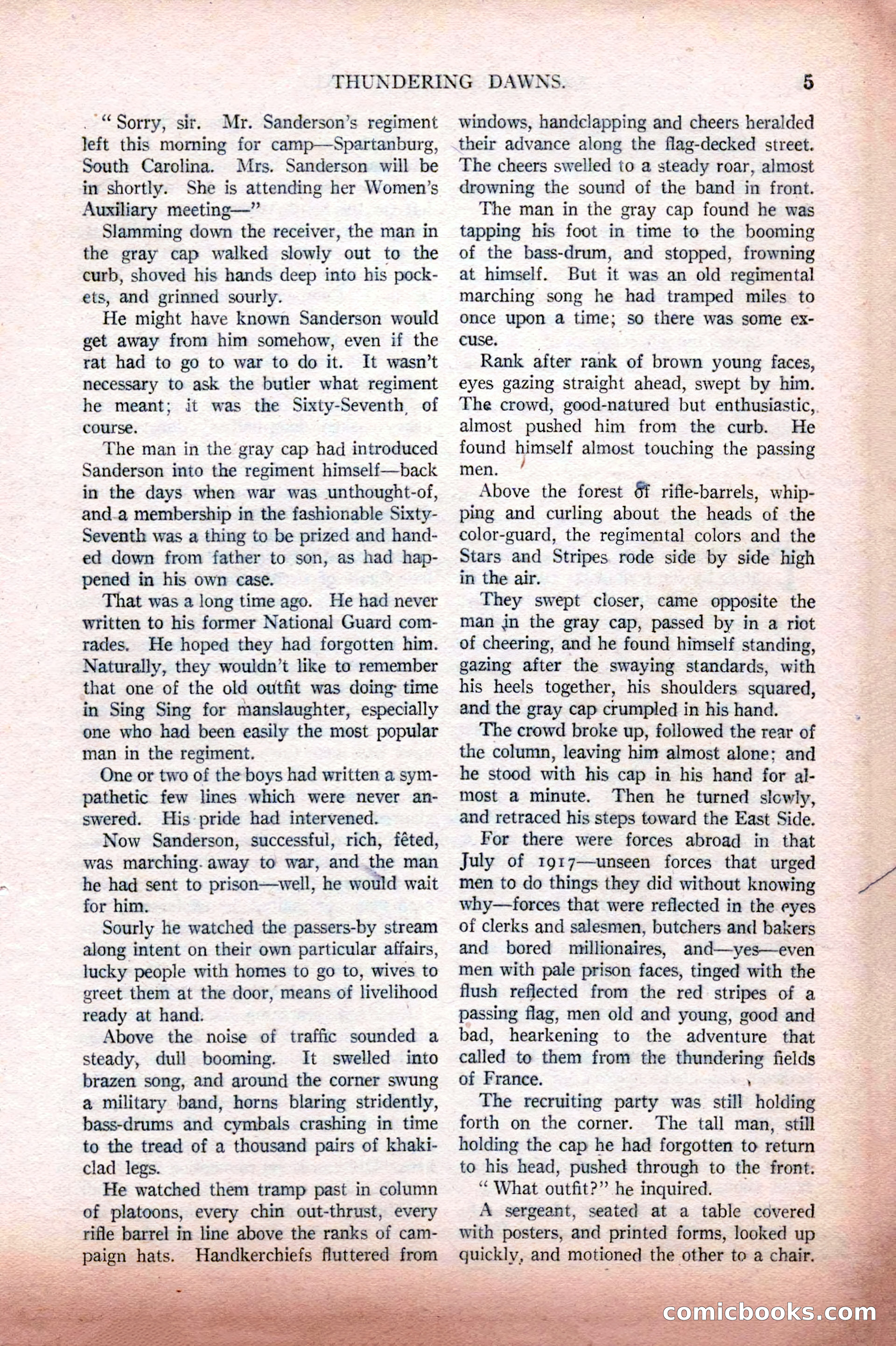
A restored page from Pulp Fiction, 1927. Page through the whole issue in the reader above.
📄 Transcribed text from this page (OCR, searchable)
Machine-transcribed from the original scan — historical spelling and the odd misread are preserved.
aay Wk ao es Seatee ~ a paign hats. — — Le See —2 THUNDERING DAWNS. 5 . “Sorry, sit. Mr. Sanderson’s regiment left this morning for camp—Spartanburg, South Carolina. Mrs. Sanderson will be in shortly. She is attending her Women’s Auxiliary meeting—” Slamming down the receiver, the man in the gray cap walked slowly out to the curb, shoved his hands deep into his pock- ets, and grinned sourly. He might have known Sanderson would get away from him somehow, even if the rat had to go to war to do it. It wasn’t necessary to ask the butier what regiment he meant; it was the Sixty-Seventh of course. The man in the gray cap had introduced Sanderson into the regiment himself—back in the days when war was unthought-of, and.a membership in the fashionable Sixty- Seventh was a thing to be prized and hand- ed down from father to son, as had hap- pened in his own case. That was a long time ago. He had never written to his former National Guard com- rades. He hoped they had forgotten him. Naturally, they wouldn’t like to remember that one of the old outfit was doing time in Sing Sing for manslaughter, especially one who had been easily the most popular man in the regiment. One or two of the boys had written a sym- pathetic few lines which were never an- swered. His pride had intervened. Now Sanderson, successful, rich, féted, was marching. away to war, and the man he had sent to prison—well, he would wait for him. Sourly he watched the passers-by stream along intent on their own particular affairs, lucky people with homes to go to, wives to greet them at the door, means of livelihood ready at hand. Above the noise of traffic sounded a steady, dull booming. It swelled into brazen song, and around the corner swung a military band, horns blaring stridently, bass-drums and cymbals crashing in time to the tread of a thousand pairs of khaki- clad legs. He watched them tramp past in column of platoons, every chin out-thrust, every rifle barrel in line above the ranks of cam- A teninerchiets i tee some ne cee! a =e oe ee ~ ae — 5 4 aes a oP = 2 ee ee et te Seen Oa << mee —— ae . > ae : es Se gS ie eR < vee “> weal ein ions, afk, * =e > windows, handclapping and cheers heralded their advance along the flag-decked street. The cheers swelled to a steady roar, almost drowning the sound of the band in front. The man in the gray cap found he was tapping his foot in time to the booming of the bass-drum, and stopped, frowning at himself. But it was an old regimental marching song he had tramped miles to once upon a time; so there was some ex- cuse. | Rank after rank of brown young faces, eyes gazing straight ahead, swept by him. The crowd, good-natured but enthusiastic, almost pushed him from the curb. He found himself almost touching the passing men. Above the forest 6 rifle-barrels, whip- ping and curling about the heads of the color-guard, the regimental colors and the Stars and Stripes rode side by side high in the air. They swept closer, came opposite the man jn the gray cap, passed by in a riot of cheering, and he found himself standing, gazing after the swaying standards, with his heels together, his shoulders squared, and the gray cap crumpled in his hand. The crowd broke up, followed the rear of the column, leaving him almost alone; and he stood with his cap in his hand for al- most a minute. Then he turned slowly, and retraced his steps toward the East Side. For there were forces abroad in that July of 1917—unseen forces that urged men to do things they did without knowing why—forces that were reflected in the eyes of clerks and salesmen, butchers and bakers and bored millionaires, and—yes—even men with pale prison faces, tinged with the flush reflected from the red stripes of a passing flag, men old and young, good and bad, hearkening to the adventure that called to them from the thundering fields of France. ’ The recruiting party was still holding forth on the corner. The tall man, still holding the cap he had forgotten to return to his head, pushed through to the front: “What outfit?” he inquired. A sergeant, seated at a table covered with ee and printed forms, looked us = ad eee a