
Pulp Fiction, 1927 · page 10 of 168
Argosy All-Story Weekly, February 12, 1927 — page 10: what you’re looking at
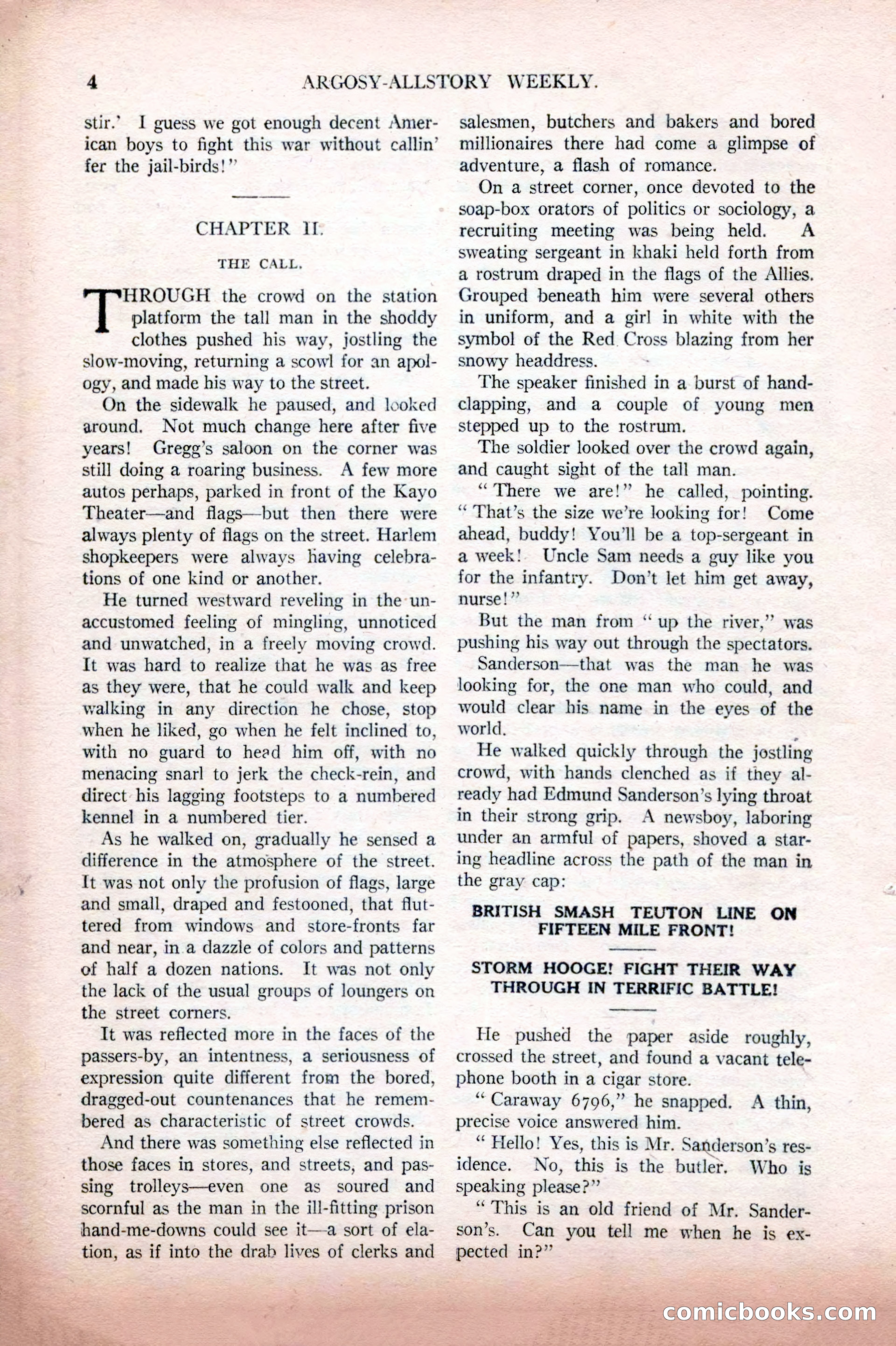
A restored page from Pulp Fiction, 1927. Page through the whole issue in the reader above.
📄 Transcribed text from this page (OCR, searchable)
Machine-transcribed from the original scan — historical spelling and the odd misread are preserved.
4 ARGOSY-ALLSTORY stir.” I guess we got enough decent Amer- ican boys to fight this war without callin’ fer the jail-birds!”’ CHAPTER 1. THE CALL, HROUGH the crowd on the station platform the tall man in the shoddy clothes pushed his way, jostling the slow-moving, returning a scowl for an apol- ogy, and made his way to the street. On the sidewalk he paused, and looked around. Not much change here after five years! Grege’s saloon on the corner was still doing a roaring business. A few more autos perhaps, parked in front of the Kayo Theater—and flags—but then there were always plenty of flags on the street. Harlem shopkeepers were always having celebra- tions of one kind or another. He turned westward reveling in the un- accustomed feeling of mingling, unnoticed and unwatched, in a freely moving crowd. It was hard to realize that he was as free as they were, that he could walk and keep walking in any direction he chose, stop when he liked, go when he felt inclined to, with no guard to head him off, with no menacing snarl to jerk the check-rein, and direct his lagging footsteps to a numbered kennel in a numbered tier. As he walked on, gradually he sensed a difference in the atmosphere of the street. {t was not only the profusion of flags, large and small, draped and festooned, that flut- tered from windows and store-fronts far and near, in a dazzle of colors and patterns ef half a dozen nations. It was not only the lack of the usual groups of loungers on the street corners. It was reflected more in the faces of the passers-by, an intentness, a seriousness of expression quite different from the bored, dragged-out countenances that he remem- bered as characteristic of street crowds. And there was something else reflected in those faces in stores, and streets, and pas- sing trolleys—even one as soured and scornful as the man in the ill-fitting prison hand-me-downs could see it—a sort of ela- tion, as if into the drab lives of clerks and WEEKLY. salesmen, butchers and bakers and bored millionaires there had come a glimpse of adventure, a flash of romance. On a street corner, once devoted to the soap-box orators of politics or sociology, a recruiting meeting was being held. A sweating sergeant in khaki held forth from a rostrum draped in the flags of the Allies. Grouped beneath him were several others in uniform, and a girl in white with the symbol of the Red Cross blazing from her snowy headdress. The speaker finished in a burst of hand- clapping, and a couple of young men stepped up to the rostrum. The soldier looked over the crowd again, and caught sight of the tall man. “There we are!” he called, pointing. ‘“ That’s the size we’re looking for! Come ahead, buddy! You'll be a top-sergeant in a week! Uncle Sam needs a guy like you for the infantry. Don’t let him get away, nurse!” But the man from “ up the river,’ was pushing his way out through the spectators. Sanderson—that was the man he was looking for, the one man who could, and would clear his name in the eyes of the world, ; He walked quickly through the jostling crowd, with hands clenched as if they al- ready had Edmund Sanderson’s lying throat in their strong grip. A newsboy, laboring under an armful of papers, shoved a star- ing headline across the path of the man in the gray cap: BRITISH SMASH TEUTON LINE ON FIFTEEN MILE FRONT! _ —--—_—-—— STORM HOOGE! FIGHT THEIR WAY THROUGH IN TERRIFIC BATTLE! Fle pushed the paper aside roughly, crossed the street, and found a vacant tele- phone booth in a cigar store. “ Caraway 6796,” he snapped. A thin, precise voice answered him. “ Hello! Yes, this is Mr. Sanderson’s res- idence. No, this is the butler. Who is speaking please?” “This is an old friend of Mr. Sander- son’s. Can you tell me when he is ex- pected in?”