
Pulp Fiction, 1927 · page 87 of 168
Argosy All-Story Weekly, February 12, 1927 — page 87: what you’re looking at
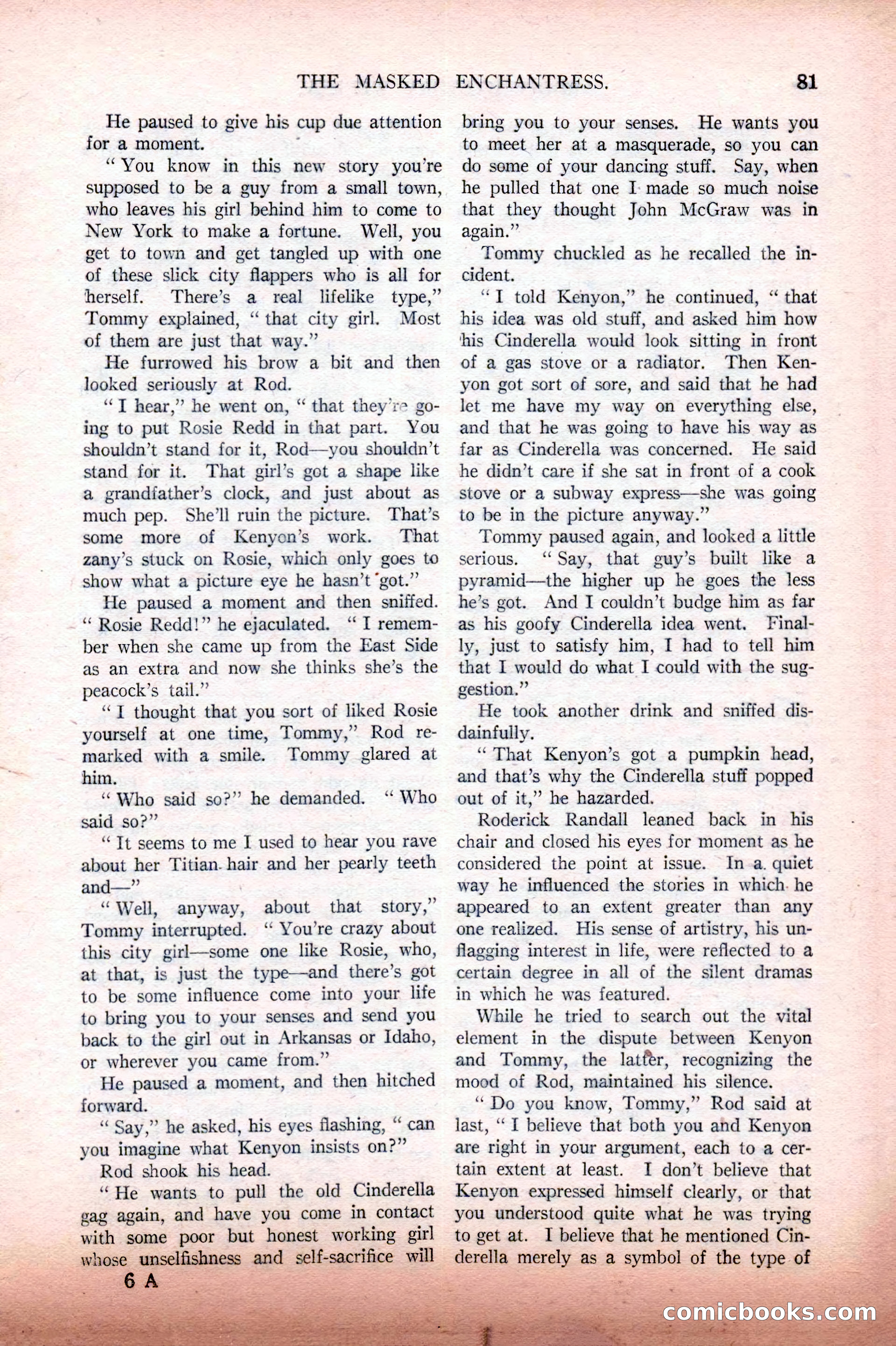
A restored page from Pulp Fiction, 1927. Page through the whole issue in the reader above.
📄 Transcribed text from this page (OCR, searchable)
Machine-transcribed from the original scan — historical spelling and the odd misread are preserved.
x > - en haem te. - with some peers 3 enes pice Se ot = See —— = = > Satie THE MASKED He paused to give his cup due attention for a moment. “You know in this new story you’re supposed to be a guy from a small town, who leaves his girl behind him to come to New York to make a fortune. Well, you get to town and get tangled up with one of these slick city flappers who is all for herself. There’s a real lifelike type,” Tommy explained, “ that city girl. Most of them are just that way.” He furrowed his brow a bit and then looked seriously at Rod. ‘“‘T hear,” he went on, “ that theyre go- ing to put Rosie Redd in that part. You shouldn’t stand for it, Rod—you shouldn’t stand for it. That girl’s got a shape like a grandifather’s clock, and just about as much pep. She’ll ruin the picture. That’s some more of Kenyon’s work. That zany’s stuck on Rosie, which only goes to show what a picture eye he hasn’t ‘got.”’ He paused a moment and then sniffed. ‘“‘ Rosie Redd!” he ejaculated. ‘“ I remem- ber when she came up from the East Side as an extra and now she thinks she’s the peacock’s tail.” “T thought that you sort of liked Rosie yourself at one time, Tommy,” Rod re- marked with a smile. Tommy glared at him. ‘“Who said so?’ he demanded. said so?”’ ‘Tt seems to me I used to hear you rave about her Titian. hair and her pearly teeth and—”’ , “Well, anyway, about that story,” Tommy interrupted. ‘“ You’re crazy about this city girl—some one like Rosie, who, at that, is just the type—and there’s got to be some influence come into your life to bring you to your senses and send you back to the girl out in Arkansas or Idaho, or wherever you came from.” He paused a moment, and then hitched forward. Say, ” he asked, his eyes flashing, “ can you imagine what Kenyon insists on?” Rod shook his head. “He wants to pull the old Cinderella gag again, and have you come in contact ““ Who ENCHANTRESS. 81 bring you to your senses, He wants you to meet her at a masquerade, so you can do seme of your dancing stuff. Say, when he pulled that one I: made so much noise that they thought John McGraw was in again.” Tommy chuckled as he recalled the in- cident. “IT told Kenyon,” he continued, “ that his idea was old stuff, and asked him how ‘his Cinderella would look sitting in front of a gas stove or a radiator. Then Ken- yon got sort of sore, and said that he had let me have my way on everything else, and that he was going to have his way as far as Cinderella was concerned. He said he didn’t care if she sat in front of a cook stove or a subway express—she was going to be in the picture anyway.” Tommy paused again, and looked a little serious. ‘‘ Say, that guy’s built like a pyramid—the higher up he goes the less he’s got. And I couldn’t budge him as far as his goofy Cinderella idea went. Final- ly, just to satisfy him, I had to tell him that I would do what I could with the sug- gestion.” He took another drink and sniffed dis- dainfully. “That Kenyon’s got a pumpkin head, and that’s why the Cinderella stuff popped out of it,” he hazarded. Roderick Randall leaned back in his chair and closed his eyes for moment as he considered the point at issue. Ina. quiet way he influenced the stories in which. he appeared to an extent greater than any one realized. His sense of artistry, his un- flagging interest in life, were reflected to a certain degree in all of the silent dramas in which he was featured. While he tried to search out the vital element in the dispute between Kenyon and Tommy, the latftr, recognizing the mood of Rod, maintained his silence. “Do you know, Tommy,” Rod said at last, ““ I believe that both you and Kenyon are right in your argument, each to a cer- tain extent at least. I don’t believe that Kenyon expressed himself clearly, or that you understood quite what he was trying to eet 4 at. T believe that he mentioned Cin- a eK _— ” SC omichCote com