
Pulp Fiction, 1927 · page 88 of 168
Argosy All-Story Weekly, February 12, 1927 — page 88: what you’re looking at
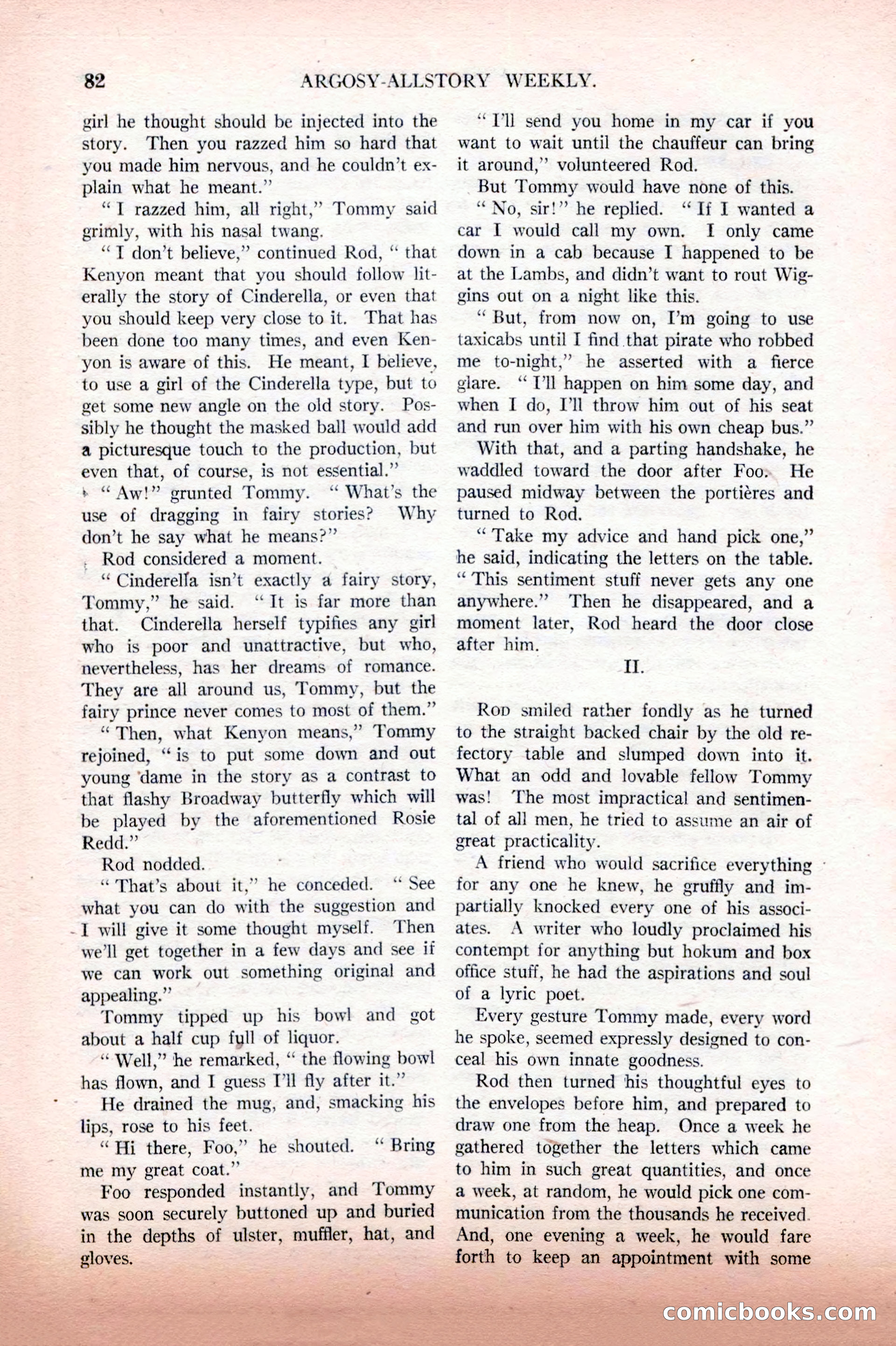
A restored page from Pulp Fiction, 1927. Page through the whole issue in the reader above.
📄 Transcribed text from this page (OCR, searchable)
Machine-transcribed from the original scan — historical spelling and the odd misread are preserved.
f oe . - ies ee ae J See 1 a = ‘a 82 ARGOSY-ALLSTORY WEEKLY. girl he thought should be injected into the story. Then you razzed him so hard that you made him nervous, and he couldn’t ex- plain what he meant.” “T razzed him, all right,’ Tommy said grimly, with his nasal twang. ‘““T don’t believe,” continued Rod, ‘ that Kenyon meant that you should follow lit- erally the story of Cinderella, or even that you should keep very close to it. That has been done too many times, and even Ken- yon is aware of this. He meant, I believe, to use a girl of the Cinderella type, but to get some new angle on the old story. Pos- sibly he thought the masked ball would add a picturesque touch to the production, but even that, of course, is not essential.” » “Aw!” grunted Tommy. “ What’s the use of dragging in fairy stories? Why don’t he say what he means?” . Rod considered a moment. “ Cinderella isn’t exactly a fairy story, Tommy,” he said. “It is far more than that. Cinderella herself typifies any girl who is poor and unattractive, but who, nevertheless, has her dreams of romance. They are all around us, Tommy, but the fairy prince never comes to most of them.” “Then, what Kenyon means,” Tommy rejoined, “is to put some down and out young ‘dame in the story as a contrast to that flashy Broadway butterfly which will be played by the aforementioned Rosie Redd.” Rod nodded. “ That’s about it,” he conceded. “ See what you can do with the suggestion and I will give it some thought myself. Then we'll get together in a few days and see if we can work out something original and appealing.” Tommy tipped up his bowl and got about a half cup full of liquor. “ Well,” he remarked, “ the flowing bowl has flown, and I guess I'll fly after it.” He drained the mug, and, smacking his lips, rose to his feet. “Hi there, Foo,” he shouted. me my great coat.” Foo responded instantly, and Tommy was soon securely buttoned up and buried in the depths of ulster, muffler, hat, and “ Bring = re, 3 sea Cas = eis 2 = s en = as ae ig a a ae "aggre, rm ae a nat 2 te ~ ity egy .— t ates = wee ed _ iS & —_< Se e . K “T’ll send you home in my car if you want to wait until the chauffeur can bring it around,” volunteered Rod. But Tommy would have none of this. ‘No, sir!” he replied. ‘“ If I wanted a car I would call my own. I only came down in a cab because I happened to be at the Lambs, and didn’t want to rout Wig- gins out on a night like this. ‘“ But, from now on, I’m going to use taxicabs until I find that pirate who robbed me to-night,” he asserted with a fierce glare. “Tl happen on him some day, and when I do, I'll throw him out of his seat and run over him with his own cheap bus.” With that, and a parting handshake, he waddled toward the door after Foo: He paused midway between the portiéres and turned to Rod. “Take my advice and hand pick one,” he said, indicating the letters on the table. “This sentiment stuff never gets any one anywhere.” Then he disappeared, and a moment later, Rod heard the door close after him. IT. Rop smiled rather fondly as he turned to the straight backed chair by the old re- fectory table and slumped down into it. What an odd and lovable fellow Tommy was! ‘The most impractical and sentimen- tal of all men, he tried to assume an air of great practicality. A friend who would sacrifice everything - for any one he knew, he gruffly and im- partially knocked every one of his associ- ates. A writer who loudly proclaimed his contempt for anything but hokum and box office stuff, he had the aspirations and soul of a lyric poet. Every gesture Tommy made, every word he spoke, seemed expressly designed to con- ceal his own innate goodness. Rod then turned his thoughtful eyes to the envelopes before him, and prepared to draw one from the heap. Once a week he gathered together the letters which came to him in such great quantities, and once a week, at random, he would pick one com- munication from the thousands he received. And, one evening a week, he would fare