
Pulp Fiction, 1927 · page 9 of 168
Argosy All-Story Weekly, February 12, 1927 — page 9: what you’re looking at
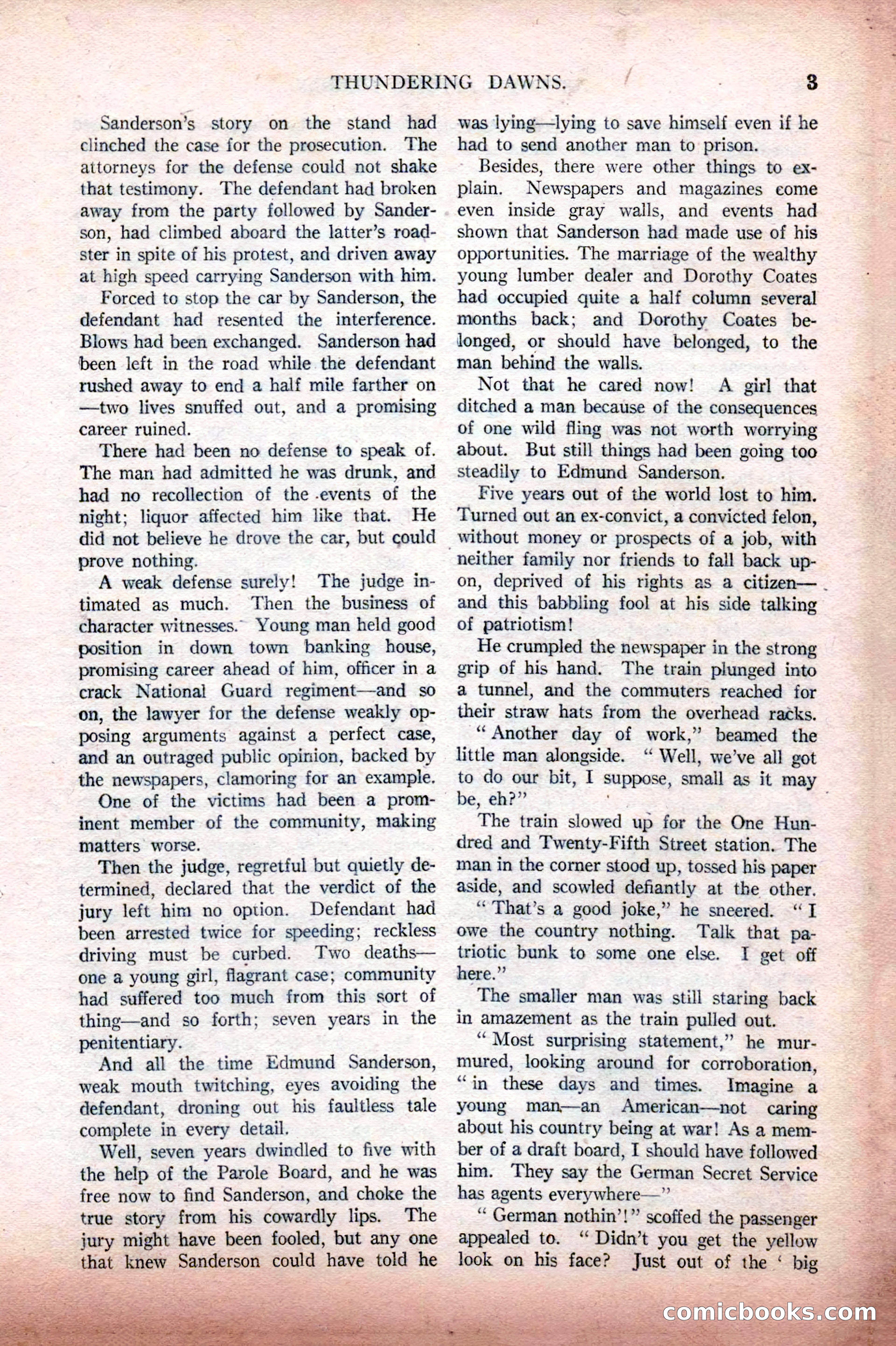
A restored page from Pulp Fiction, 1927. Page through the whole issue in the reader above.
📄 Transcribed text from this page (OCR, searchable)
Machine-transcribed from the original scan — historical spelling and the odd misread are preserved.
THUNDERING DAWNS. f 3 3 Sanderson’s story on the stand had clinched the case for the prosecution. The attorneys for the defense could not shake that testimony. The defendant had broken away from the party followed by Sander- son, had climbed aboard the latter’s road- ster in spite of his protest, and driven away at high speed carrying Sanderson with him. Forced to stop the car by Sanderson, the defendant had resented the interference. Blows had been exchanged. Sanderson had been left in the road while the defendant rushed away to end a half mile farther on —two lives snuffed out, and a promising career ruined. There had been no defense to speak of. The man had admitted he was drunk, and had no recollection of the -events of the night; liquor affected him like that. He did not believe he drove the car, but could prove nothing. A weak defense surely! The judge in- timated as much. Then the business of character witnesses. Young man held good position in down town banking house, promising career ahead of him, officer in a crack National Guard regiment—and so on, the lawyer for the defense weakly op- posing arguments against a perfect case, and an outraged public opinion, backed by the newspapers, clamoring for an example. One of the victims had been a prom- inent member of the community, making matters worse. Then the judge, regretful but quietly de- termined, declared that the verdict of the jury left him no option. Defendant had been arrested twice for speeding; reckless driving must be curbed. Two deaths— one a young girl, flagrant case; community had suffered too much from this sort of thing—and so forth; seven years in the penitentiary. And all the time Edmund Sanderson, weak mouth twitching, eyes avoiding the defendant, droning out his faultless tale complete in every detail. Well, seven years dwindled to five with the help of the Parole Board, and he was free now to find Sanderson, and choke the true story from his cowardly lips. The jury might have been fooled, but any one _ that BREW. Sanderson could have told he ——< = iS a ee = = Boks be Pri ee Cat ae roe = y Ey Se : : aan SS _— ae! oe Se cans — —* ms py a Sh a ei awe a ~ ~ =e - ous te a z. Fe a > . at <=» ~~ ee uP) = a Sa. pe se a i oo ee = ~ bl aa pees ge i= ae was lying—lying to save himself even if he had to send another man to prison. - Besides, there were other things to ex- plain. Newspapers and magazines eome even inside gray walls, and events had shown that Sanderson had made use of his opportunities. The marriage of the wealthy young lumber dealer and Dorothy Coates had occupied quite a half column several months back; and Dorothy Coates be- longed, or should have belonged, to the man behind the walls. Not that he cared now! A girl that ditched a man because of the consequences of one wild fling was not worth worrying about. But still things had been going too steadily to Edmund Sanderson. Five years out of the world lost to him. Turned out an ex-convict, a convicted felon, without money or prospects of a job, with “neither family nor friends to fall back up- on, deprived of his rights as a citizen— - and this babbling fool at his side talking of patriotism! He crumpled the newspaper in the strong grip of his hand. The train plunged into a tunnel, and the commuters reached for their straw hats from the overhead racks. “Another day of work,” beamed the little man alongside. “ Well, we’ve all got to do our bit, I Suppose, small as it may be, eh?” The train slowed up for the One Hun- dred and Twenty-Fifth Street station. The man in the corner stood up, tossed his paper aside, and scowled defiantly at the other. “ That’s a good joke,” he sneered. “I owe the country nothing. Talk that pa- triotic bunk to some one else. I get off here.”’ The smaller man was still staring back in amazement as the train pulled out. “Most surprising statement,” he mur- mured, looking around for corroboration, ‘in these days and times. Imagine a young man—an American—not caring about his country being at war! As a mem- ber of a draft board, I should have followed him. They say the German Secret Service has agents everywhere—”’ “ German nothin’!” scoffed the passenger appealed to. “ Didn’t you get the yellow look on his face? Just out of the | ‘big = | rie eee = as a. raed 0 (el ooye