
Pulp Fiction, 1927 · page 98 of 168
Argosy All-Story Weekly, February 12, 1927 — page 98: what you’re looking at
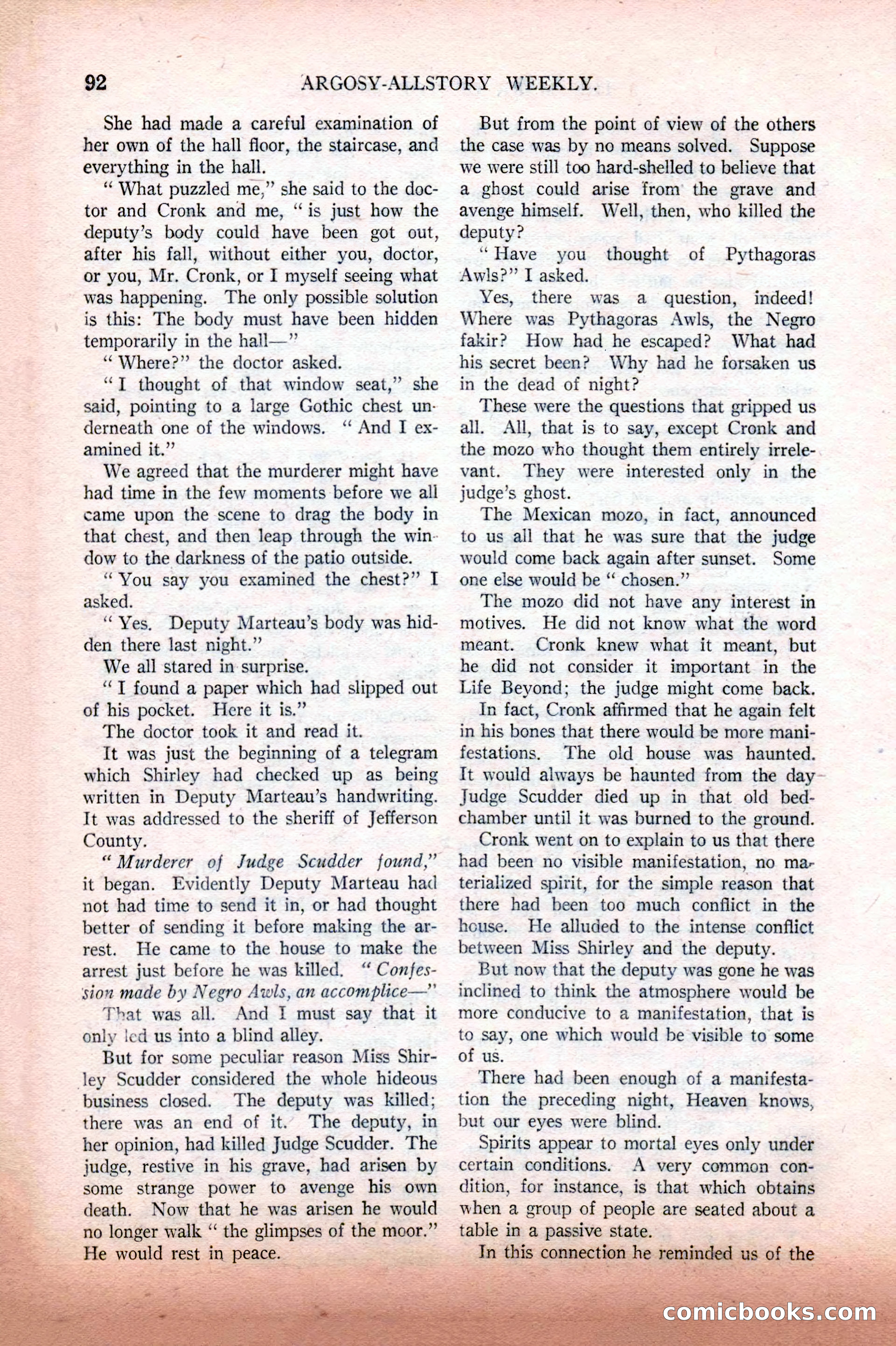
A restored page from Pulp Fiction, 1927. Page through the whole issue in the reader above.
📄 Transcribed text from this page (OCR, searchable)
Machine-transcribed from the original scan — historical spelling and the odd misread are preserved.
92 ARGOSY-ALLSTORY WEEKLY. She had made a careful examination of her own of the hall floor, the staircase, and everything in the hall. ‘What puzzled me,” she said to the doc- tor and Cronk and me, “is just how the deputy’s body could have been got out, after his fall, without either you, doctor, or you, Mr. Cronk, or I myself seeing what was happening. The only possible solution is this: The body must have been hidden temporarily in the hall—’”’ “Where?” the doctor asked. “J thought of that window seat,’ she said, pointing to a large Gothic chest un- derneath one of the windows. ‘“ And I ex- amined it.” We agreed that the murderer might have had time in the few moments before we all came upon the scene to drag the body in that chest, and then leap through the win- dow to the darkness of the patio outside. “You say you examined the chest?” I asked. “Yes. Deputy Marteau’s body was hid- den there last night.” We all stared in surprise. “T found a paper which had slipped out of his pocket. Here it is.” The doctor took it and read it. It was just the beginning of a telegram which Shirley had checked up as being written in Deputy Marteau’s handwriting. It was addressed to the sheriff of Jefferson County. “ Murderer of Judge Scudder found,” it began. Evidently Deputy Marteau hac not had time to send it in, or had thought better of sending it before making the ar- rest. He came to the house to make the arrest just before he was killed. “ Confes- sion made by Negro Awls, an accomplice—”’ That was all. And I must say that it only led us into a blind alley. But for some peculiar reason Miss Shir- ley Scudder considered the whole hideous business closed. The deputy was killed; there was an end of it. The deputy, in her opinion, had killed Judge Scudder. The judge, restive in his grave, had arisen by some strange power to avenge his own death. Now that he was arisen he would no longer walk ‘‘ the a 3a es moor. = 3 ie gad Le a eee Te ae ae —— sa eae But from the point of view of the others the case was by no means solved. Suppose we were still too hard-shelled to believe that a ghost could arise from the grave and avenge himself. Well, then, who killed the deputy? ‘Have you thought of Pythagoras Awls?”’ I asked. Yes, there was a question, indeed! Where was Pythagoras Awls, the Negro fakir? How had he escaped? What had his secret been? Why had he forsaken us in the dead of night? These were the questions that gripped us all. All, that is to say, except Cronk and the mozo who thought them entirely irrele- vant. They were interested only in the judge’s ghost. The Mexican mozo, in fact, announced to us all that he was sure that the judge would come back again after sunset. Some one else would be “ chosen.” The mozo did not have any interest in motives. He did not know what the word meant. Cronk knew what it meant, but he did not consider it important in the Life Beyond; the judge might come back. In fact, Cronk affirmed that he again felt in his bones that there would be more mani- festations. The old house was haunted. It would always be haunted from the day- Judge Scudder died up in that old bed- chamber until it was burned to the ground. Cronk went on to explain to us that there had been no visible manifestation, no ma- terialized spirit, for the simple reason that there had been too much conflict in the house. He alluded to the intense conflict between Miss Shirley and the deputy. But now that the deputy was gone he was inclined to think the atmosphere would be more conducive to a manifestation, that is to say, one which would be visible to some of us. There had been enough of a manifesta- tion the preceding night, Heaven knows, but our eyes were blind. Spirits appear to mortal eyes only under certain conditions. A very common con- dition, for instance, is that which obtains when a group of people are seated about a ieble 3 ina pea Staie es comicbooks.com