
Pulp Fiction, 1927 · page 99 of 168
Argosy All-Story Weekly, February 12, 1927 — page 99: what you’re looking at
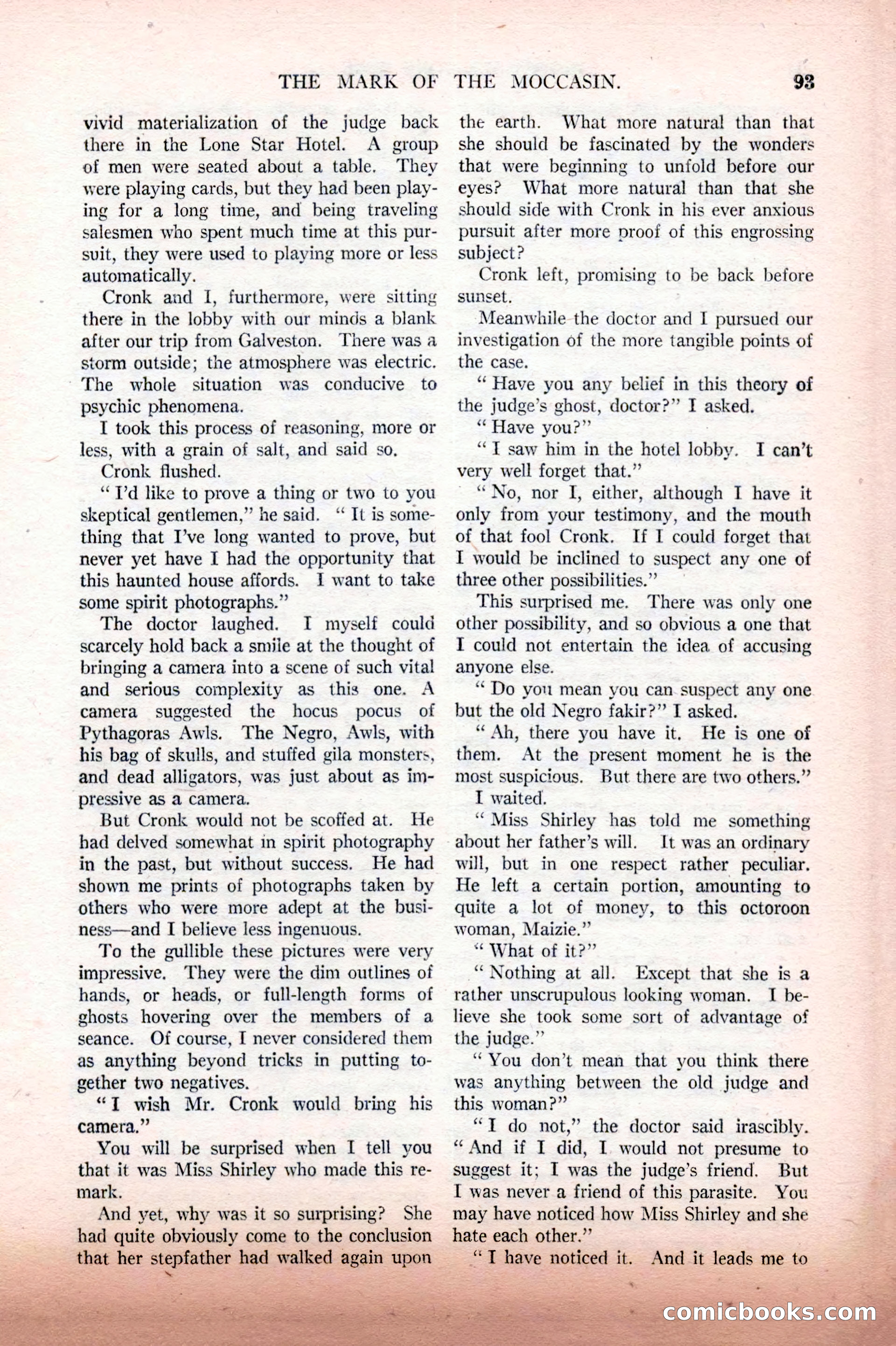
A restored page from Pulp Fiction, 1927. Page through the whole issue in the reader above.
📄 Transcribed text from this page (OCR, searchable)
Machine-transcribed from the original scan — historical spelling and the odd misread are preserved.
THE MARK OF vivid materialization of the judge back there in the Lone Star Hotel. A group of men were seated about a table. They were playing cards, but they had been play- ing for a long time, and being traveling salesmen who spent much time at this pur- suit, they were used to playing more or less automatically. Cronk and I, furthermore, were sitting there in the lobby with our minds a blank after our trip from Galveston. There was a storm outside; the atmosphere was electric. The whole situation was conducive to psychic phenomena. I took this process of reasoning, more or less, with a grain of salt, and said so, Cronk flushed. “Td like to prove a thing or two to you skeptical gentlemen,” he said. ‘ It is some- thing that I’ve long wanted to prove, but never yet have I had the opportunity that this haunted house affords. I want to take some spirit photographs.” The doctor laughed. I myself could scarcely hold back a smile at the thought of bringing a camera into a scene of such vital and serious complexity as this one. A camera suggested the hocus pocus of Pythagoras Awls. The Negro, Awls, with his bag of skulls, and stuffed gila monsters, and dead alligators, was just about as im- pressive as a camera. But Cronk would not be scoffed at. He had delved somewhat in spirit photography in the past, but without success. He had shown me prints of photographs taken by others who were more adept at the busi- ness—and I believe less ingenuous. To the gullible these pictures were very impressive. They were the dim outlines of hands, or heads, or full-length forms of ghosts hovering over the members of a seance. Of course, I never considered them as anything beyond tricks in putting to- gether two negatives. “J wish Mr. Cronk would bring his camera.” You will be surprised when I tell you that it was Miss Shirley who made this re- mark. And yet, why was it so surprising? She te ob vi usly come to a Be conclusion THE MOCCASIN. 93 the earth. What more natural than that she should be fascinated by the wonders that were beginning to unfold before our eyes? What more natural than that she should side with Cronk in his ever anxious pursuit after more proof of this engrossing subject? Cronk left, promising to be back before sunset. Meanwhile the doctor and I pursued our investigation of the more tangible points of the case. ‘““ Have you any belief in this theory of the judge’s ghost, doctor?” I asked. ‘“* Have you?” ‘““T saw him in the hotel lobby. very well forget that.” ~ “No, nor I, either, although I have it only from your testimony, and the mouth of that fool Cronk. If I could forget that I would be inclined to suspect any one of three other possibilities.” This surprised me. There was only one other possibility, and so obvious a one that I could not entertain the idea of accusing anyone else. “Do you mean you can suspect any one but the old Negro fakir?” I asked. “Ah, there you have it. He is one of them. At the present moment he is the most suspicious. But there are two others.” I waited. “Miss Shirley has told me something about her father’s will. It was an ordinary will, but in one respect rather peculiar. He left a certain portion, amounting to quite a lot of money, to this octoroon woman, Maizie.”’ ** What of it?” “Nothing at all. Except that she is a rather unscrupulous looking woman. I be- lieve she took some sort of advantage of the judge.”’ “You don’t mean that you think there was anything between the old judge and this woman?” “1 do not,” the doctor said irascibly. “And if I did, I would not presume to suggest it; I was the judge’s friend. But I was never a friend of this parasite. You may have noticed how Miss Shirley and she hate each gS a T can’t Fea ichooe com