
Pulp Fiction, 1927 · page 138 of 180
Argosy All-Story Weekly, Vol. 189, No. 4 — page 138: what you’re looking at
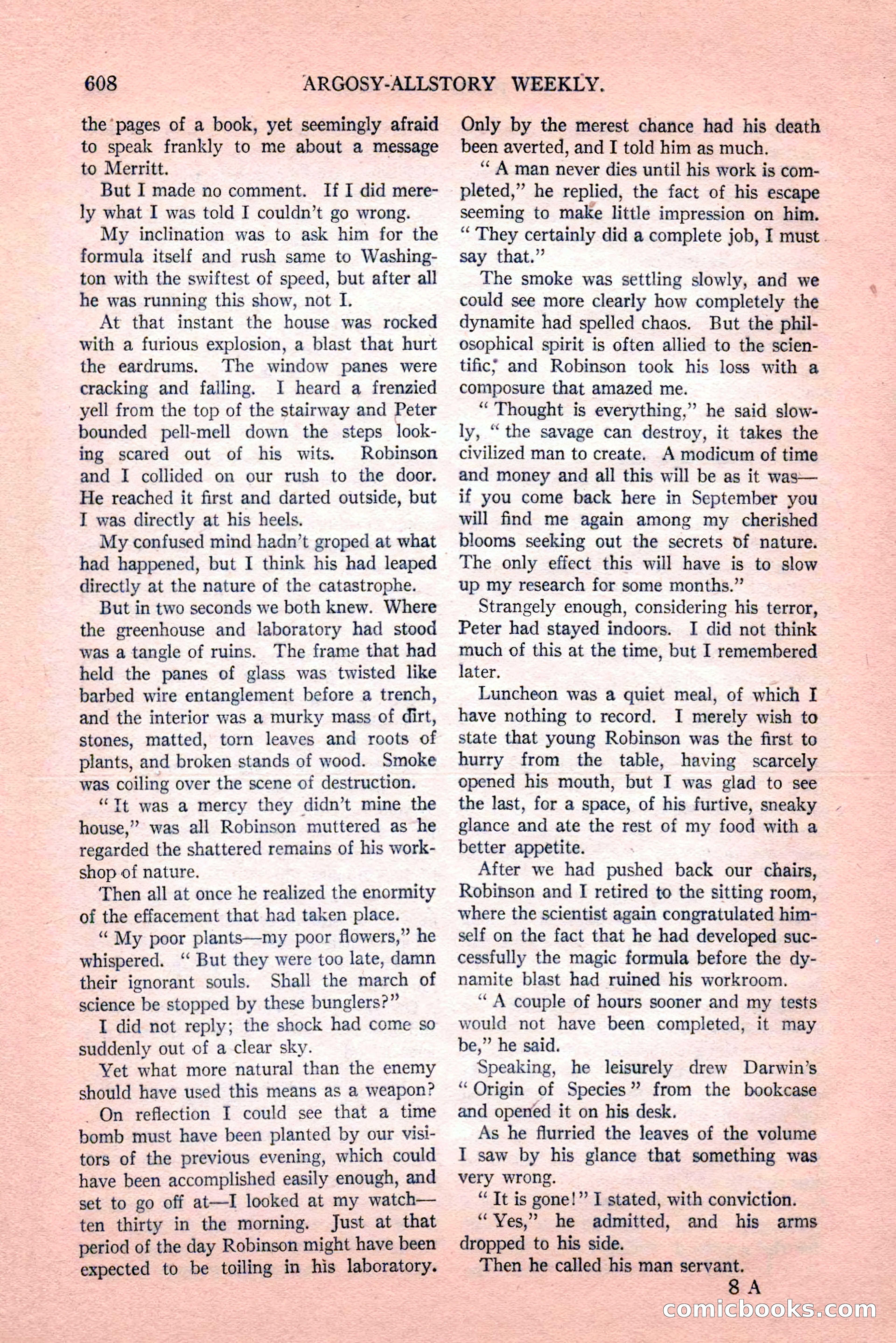
A restored page from Pulp Fiction, 1927. Page through the whole issue in the reader above.
📄 Transcribed text from this page (OCR, searchable)
Machine-transcribed from the original scan — historical spelling and the odd misread are preserved.
608 the pages of a book, yet seemingly afraid to speak frankly to me about a message to Merritt. But I made no comment. If I did mere- ly what I was told I couldn’t go wrong. My inclination was to ask him for the formula itself and rush same to Washing- ton with the swiftest of speed, but after all he was running this show, not I. At that instant the house was rocked with a furious explosion, a blast that hurt the eardrums. The window panes were cracking and falling. I heard a frenzied yell from the top of the stairway and Peter bounded pell-mell down the steps look- ing scared out of his wits. Robinson and I collided on our rush to the door. He reached it first and darted outside, but I was directly at his heels. My confused mind hadn’t groped at what had happened, but I think his had leaped directly at the nature of the catastrophe. But in two seconds we both knew. Where the greenhouse and laboratory had stood was a tangle of ruins. The frame that had held the panes of glass was twisted like barbed wire entanglement before a trench, and the interior was a murky mass of dirt, stones, matted, torn leaves and roots of plants, and broken stands of wood. Smoke was coiling over the scene of destruction. “Tt was a mercy they didn’t mine the house,” was all Robinson muttered as he regarded the shattered remains of his work- shop of nature. Then all at once he realized the enormity of the effacement that had taken place. “ My poor plants—my poor flowers,” he whispered. ‘‘ But they were too late, damn their ignorant souls. Shall the march of science be stopped by these bunglers?” I did not reply; the shock had come so suddenly out of a clear sky. Yet what more natural than the enemy should have used this means as a weapon? On reflection I could see that a time bomb must have been planted by our visi- tors of the previous evening, which could have been accomplished easily enough, and set to go off at—I looked at my watch— ten thirty in the morning. Just at that period of the day Robinson might have been expected to be toiling in his laboratory. ARGOSY-ALLSTORY WEEKLY. Only by the merest chance had his death been averted, and I told him as much. “A man never dies until his work is com- pleted,” he replied, the fact of his escape seeming to make little impression on him. “They certainly did a complete job, I must. say that.” The smoke was settling slowly, and we could see more clearly how completely the dynamite had spelled chaos. But the phil- osophical spirit is often allied to the scien- tific’ and Robinson took his loss with a composure that amazed me. “Thought is everything,” he said slow- ly, “the savage can destroy, it takes the civilized man to create. A modicum of time and money and all this will be as it wags— if you come back here in September you will find me again among my cherished blooms seeking out the secrets of nature. The only effect this will have is to slow up my research for some months.” Strangely enough, considering his terror, Peter had stayed indoors. I did not think much of this at the time, but I remembered later. Luncheon was a quiet meal, of which I have nothing to record. I merely wish to state that young Robinson was the first to hurry from the table, having scarcely opened his mouth, but I was glad to see the last, for a space, of his furtive, sneaky glance and ate the rest of my food with a better appetite. After we had pushed back our chairs, Robinson and I retired to the sitting room, where the scientist again congratulated him- self on the fact that he had developed suc- cessfully the magic formula before the dy- namite blast had ruined his workroom. ‘““A couple of hours sooner and my tests would not have been completed, it may be,” he said. Speaking, he leisurely drew Darwin’s “ Origin of Species” from the bookcase and opened it on his desk. As he flurried the leaves of the volume I saw by his glance that something was very wrong. “ It is gone!” I stated, with conviction. “Yes,” he admitted, and his arms dropped to his side. Then he called his man servant. 8A cComicbooks (E(O)