
Pulp Fiction, 1927 · page 139 of 180
Argosy All-Story Weekly, Vol. 189, No. 4 — page 139: what you’re looking at
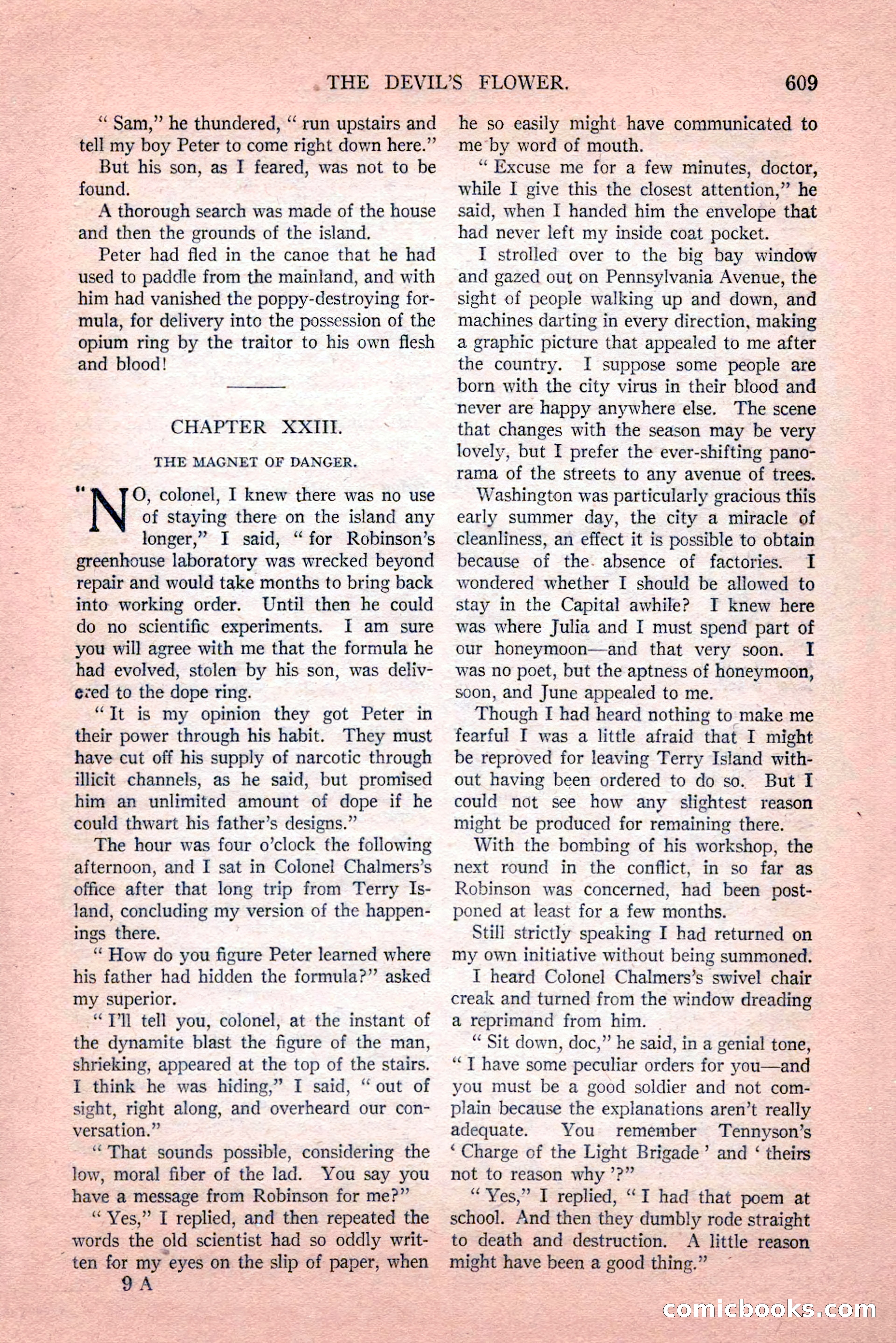
A restored page from Pulp Fiction, 1927. Page through the whole issue in the reader above.
📄 Transcribed text from this page (OCR, searchable)
Machine-transcribed from the original scan — historical spelling and the odd misread are preserved.
. THE DEVIL’S FLOWER. “Sam,” he thundered, “ run upstairs and tell my boy Peter to come right down here.” But his son, as I feared, was not to be found. A thorough search was made of the house and then the grounds of the island. Peter had fled in the canoe that he had used to paddle from the mainland, and with him had vanished the poppy-destroying for- mula, for delivery into the possession of the opium ring by the traitor to his own flesh and blood! ee CHAPTER XXIII. THE MAGNET OF DANGER. ¥ O, colonel, I knew there was no use of staying there on the island any longer,” I said, “‘ for Robinson’s greenhouse laboratory was wrecked beyond repair and would take months to bring back into working order. Until then he could do no scientific experiments. I am sure you will agree with me that the formula he had evolved, stolen by his son, was deliv- ezed to the dope ring. “Tt is my opinion they got Peter in their power through his habit. They must have cut off his supply of narcotic through illicit channels, as he said, but promised him an unlimited amount of dope if he could thwart his father’s designs.” The hour was four o’clock fhe following afternoon, and I sat in Colonel Chalmers’s office after that long trip from Terry Is- land, concluding my version of the happen- ings there. “How do you figure Peter learned where his father had hidden the formula?” asked my superior. “Tl tell you, colonel, at the instant of the dynamite blast the figure of the man, shrieking, appeared at the top of the stairs. I think he was hiding,” I said, “ out of sight, right along, and overheard our con- versation.” “That sounds possible, considering the low, moral fiber of the lad. You say you have a message from Robinson for me?” “Yes,” I replied, and then repeated the words the old scientist had so oddly writ- ten for my eyes on the slip of paper, when 609 he so easily might have communicated to me by word of mouth. “Excuse me for a few minutes, doctor, while I give this the closest attention,” he said, when I handed him the envelope that had never left my inside coat pocket. I strolled over to the big bay window and gazed out on Pennsylvania Avenue, the sight of people walking up and down, and machines darting in every direction, making a graphic picture that appealed to me after the country. I suppose some people are born with the city virus in their blood and never are happy anywhere else. The scene that changes with the season may be very lovely, but I prefer the ever-shifting pano- rama of the streets to any avenue of trees. Washington was particularly gracious this early summer day, the city a miracle of cleanliness, an effect it is possible to obtain because of the. absence of factories. I wondered whether I should be allowed to stay in the Capital awhile? JI knew here was where Julia and I must spend part of our honeymoon—and that very soon. I was no poet, but the aptness of honeymoon, soon, and June appealed to me. Though I had heard nothing to make me fearful I was a little afraid that I might be reproved for leaving Terry Island with- out having been ordered to do so. But I could not see how any slightest reason might be produced for remaining there. With the bombing of his workshop, the next round in the conflict, in so far as Robinson was concerned, had been post- poned at least for a few months. Still strictly speaking I had returned on my own initiative without being summoned. I heard Colonel Chalmers’s swivel chair creak and turned from the window dreading a reprimand from him. - “Sit down, doc,” he said, in a genial tone, ‘“T have some peculiar orders for you—and you must be a good soldier and not com- plain because the explanations aren’t really adequate. You remember Tennyson’s ‘Charge of the Light Brigade’ and ‘ theirs not to reason why ’?” “Yes,” I replied, “I had that poem at school. And then they dumbly rode straight to death and destruction. A little reason might have been a good thing.” Eomichbooks (E(@)