
Pulp Fiction, 1927 · page 150 of 180
Argosy All-Story Weekly, Vol. 189, No. 4 — page 150: what you’re looking at
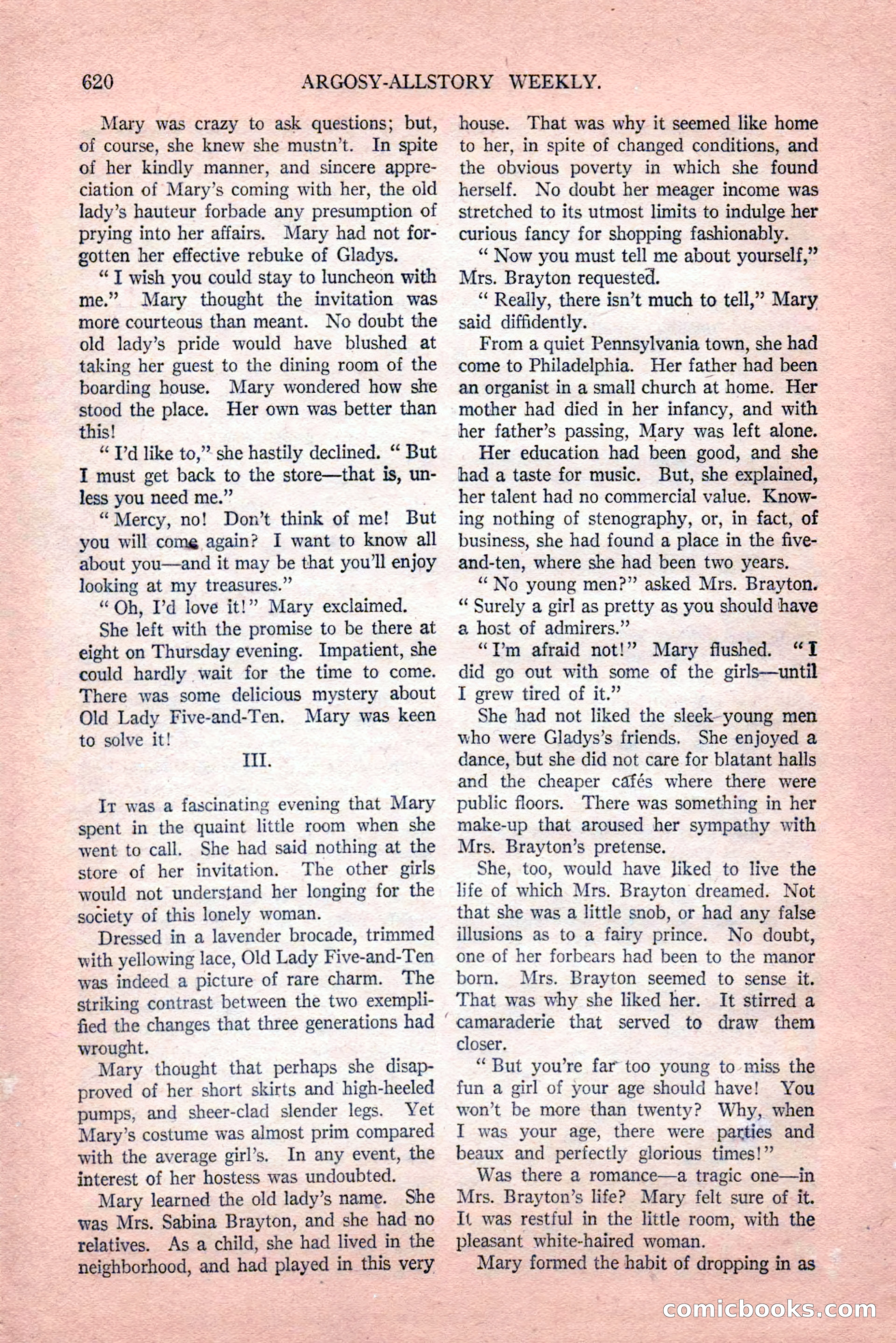
A restored page from Pulp Fiction, 1927. Page through the whole issue in the reader above.
📄 Transcribed text from this page (OCR, searchable)
Machine-transcribed from the original scan — historical spelling and the odd misread are preserved.
620 Mary was crazy to ask questions; but, of course, she knew she mustn’t. In spite of her kindly manner, and sincere appre- ciation of Mary’s coming with her, the old lady’s hauteur forbade any presumption of prying into her affairs. Mary had not for- gotten her effective rebuke of Gladys. “T wish you could stay to luncheon with me.” Mary thought the invitation was more courteous than meant. No doubt the old lady’s pride would have blushed at taking her guest to the dining room of the boarding house. Mary wondered how she stood the place. Her own was better than this! “ T’d like to,” she hastily declined. “ But I must get back to the store—that is, un- less you need me.” 3 “Mercy, no! Don’t think of me! But you will comg again? I want to know all about you—and it may be that you'll enjoy looking at my treasures.” “Oh, I’d love it!” Mary exclaimed. She left with the promise to be there at eight on Thursday evening. Impatient, she could hardly wait for the time to come. There was some delicious mystery about Old Lady Five-and-Ten. Mary was keen to solve it! III. Ir was a fascinating evening that Mary spent in the quaint little room when she went to call. She had said nothing at the store of her invitation. The other girls would not understand her longing for the society of this lonely woman. Dressed in a lavender brocade, trimmed with yellowing lace, Old Lady Five-and-Ten was indeed a picture of rare charm. The striking contrast between the two exempli- fied the changes that three generations had wrought. Mary thought that perhaps she disap- proved of her short skirts and high-heeled pumps, and sheer-clad slender legs. Yet Mary’s costume was almost prim compared with the average girl’s. In any event, the interest of her hostess was undoubted. Mary learned the old lady’s name. She was Mrs. Sabina Brayton, and she had no relatives. As a child, she had lived in the neighborhood, and had played in this very ARGOSY-ALLSTORY WEEKLY. house. That was why it seemed like home to her, in spite of changed conditions, and the obvious poverty in which she found herself. No doubt her meager income was stretched to its utmost limits to indulge her curious fancy for shopping fashionably. “ Now you must tell me about yourself,” Mrs. Brayton requested. “ Really, there isn’t much to tell,” Mary said diffidently. | From a quiet Pennsylvania town, she had come to Philadelphia. Her father had been an organist in a small church at home. Her mother had died in her infancy, and with her father’s passing, Mary was left alone. Her education had been good, and she had a taste for music. But, she explained, her talent had no commercial value. Know- ing nothing of stenography, or, in fact, of business, she had found a place in the five- and-ten, where she had been two years. ““No young men?” asked Mrs. Brayton. “ Surely a girl as pretty as you should have a host of admirers.” “Tm afraid not!” Mary flushed. “T did go out with some of the girls—until I grew tired of it.” She had not liked the sleek-young men who were Gladys’s friends. She enjoyed a dance, but she did not care for blatant halls and the cheaper cafés where there were public floors. There was something in her make-up that aroused her sympathy with Mrs. Brayton’s pretense. She, too, would have Jiked to live the life of which Mrs. Brayton dreamed. Not that she was a little snob, or had any false illusions as to a fairy prince. No doubt, one of her forbears had been to the manor born. Mrs. Brayton seemed to sense it. That was why she liked her. It stirred a ‘ camaraderie that served to draw them closer. “ But you’re far too young to miss the fun a girl of your age should have! You won’t be more than twenty? Why, when I was your age, there were parties and beaux and perfectly glorious times!” Was there a romance—a tragic one—in Mrs. Brayton’s life? Mary felt sure of it. It was restful in the little room, with the pleasant white-haired woman. Mary formed the habit of dropping in as Gomichooks.co =e