
Pulp Fiction, 1927 · page 151 of 180
Argosy All-Story Weekly, Vol. 189, No. 4 — page 151: what you’re looking at
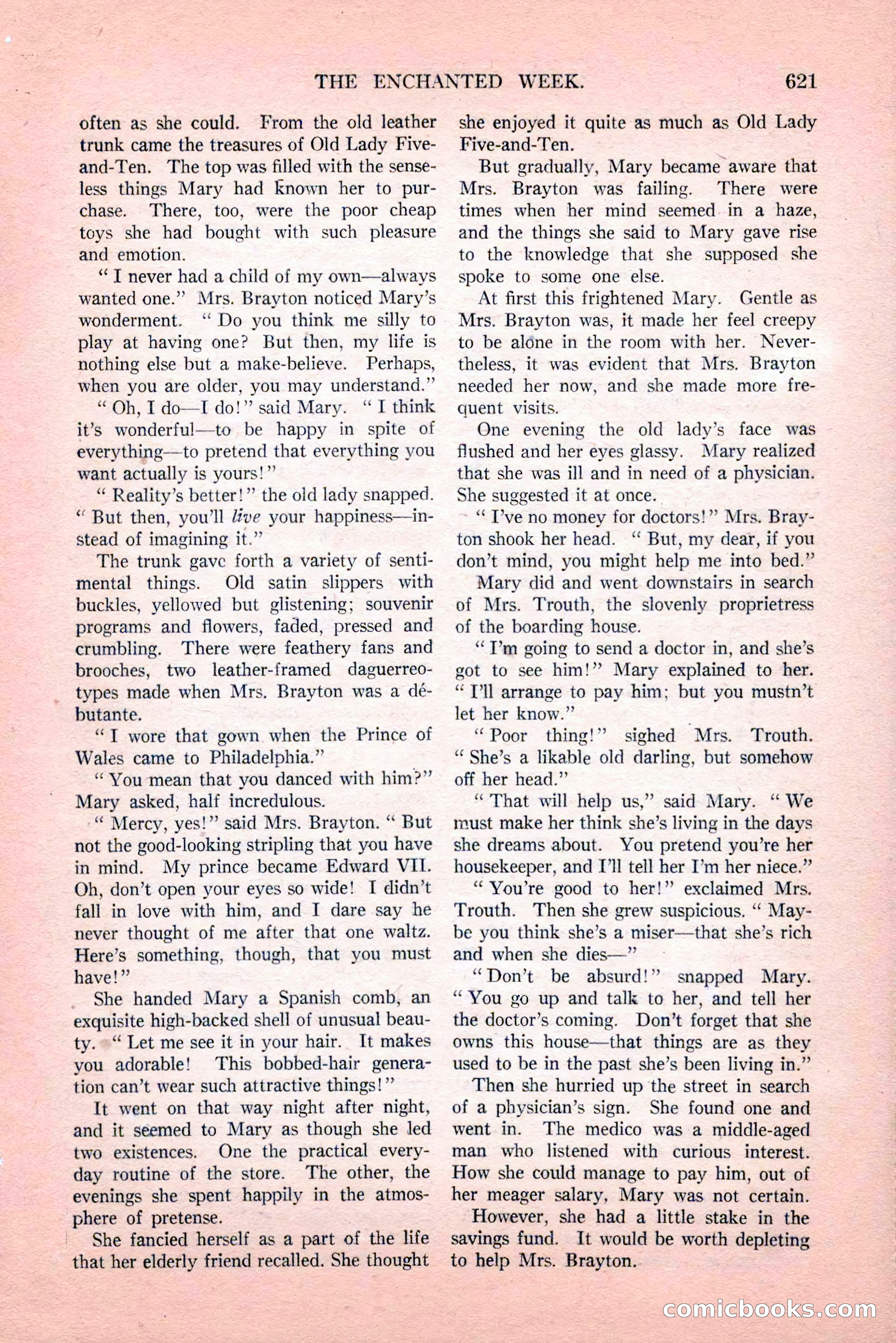
A restored page from Pulp Fiction, 1927. Page through the whole issue in the reader above.
📄 Transcribed text from this page (OCR, searchable)
Machine-transcribed from the original scan — historical spelling and the odd misread are preserved.
THE ENCHANTED WEEK. often as she could. From the old leather trunk came the treasures of Old Lady Five- and-Ten. The top was filled with the sense- less things Mary had known her to pur- chase. There, too, were the poor cheap toys she had bought with such pleasure and emotion. “{ never had a child of my own—always wanted one.”’ Mrs. Brayton noticed Mary’s wonderment. ‘‘ Do you think me silly to play at having one? But then, my life is nothing else but a make-believe. Perhaps, when you are older, you may understand.” “Oh, I do—I do!” said Mary. “I think it’s wonderful—to be happy in spite of everything—to pretend that everything you want actually is yours!”’ “ Reality’s better!” the old lady snapped. “ But then, you’ll #ve your happiness—in- stead of imagining it.” The trunk gave forth a variety of senti- mental things. Old satin slippers with buckles, yellowed but glistening; souvenir programs and flowers, faded, pressed and crumbling. There were feathery fans and brooches, two leather-framed daguerreo- types made when Mrs. Brayton was a dé- butante. “T wore that gown when the Prince of Wales came to Philadelphia.” “You mean that you danced with him?” Mary asked, half incredulous. “ Mercy, yes!” said Mrs. Brayton. “ But not the good-looking stripling that you have in mind. My prince became Edward VII. Oh, don’t open your eyes so wide! I didn’t fall in love with him, and I dare say he never thought of me after that one waltz. Here’s something, though, that you must have!” She handed Mary a Spanish comb, an exquisite high-backed shell of unusual beau- ty. -“ Let me see it in your hair. It makes you adorable! This bobbed-hair genera- tion can’t wear such attractive things!” It went on that way night after night, and it seemed to Mary as though she led two existences. One the practical every- day routine of the store. The other, the evenings she spent happily in the atmos- phere of pretense. She fancied herself as a part of the life that her elderly friend recalled. She thought 621 she enjoyed it quite as much as Old Lady Five-and-Ten. But gradually, Mary became aware that Mrs. Brayton was failing. There were times when her mind seemed in a haze, and the things she said to Mary gave rise to the knowledge that she supposed she spoke to some one else. At first this frightened Mary. Gentle as Mrs. Brayton was, it made her feel creepy to be alone in the room with her. Never- theless, it was evident that Mrs. Brayton needed her now, and she made more fre- quent visits. One evening the old lady’s face was flushed and her eyes glassy. Mary realized that she was ill and in need of a physician. She suggested it at once. ‘‘ T’ve no money for doctors!” Mrs. Bray- ton shook her head. ‘‘ But, my dear, if you don’t mind, you might help me into bed.” Mary did and went downstairs in search of Mrs. Trouth, the slovenly proprietress of the boarding house. “T’m going to send a doctor in, and she’s got to see him!” Mary explained to her. “Tl arrange to pay him; but you mustn’t let her know.” “Poor thing!” sighed Mrs. Trouth. ‘““ She’s a likable old darling, but somehow off her head.” “That will help us,” said Mary. “‘ We must make her think she’s living in the days she dreams about. You pretend you’re her housekeeper, and I’ll tell her I’m her niece.” “You’re good to her!” exclaimed Mrs. Trouth. Then she grew suspicious. ‘‘ May- be you think she’s a miser—that she’s rich and when she dies—” “Don’t be absurd!” snapped Mary. “You go up and talk to her, and tell her the doctor’s coming. Don’t forget that she owns this house—that things are as they used to be in the past she’s been living in.” Then she hurried up the street in search of a physician’s sign. She found one and went in. The medico was a middle-aged man who listened with curious interest. How she could manage to pay him, out of her meager salary, Mary was not certain. However, she had a little stake in the savings fund. It would be worth depleting to help Mrs. Brayton. Gomichbooks (E@)