
Pulp Fiction, 1927 · page 137 of 168
Argosy All-Story Weekly, November 12, 1927 — page 137: what you’re looking at
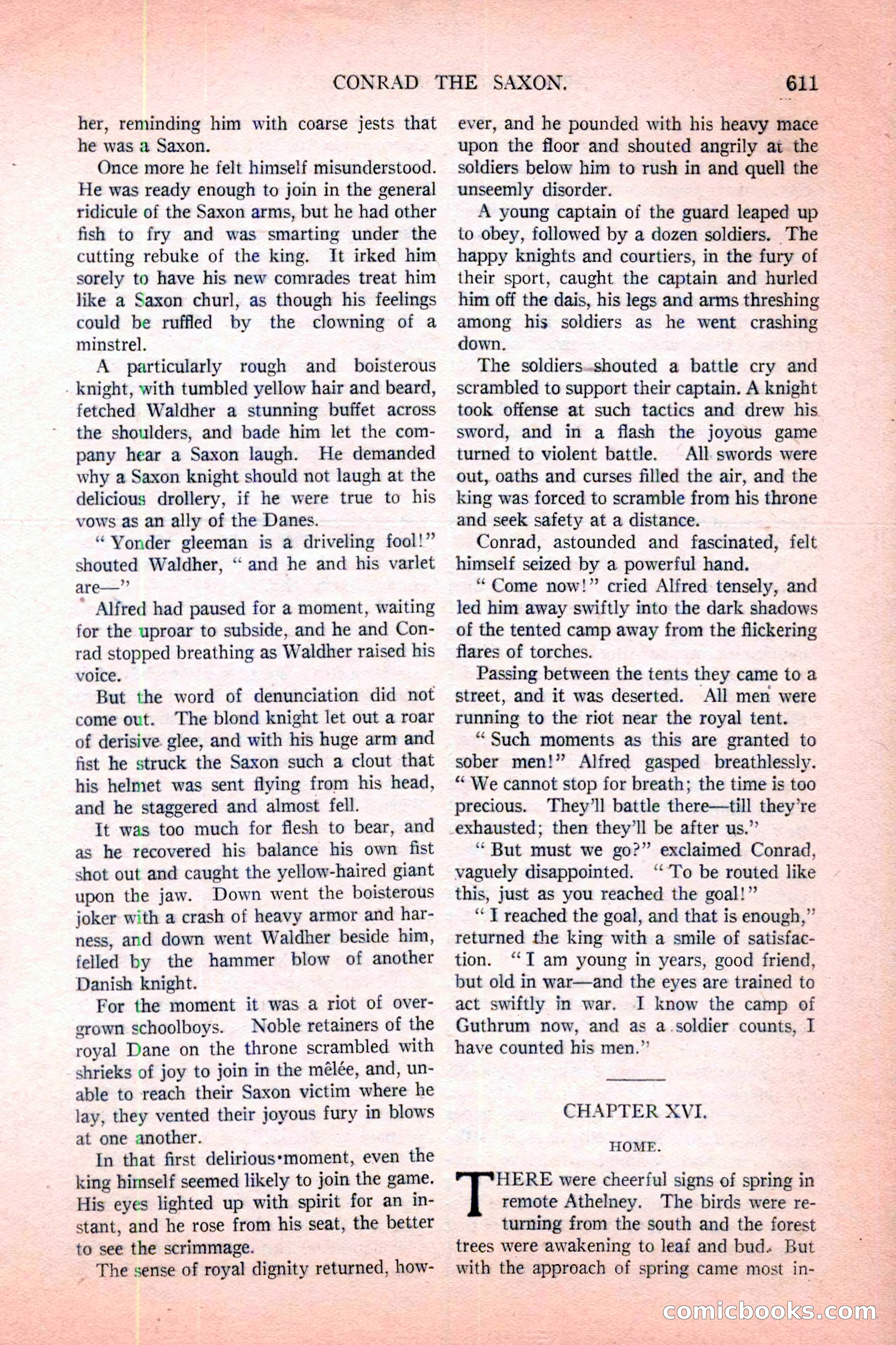
A restored page from Pulp Fiction, 1927. Page through the whole issue in the reader above.
📄 Transcribed text from this page (OCR, searchable)
Machine-transcribed from the original scan — historical spelling and the odd misread are preserved.
CONRAD THE SAXON, her, reminding him with coarse jests that he was a Saxon. Once more he felt himself misunderstood. He was ready enough to join in the general ridicule of the Saxon arms, but he had other fish to fry and was smarting under the cutting rebuke of the king. It irked him sorely to have his new comrades treat him like a Saxon churl, as though his feelings could be ruffled by the clowning of a minstrel. A particularly rough and_ boisterous knight, with tumbled yellow hair and beard, fetched Waldher a stunning buffet across the shoulders, and bade him let the com- pany hear a Saxon laugh. He demanded why a Saxon knight should not laugh at the delicious drollery, if he were true to his vows as an ally of the Danes. “Vonder gleeman is a driveling fool!” shouted Waldher, ‘“ and he and his varlet are—”’ ’ Alfred had paused for a moment, waiting for the uproar to subside, and he and Con- rad stopped breathing as Waldher raised his voice. But the word of denunciation did not come out. The blond knight let out a roar of derisive glee, and with his huge arm and fist he struck the Saxon such a clout that his helmet was sent flying from his head, and he staggered and almost fell. It was too much for flesh to bear, and as he recovered his balance his own fist shot out and caught the yellow-haired giant upon the jaw. Down went the boisterous joker with a crash of heavy armor and har- ness, and down went Waldher beside him, felled by the hammer blow of another Danish knight. For the moment it was a riot of over- grown schoolboys. Noble retainers of the royal Dane on the throne scrambled with shrieks of joy to join in the mélée, and, un- able to reach their Saxon victim where he lay, they vented their joyous fury in blows at one another. In that first deliriousemoment, even the king himself seemed likely to join the game. His eyes lighted up with spirit for an in- stant, and he rose from his seat, the better to see the scrimmage. _ The sense of royal dignity returned, how- ne 611 ever, and he pounded with his heavy mace — upon the floor and shouted angrily at the soldiers below him to rush in and quell the unseemly disorder. A young captain of the guard leaped up to obey, followed by a dozen soldiers. The happy knights and courtiers, in the fury of their sport, caught the captain and hurled him off the dais, his legs and arms threshing among his soldiers as he went crashing down. The soldiers.shouted a battle cry and scrambled to support their captain. A knight took offense at such tactics and drew his sword, and in a flash the joyous game turned to violent battle. All swords were out, oaths and curses filled the air, and the king was forced to scramble from his throne and seek safety at a distance. Conrad, astounded and fascinated, felt himself seized by a powerful hand. “Come now!” cried Alfred tensely, and led him away swiftly into the dark shadows of the tented camp away from the flickering flares of torches. Passing between the tents they came to a street, and it was deserted. All men were running to the riot near the royal tent. “Such moments as this are granted to sober men!” Alfred gasped breathlessly. “We cannot stop for breath; the time is too precious. They’ll battle there—till they’re exhausted; then they’ll be after us.” ‘But must we go?” exclaimed Conrad, vaguely disappointed. ‘“‘ To be routed like this, just as you reached the goal!” ‘““T reached the goal, and that is enough,” returned the king with a smile of satisfac- tion. “TIT am young in years, good friend, but old in war—and the eyes are trained to act swiftly in war. I know the camp of Guthrum now, and as a-soldier counts, I have counted his men.”’ CHAPTER XVI. HOME. HERE were cheerful signs of spring in remote Athelney. The birds were re- turning from the south and the forest trees were awakening to leaf and bud. But with the approach of spring came most in- (e(0) DOOKS mie (E@)