
Pulp Fiction, 1927 · page 138 of 168
Argosy All-Story Weekly, November 12, 1927 — page 138: what you’re looking at
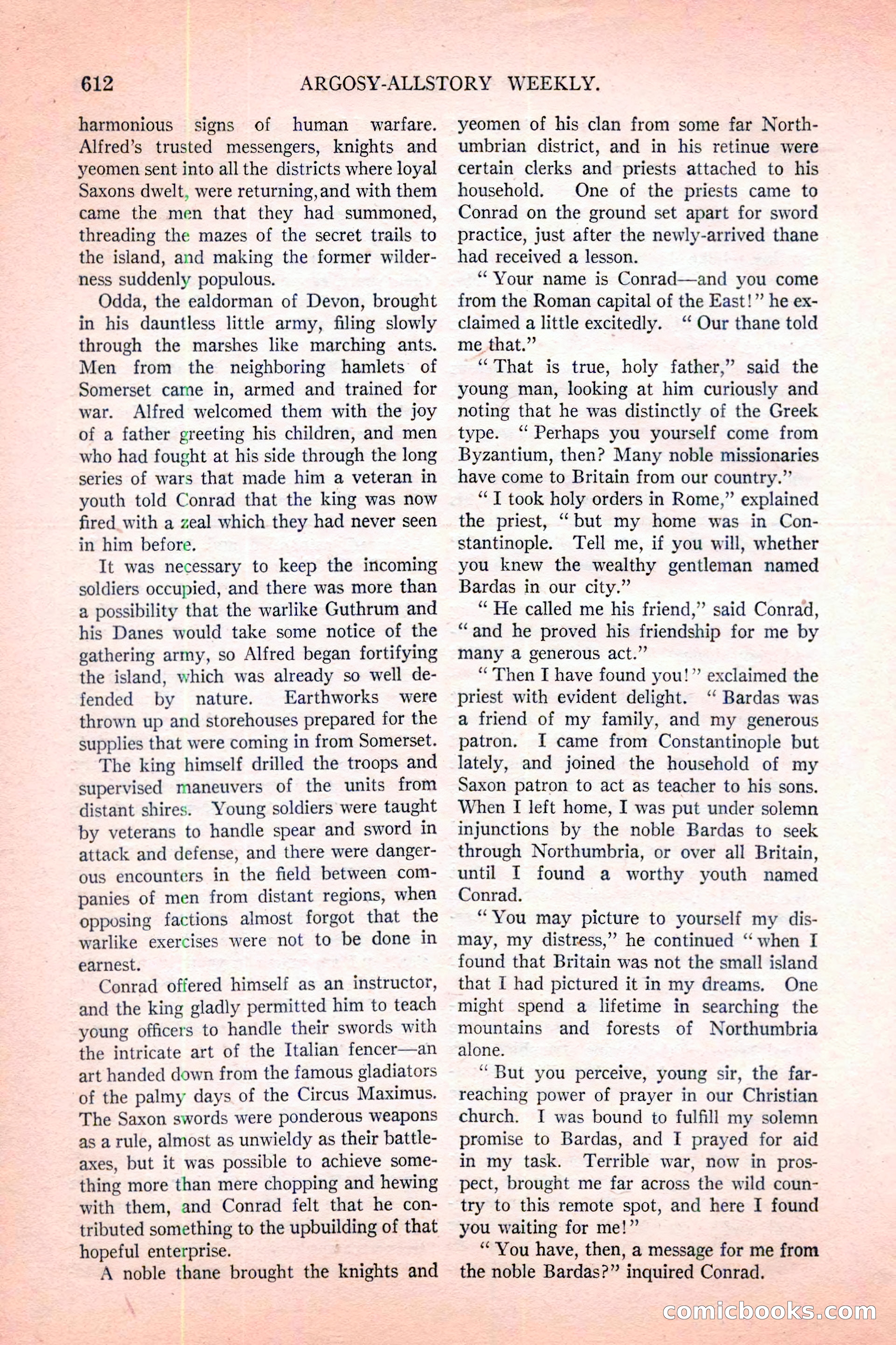
A restored page from Pulp Fiction, 1927. Page through the whole issue in the reader above.
📄 Transcribed text from this page (OCR, searchable)
Machine-transcribed from the original scan — historical spelling and the odd misread are preserved.
612 harmonious signs of human warfare. Alfred’s trusted messengers, knights and yeomen sent into all the districts where loyal Saxons dwelt, were returning,and with them came the men that they had summoned, threading the mazes of the secret trails to the island, and making the former wilder- ness suddenly populous. Odda, the ealdorman of Devon, brought in his dauntless little army, filing slowly through the marshes like marching ants. Men from the neighboring hamlets of Somerset came in, armed and trained for war. Alfred welcomed them with the joy of a father greeting his children, and men who had fought at his side through the long series of wars that made him a veteran in youth told Conrad that the king was now fired with a zeal which they had never seen in him before. It was necessary to keep the incoming soldiers occupied, and there was more than a possibility that the warlike Guthrum and his Danes would take some notice of the gathering army, so Alfred began fortifying the island, which was already so well de- fended by nature. Earthworks were thrown up and storehouses prepared for the supplies that were coming in from Somerset. The king himself drilled the troops and supervised maneuvers of the units from distant shires. Young soldiers were taught by veterans to handle spear and sword in attack and defense, and there were danger- ous encounters in the field between com- panies of men from distant regions, when opposing factions almost forgot that the warlike exercises were not to be done in earnest. Conrad offered himself as an instructor, and the king gladly permitted him to teach young officers to handle their swords with the intricate art of the Italian fencer—an art handed down from the famous gladiators of the palmy days of the Circus Maximus. The Saxon swords were ponderous weapons as arule, almost as unwieldy as their battle- axes, but it was possible to achieve some- thing more than mere chopping and hewing with them, and Conrad felt that he con- tributed something to the upbuilding of that hopeful enterprise. A noble thane brought the knights and ARGOSY-ALLSTORY WEEKLY. yeomen of his clan from some far North- umbrian district, and in his retinue were certain clerks and priests attached to his household. One of the priests came to Conrad on the ground set apart for sword practice, just after the newly-arrived thane had received a lesson. “Your name is Conrad—and you come from the Roman capital of the East!” he ex- claimed a little excitedly. “ Our thane told me that.” “That is true, holy father,” said the young man, looking at him curiously and noting that he was distinctly of the Greek type. ‘“ Perhaps you yourself come from Byzantium, then? Many noble missionaries have come to Britain from our country.” ‘“‘T took holy orders in Rome,” explained the priest, “but my home was in Con- stantinople. Tell me, if you will, whether you knew the wealthy gentleman named Bardas in our city.” “He called me his friend,” said Conrad, “and he proved his friendship for me by many a generous act.” “Then I have found you!” exclaimed the priest with evident delight. ‘‘ Bardas was a friend of my family, and my generous patron. I came from Constantinople but lately, and joined the household of my Saxon patron to act as teacher to his sons. When I left home, I was put under solemn injunctions by the noble Bardas to seek through Northumbria, or over all Britain, until I found a worthy youth named Conrad. “You may picture to yourself my dis- may, my distress,” he continued “ when I found that Britain was not the small island that I had pictured it in my dreams. One might spend a lifetime in searching the mountains and forests of Northumbria alone. ‘But you perceive, young sir, the far- reaching power of prayer in our Christian church. I was bound to fulfill my solemn promise to Bardas, and I prayed for aid in my task. Terrible war, now in pros- pect, brought me far across the wild coun- try to this remote spot, and here I found you waiting for me!” “You have, then, a message for me from the noble Bardas?” inquired Conrad. (S@) mie cS DOO (E@)