
Pulp Fiction, 1927 · page 149 of 168
Argosy All-Story Weekly, November 12, 1927 — page 149: what you’re looking at
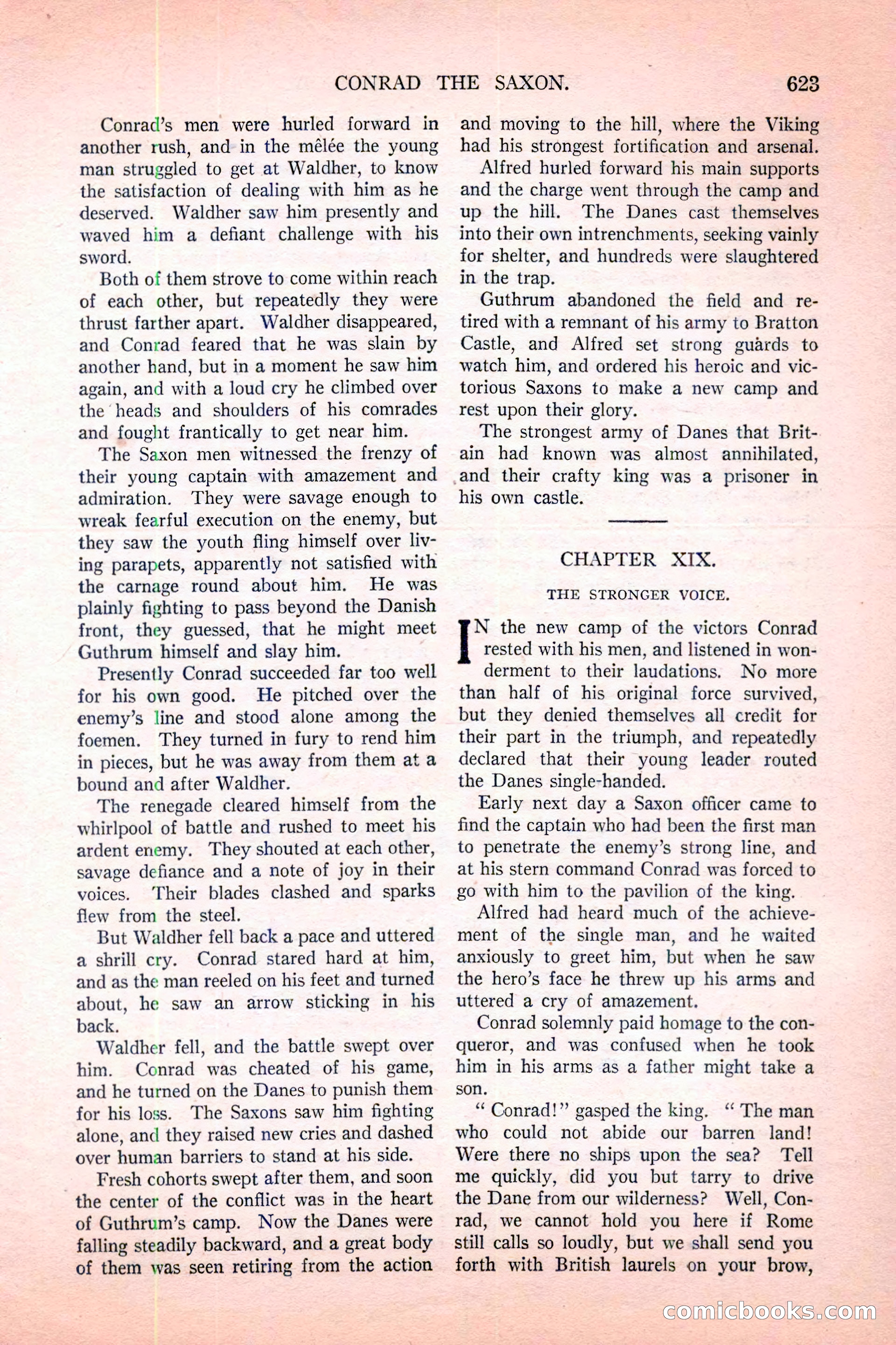
A restored page from Pulp Fiction, 1927. Page through the whole issue in the reader above.
📄 Transcribed text from this page (OCR, searchable)
Machine-transcribed from the original scan — historical spelling and the odd misread are preserved.
CONRAD THE SAXON. Conrad’s men were hurled forward in another rush, and in the mélée the young man struggled to get at Waldher, to know the satisfaction of dealing with him as he deserved. Waldher saw him presently and waved him a defiant challenge with his sword. Both of them strove to come within reach of each other, but repeatedly they were thrust farther apart. Waldher disappeared, and Conrad feared that he was slain by another hand, but in a moment he saw him again, and with a loud cry he climbed over the heads and shoulders of his comrades and fought frantically to get near him. The Saxon men witnessed the frenzy of their young captain with amazement and admiration. They were savage enough to wreak fearful execution on the enemy, but they saw the youth fling himself over liv- ing parapets, apparently not satisfied with the carnage round about him. He was plainly fighting to pass beyond the Danish front, they guessed, that he might meet Guthrum himself and slay him. Presently Conrad succeeded far too well for his own good. He pitched over the enemy’s line and stood alone among the foemen. They turned in fury to rend him in pieces, but he was away from them at a bound and after Waldher. The renegade cleared himself from the whirlpool of battle and rushed to meet his ardent enemy. They shouted at each other, savage defiance and a note of joy in their voices. ‘Their blades clashed and sparks flew from the steel. But Waldher fell back a pace and uttered a shrill cry. Conrad stared hard at him, and as the man reeled on his feet and turned about, he saw an arrow sticking in his back. Waldher fell, and the battle swept over him. Conrad was cheated of his game, and he turned on the Danes to punish them for his loss. The Saxons saw him fighting alone, and they raised new cries and dashed over human barriers to stand at his side. Fresh cohorts swept after them, and soon the center of the conflict was in the heart of Guthrum’s camp. Now the Danes were falling steadily backward, and a great body of them was seen retiring from the action 625 and moving to the hill, where the Viking had his strongest fortification and arsenal. Alfred hurled forward his main supports and the charge went through the camp and up the hill. The Danes cast themselves into their own intrenchments, seeking vainly for shelter, and hundreds were slaughtered in the trap. Guthrum abandoned the field and re- tired with a remnant of his army to Bratton Castle, and Alfred set strong guards to watch him, and ordered his heroic and vic- torious Saxons to make a new camp and rest upon their glory. The strongest army of Danes that Brit- ain had known was almost annihilated, and their crafty king was a prisoner in his own castle. CHAPTER XIX. THE STRONGER VOICE. N the new camp of the victors Conrad rested with his men, and listened in won- derment to their laudations. No more than half of his original force survived, but they denied themselves all credit for their part in the triumph, and repeatedly declared that their young leader routed the Danes single-handed. Early next day a Saxon officer came to find the captain who had been the first man to penetrate the enemy’s strong line, and at his stern command Conrad was forced to go with him to the pavilion of the king. Alfred had heard much of the achieve- ment of the single man, and he waited anxiously to greet him, but when he saw the hero’s face he threw up his arms and uttered a cry of amazement. Conrad solemnly paid homage to the con- queror, and was confused when he took him in his arms as a father might take a son. “Conrad!” gasped the king. “ The man who could not abide our barren land! Were there no ships upon the sea? Tell me quickly, did you but tarry to drive the Dane from our wilderness? Well, Con- rad, we cannot hold you here if Rome still calls so loudly, but we shall send you forth with British laurels on your brow, COPMICLOOO KS (E©)