
Pulp Fiction, 1927 · page 150 of 168
Argosy All-Story Weekly, November 12, 1927 — page 150: what you’re looking at
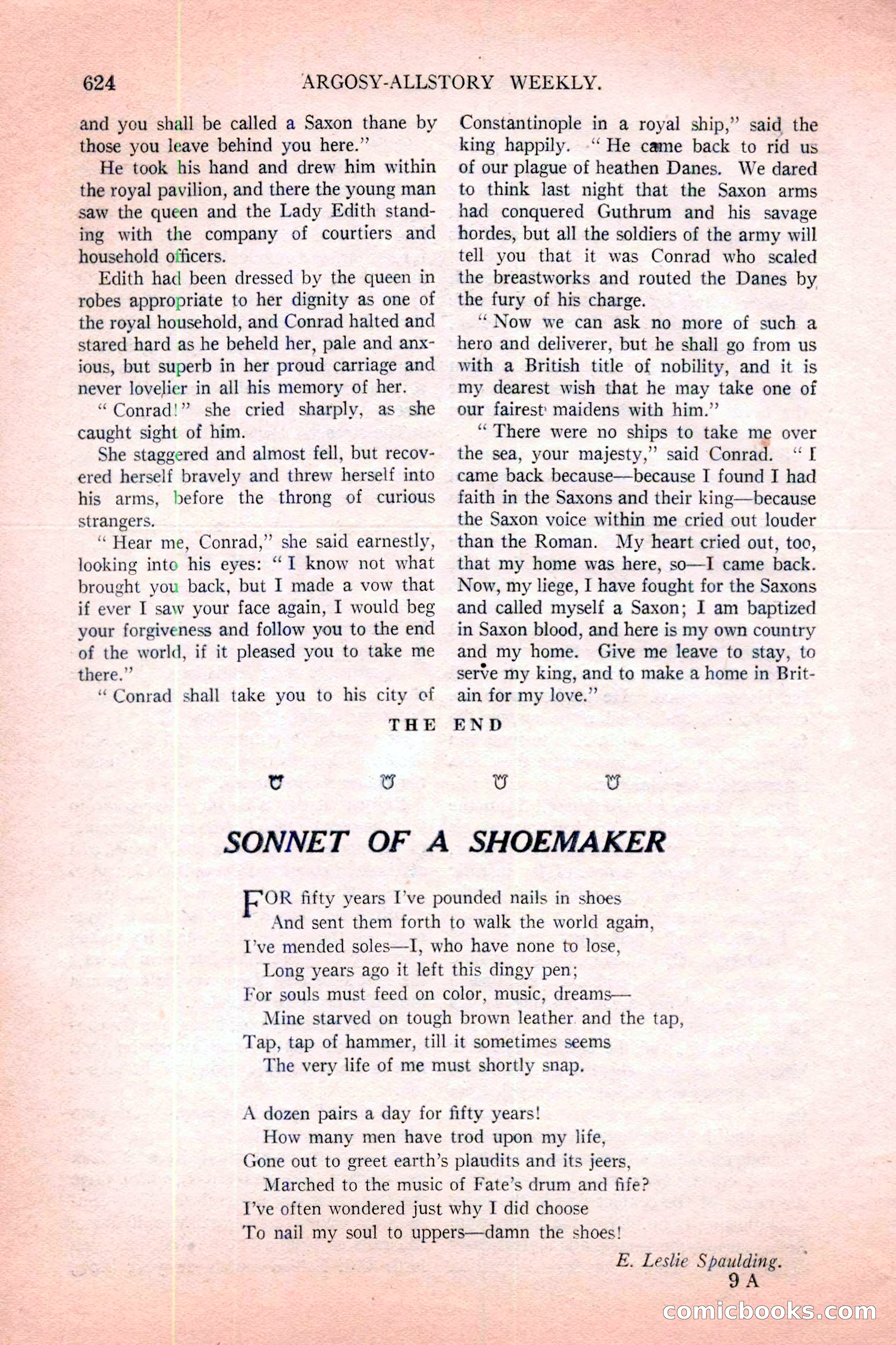
A restored page from Pulp Fiction, 1927. Page through the whole issue in the reader above.
📄 Transcribed text from this page (OCR, searchable)
Machine-transcribed from the original scan — historical spelling and the odd misread are preserved.
624 and you shall be called a Saxon thane by those you leave behind you here.”’ He took his hand and drew him within the royal pavilion, and there the young man saw the queen and the Lady Edith stand- ing with the company of courtiers and household officers. Edith had been dressed by the queen in robes appropriate to her dignity as one of the royal household, and Conrad halted and stared hard as he beheld her, pale and anx- ious, but superb in her proud carriage and never lovelier in all his memory of her. “Conrad!” she cried sharply, as she caught sight of him. She staggered and almost fell, but recov- ered herself bravely and threw herself into his arms, before the throng of curious strangers. ‘Hear me, Conrad,” she said earnestly, looking into his eyes: “I know not what brought you back, but I made a vow that if ever I saw your face again, I would beg your forgiveness and follow you to the end of the world, if it pleased you to take me there.” ‘Conrad shall take you to his city of THE U U ARGOSY-ALLSTORY WEEKLY. Constantinople in a royal ship,” said the king happily. ‘‘ He came back to rid us of our plague of heathen Danes. We dared to think last night that the Saxon arms had conquered Guthrum and his savage hordes, but all the soldiers of the army will tell you that it was Conrad who scaled the breastworks and routed the Danes by the fury of his charge. ‘“Now we can ask no more of such a hero and deliverer, but he shall go from us with a British title of nobility, and it is my dearest wish that he may take one of our fairest’ maidens with him.” “There were no ships to take me over the sea, your majesty,” said Conrad. “I came back because—because I found I had faith in the Saxons and their king—because the Saxon voice within me cried out louder than the Roman. My heart cried out, too, that my home was here, so—I came back. Now, my liege, I have fought for the Saxons and called myself a Saxon; I am baptized in Saxon blood, and here is my own country and my home. Give me leave to stay, to serve my king, and to make a home in Brit- ain for my love.” END U U SONNET OF A SHOEMAKER OR fifty years I’ve pounded nails in shoes And sent them forth to walk the world agam, I’ve mended soles—I, who have none to lose, Long years ago it left this dingy pen; For souls must feed on color, music, dreams— Mine starved on tough brown leather and the tap, Tap, tap of hammer, till it sometimes seems The very life of me must shortly snap. A dozen pairs a day for fifty years! How many men have trod upon my life, Gone out to greet earth’s plaudits and its jeers, Marched to the music of Fate’s drum and fife? I’ve often wondered just why I did choose To nail my soul to uppers—damn the shoes! E. Leslie Spaulding. 9A Gomichbooks (E©)