
Pulp Fiction, 1928 · page 100 of 164
Argosy All-Story Weekly, February 18, 1928 — page 100: what you’re looking at
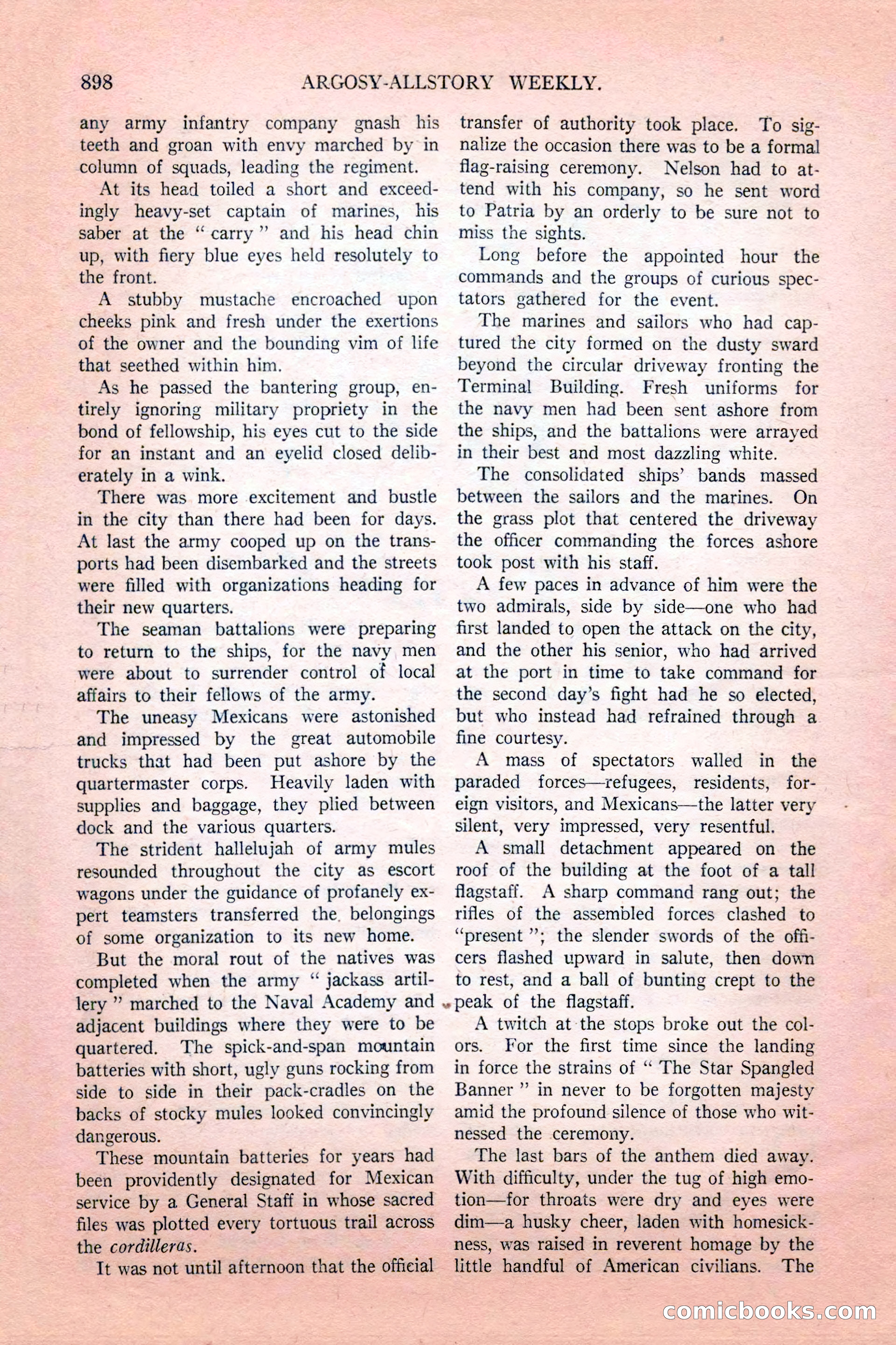
A restored page from Pulp Fiction, 1928. Page through the whole issue in the reader above.
📄 Transcribed text from this page (OCR, searchable)
Machine-transcribed from the original scan — historical spelling and the odd misread are preserved.
898 any army infantry company gnash his teeth and groan with envy marched by in column of squads, leading the regiment. At its head toiled a short and exceed- ingly heavy-set captain of marines, his saber at the “ carry”’ and his head chin up, with fiery blue eyes held resolutely to the front. A stubby mustache encroached upon cheeks pink and fresh under the exertions of the owner and the bounding vim of life that seethed within him. As he passed the bantering group, en- tirely ignoring military propriety in the bond of fellowship, his eyes cut to the side for an instant and an eyelid closed delib- erately in a wink. There was more excitement and bustle in the city than there had been for days. At last the army cooped up on the trans- ports had been disembarked and the streets were filled with organizations heading for their new quarters. The seaman battalions were preparing to return to the ships, for the navy men were about to surrender control of local affairs to their fellows of the army. The uneasy Mexicans were astonished and impressed by the great automobile trucks that had been put ashore by the quartermaster corps. Heavily laden with supplies and baggage, they plied between dock and the various quarters. The strident hallelujah of army mules resounded throughout the city as escort wagons under the guidance of profanely ex- pert teamsters transferred the. belongings of some organization to its new home. But the moral rout of the natives was completed when the army “ jackass artil- lery ” marched to the Naval Academy and adjacent buildings where they were to be quartered. The spick-and-span mountain batteries with short, ugly guns rocking from side to side in their pack-cradles on the backs of stocky mules looked convincingly dangerous. These mountain batteries for years had been providently designated for Mexican service by a General Staff in whose sacred files was plotted every tortuous trail across the cordilleras. It was not until afternoon that the official ARGOSY-ALLSTORY WEEKLY. transfer of authority took place. To sig- nalize the occasion there was to be a formal flag-raising ceremony. Nelson had to at- tend with his company, so he sent word to Patria by an orderly to be sure not to miss the sights. Long before the appointed hour the commands and the groups of curious spec- tators gathered for the event. The marines and sailors who had cap- tured the city formed on the dusty sward beyond the circular driveway fronting the Terminal Building. Fresh uniforms for the navy men had been sent ashore from the ships, and the battalions were arrayed in their best and most dazzling white. The consolidated ships’ bands massed between the sailors and the marines. On the grass plot that centered the driveway the officer commanding the forces ashore took post with his staff. A few paces in advance of him were the two admirals, side by side—one who had first landed to open the attack on the city, and the other his senior, who had arrived at the port in time to take command for the second day’s fight had he so elected, but who instead had refrained through a fine courtesy. A mass of spectators walled in the paraded forces—refugees, residents, for- eign visitors, and Mexicans—the latter very silent, very impressed, very resentful. A small detachment appeared on the roof of the building at the foot of a tall flagstaff. A sharp command rang out; the rifles of the assembled forces clashed to “present ”’; the slender swords of the offi- cers flashed upward in salute, then down to rest, and a ball of bunting crept to the »peak of the flagstaff. A twitch at the stops broke out the col- ors. For the first time since the landing in force the strains of “ The Star Spangled Banner ”’ in never to be forgotten majesty amid the profound silence of those who wit- nessed the ceremony. The last bars of the anthem died away. With difficulty, under the tug of high emo- tion—for throats were dry and eyes were dim—a husky cheer, laden with homesick- ness, was raised in reverent homage by the little handful of American civilians. The GEomichbooks (EO)