
Pulp Fiction, 1928 · page 99 of 164
Argosy All-Story Weekly, February 18, 1928 — page 99: what you’re looking at
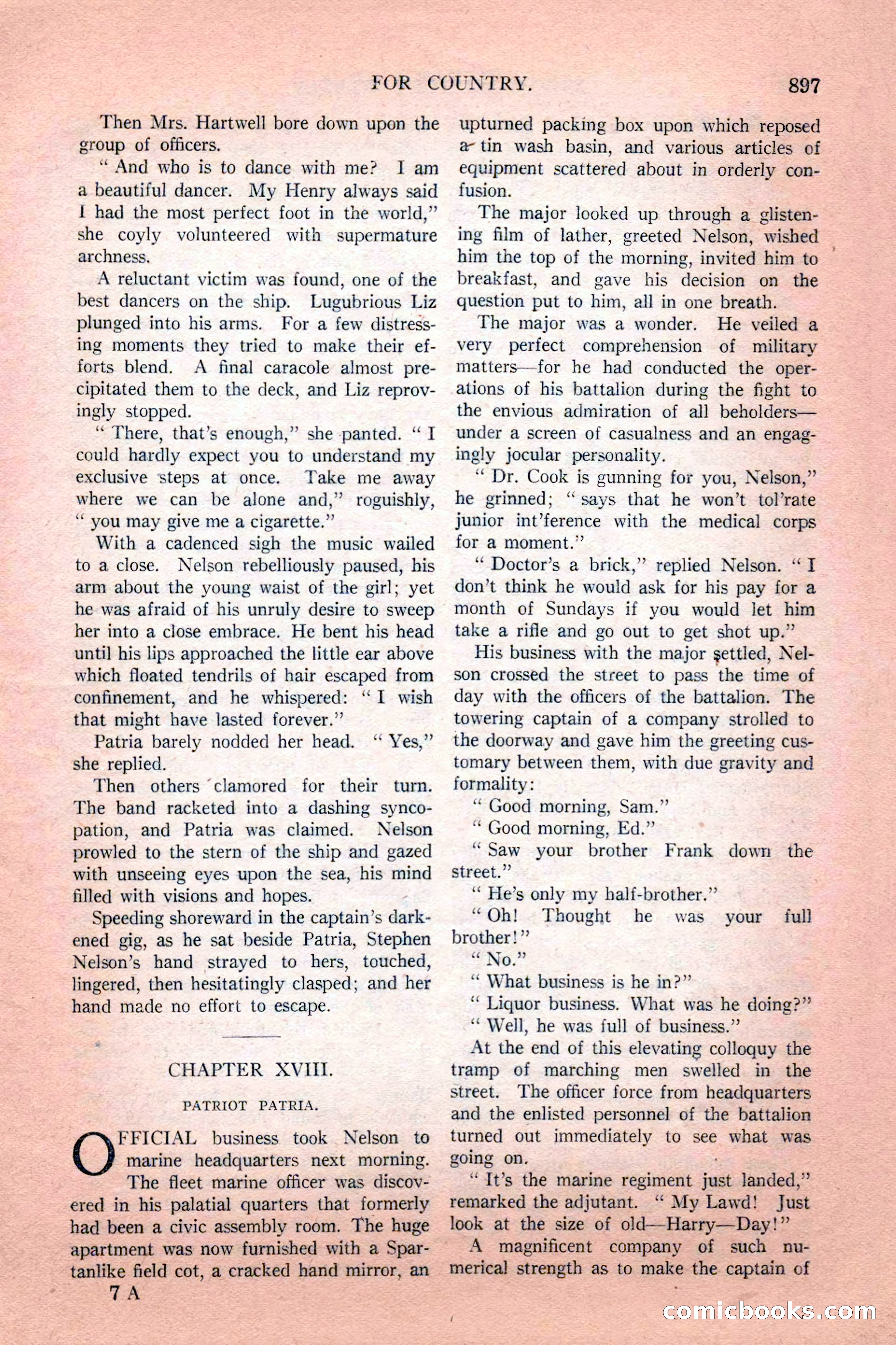
A restored page from Pulp Fiction, 1928. Page through the whole issue in the reader above.
📄 Transcribed text from this page (OCR, searchable)
Machine-transcribed from the original scan — historical spelling and the odd misread are preserved.
? FOR COUNTRY. Then Mrs. Hartwell bore down upon the group of officers. ‘And who is to dance with me? I am a beautiful dancer. My Henry always said 1 had the most perfect foot in the world,” she coyly volunteered with supermature archness. A reluctant victim was found, one of the best dancers on the ship. Lugubrious Liz plunged into his arms. For a few distress- ing moments they tried to make their ef- forts blend. A final caracole almost pre- cipitated them to the deck, and Liz reprov- ingly stopped. ‘There, that’s enough,” she -panted. “ I could hardly expect you to understand my exclusive steps at once. Take me away where we can be alone and,” roguishly, ‘you may give me a cigarette.” With a cadenced sigh the music wailed to a close. Nelson rebelliously paused, his arm about the young waist of the girl; yet he was afraid of his unruly desire to sweep her into a close embrace. He bent his head until his lips approached the little ear above which floated tendrils of hair escaped from confinement, and he whispered: “I wish that might have lasted forever.” Patria barely nodded her head. she replied. Then others clamored for their turn. The band racketed into a dashing synco- pation, and Patria was claimed. Nelson prowled to the stern of the ship and gazed with unseeing eyes upon the sea, his mind filled with visions and hopes. Speeding shoreward in the captain’s dark- ened gig, as he sat beside Patria, Stephen Nelson’s hand strayed to hers, touched, lingered, then hesitatingly clasped; and her hand made no effort to escape. c¢ Ves?’ CHAPTER XVIII. PATRIOT PATRIA. FFICIAL business took Nelson to marine headquarters next morning. The fleet marine officer was discov- ered in his palatial quarters that formerly had been a civic assembly room. The huge apartment was now furnished with a Spar- — _tanlike field cot, a cracked hand mirror, an TA 897 upturned packing box upon which reposed a tin wash basin, and various articles of equipment scattered about in orderly con- fusion. The major looked up through a glisten- ing film of lather, greeted Nelson, wished him the top of the morning, invited him to breakfast, and gave his decision on the question put to him, all in one breath. The major was a wonder. He veiled a very perfect comprehension of military matters—for he had conducted the oper- ations of his battalion during the fight to the envious admiration of all beholders— under a screen of casualness and an engag- ingly jocular personality. ‘Dr. Cook is gunning for you, Nelson,” he grinned; “says that he won’t tol’rate junior int’ference with the medical corps for a moment.” “ Doctor’s a brick,” replied Nelson. “I don’t think he would ask for his pay for a month of Sundays if you would let him take a rifle and go out to get shot up.” His business with the major settled, Nel- son crossed the street to pass the time of day with the officers of the battalion. The towering captain of a company strolled to the doorway and gave him the greeting cus- tomary between them, with due gravity and formality: “Good morning, Sam.” ‘Good morning, Ed.” “Saw your brother Frank down the street.” ‘““ He’s only my half-brother.” “Oh! Thought he was brother!” oc No.” ‘““ What business is he in?” ‘“ Liquor business. What was he doing?” ‘“ Well, he was full of business.” At the end of this elevating colloquy the tramp of marching men swelled in the street. The officer force from headquarters and the enlisted personnel of the battalion turned out immediately to see what was going on. “It’s the marine regiment just landed,” remarked the adjutant. “ My Lawd! Just look at the size of old—Harry—Day!” A magnificent company of such nu- merical strength as to make the captain of your full books (ECO AME é com