
Pulp Fiction, 1928 · page 14 of 164
Argosy All-Story Weekly, February 18, 1928 — page 14: what you’re looking at
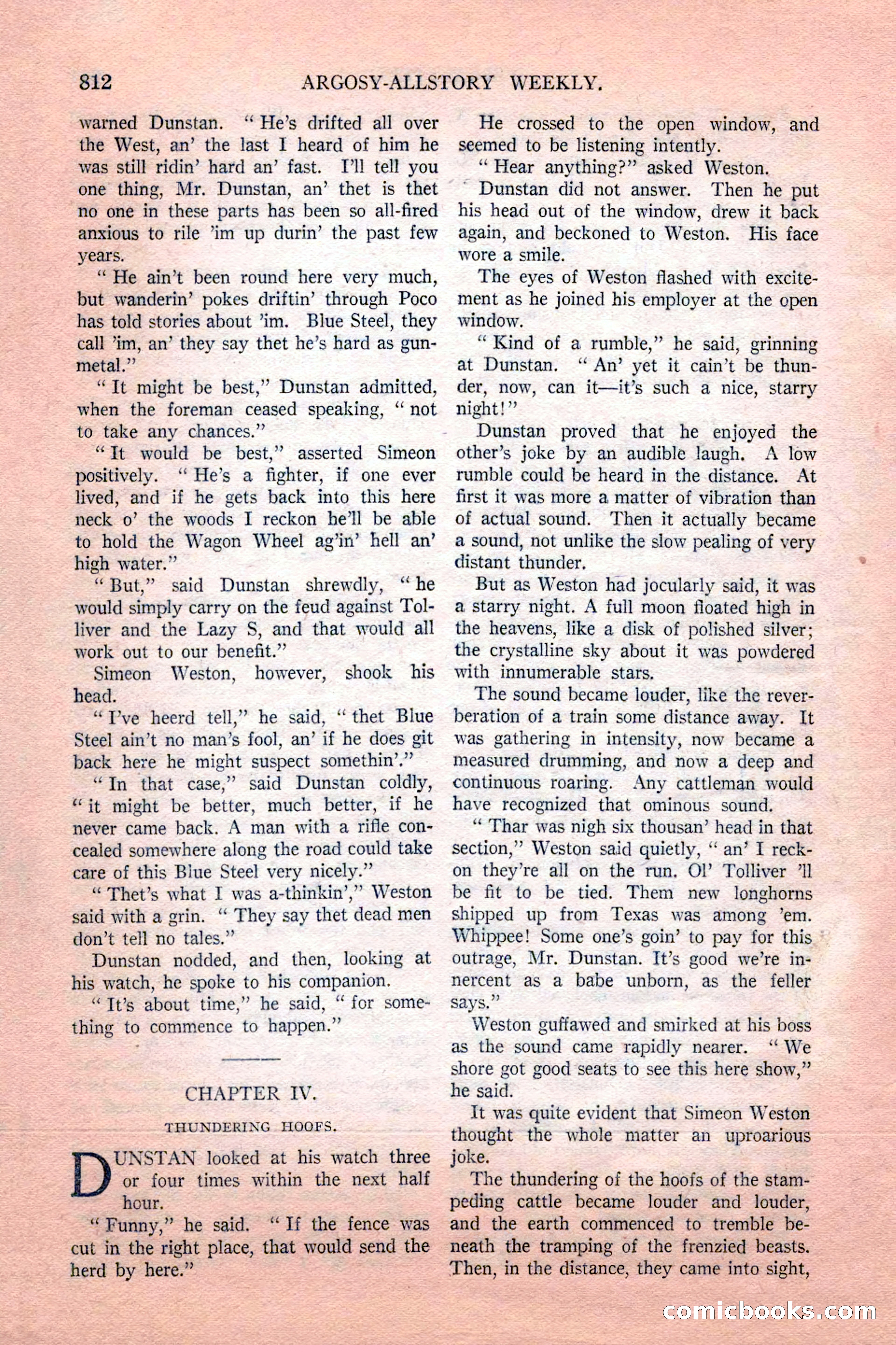
A restored page from Pulp Fiction, 1928. Page through the whole issue in the reader above.
📄 Transcribed text from this page (OCR, searchable)
Machine-transcribed from the original scan — historical spelling and the odd misread are preserved.
$12 warned Dunstan. ‘“ He’s drifted all over the West, an’ the last I heard of him he was still ridin’ hard an’ fast. Ill tell you one thing, Mr. Dunstan, an’ thet is thet no one in these parts has been so all-fired anxious to rile ‘im up durin’ the past few years. “He ain’t been round here very much, but wanderin’ pokes driftin’ through Poco has told stories about ’im. Blue Steel, they call ’im, an’ they say thet he’s hard as gun- metal.”’ “It might be best,” Dunstan admitted, when the foreman ceased speaking, “‘ not to take any chances.” “Tt would be best,” asserted Simeon positively. “‘He’s a fighter, if one ever lived, and if he gets back into this here neck o’ the woods I reckon he’ll be able to hold the Wagon Wheel ag’in’ hell an’ high water.” “But,” said Dunstan shrewdly, “ he would simply carry on the feud against Tol- liver and the Lazy S, and that would all work out to our benefit.” Simeon Weston, however, head. “Tye heerd tell,” he said, “thet Blue Steel ain’t no man’s fool, an’ if he does git back here he might suspect somethin’.” “Tn that case,” said Dunstan coldly, “it might be better, much better, if he never came back. A man with a rifle con- cealed somewhere along the road could take care of this Blue Steel very nicely.” “ Thet’s what I was a-thinkin’,” Weston said with a grin. “ They say thet dead men don’t tell no tales.” Dunstan nodded, and then, looking at his watch, he spoke to his companion. “Tt’s about time,” he said, “ for some- thing to commence to happen.” shook his CHAPTER IV. THUNDERING HOOFS. UNSTAN looked at his watch three D or four times within the next half hour. “Funny,” he said. “If the fence was cut in the right place, that would send the herd by here.” 7 ARGOSY-ALLSTORY WEEKLY. He crossed to the open window, and seemed to be listening intently. “Hear anything?” asked Weston. ' Dunstan did not answer. Then he put his head out of the window, drew it back again, and beckoned to Weston. His face wore a smile. The eyes of Weston flashed with excite- ment as he joined his employer at the open window. ‘Kind of a rumble,” he said, grinning at Dunstan. “ An’ yet it cain’t be thun- der, now, can it—it’s such a nice, starry night!” Dunstan proved that he enjoyed the other’s joke by an audible laugh, A low rumble could be heard in the distance. At first it was more a matter of vibration than of actual sound. Then it actually became a sound, not unlike the slow pealing of very distant thunder. But as Weston had jocularly said, it was a starry night. A full moon floated high in the heavens, like a disk of polished silver; the crystalline sky about it was powdered with innumerable stars. The sound became louder, like the rever- beration of a train some distance away. It was gathering in intensity, now became a measured drumming, and now a deep and continuous roaring. Any cattleman would have recognized that ominous sound. ‘“* Thar was nigh six thousan’ head in that section,” Weston said quietly, “ an’ I reck- on they’re all on the run, Ol Tolliver ‘Il be fit to be tied. Them new longhorns shipped up from Texas was among ’em. Whippee! Some one’s goin’ to pay for this outrage, Mr. Dunstan. It’s good we’re in- nercent as a babe unborn, as the feller Says.” Weston guffawed and smirked at his boss as the sound came rapidly nearer. ‘“‘ We shore got good seats to see this here show,” he said. It was quite evident that Simeon Weston thought the whole matter an uproarious joke. | The thundering of the hoofs of the stam- peding cattle became louder and louder, and the earth commenced to tremble be- neath the tramping of the frenzied beasts. Then, in the distance, they came into sight, —comicbooks (6)