
Pulp Fiction, 1928 · page 15 of 164
Argosy All-Story Weekly, February 18, 1928 — page 15: what you’re looking at
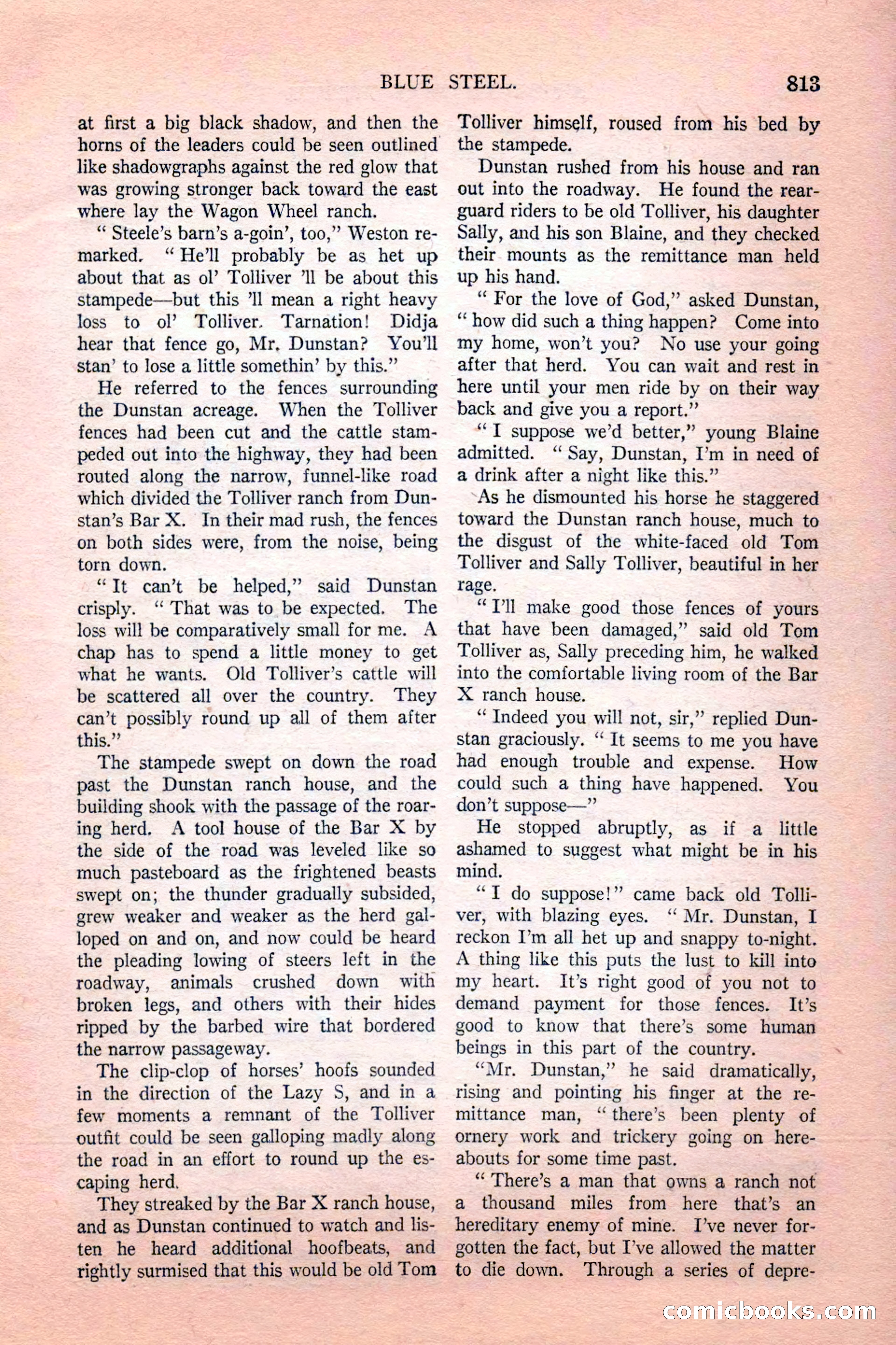
A restored page from Pulp Fiction, 1928. Page through the whole issue in the reader above.
📄 Transcribed text from this page (OCR, searchable)
Machine-transcribed from the original scan — historical spelling and the odd misread are preserved.
BLUE STEEL. at first a big black shadow, and then the horns of the leaders could be seen outlined like shadowgraphs against the red glow that was growing stronger back toward the east where lay the Wagon Wheel ranch. “ Steele’s barn’s a-goin’, too,” Weston re- marked. “He'll probably be as het up about that as ol’ Tolliver ‘Il be about this stampede—but this ’ll mean a right heavy loss to ol’ Tolliver. Tarnation! Didja hear that fence go, Mr, Dunstan? You'll stan’ to lose a little somethin’ by this.” He referred to the fences surrounding the Dunstan acreage. When the Tolliver fences had been cut and the cattle stam- peded out into the highway, they had been routed along the narrow, funnel-like road which divided the Tolliver ranch from Dun- stan’s Bar X. In their mad rush, the fences on both sides were, from the noise, being torn down. “Tt can’t be helped,” said Dunstan crisply. ‘‘ That was to be expected. The loss will be comparatively small for me. A chap has to spend a little money to get what he wants. Old Tolliver’s cattle will be scattered all over the country. They can’t possibly round up all of them after this.” The stampede swept on down the road past the Dunstan ranch house, and the building shook with the passage of the roar- ing herd. A tool house of the Bar X by the side of the road was leveled like so much pasteboard as the frightened beasts swept on; the thunder gradually subsided, grew weaker and weaker as the herd gal- loped on and on, and now could be heard the pleading lowing of steers left in the roadway, animals crushed down with broken legs, and others with their hides ripped by the barbed wire that bordered the narrow passageway. The clip-clop of horses’ hoofs sounded in the direction of the Lazy 5, and in a few moments a remnant of the Tolliver outfit could be seen galloping madly along the road in an effort to round up the es- caping herd. They streaked by the Bar X ranch house, and as Dunstan continued to watch and lis- ten he heard additional hoofbeats, and tightly surmised that this would be old Tom 813 Tolliver himself, roused from his bed by the stampede. Dunstan rushed from his house and ran out into the roadway. He found the rear- guard riders to be old Tolliver, his daughter Sally, and his son Blaine, and they checked their mounts as the remittance man held up his hand. “For the love of God,” asked Dunstan, “how did such a thing happen? Come into my home, won’t you? No use your going after that herd. You can wait and rest in here until your men ride by on their way back and give you a report.” ‘“T suppose we’d better,” young Blaine admitted. ‘‘ Say, Dunstan, I’m in need of a drink after a night like this.” As he dismounted his horse he staggered ~ toward the Dunstan ranch house, much to the disgust of the white-faced old Tom Tolliver and Sally Tolliver, beautiful in her rage. “Tl make good those fences of yours that have been damaged,” said old Tom Tolliver as, Sally preceding him, he walked into the comfortable living room of the Bar X ranch house. ‘Indeed you will not, sir,” replied Dun- stan graciously. ‘“‘ It seems to me you have had enough trouble and expense. How could such a thing have happened. You don’t suppose—” He stopped abruptly, as if a little ashamed to suggest what might be in his mind. “1 do suppose!” came back old Tolli- ver, with blazing eyes. ‘“‘ Mr. Dunstan, I reckon I’m all het up and snappy to-night. A thing like this puts the lust to kill into my heart. It’s right good of you not to demand payment for those fences. It’s good to know that there’s some human beings in this part of the country. “Mr. Dunstan,” he said dramatically, rising and pointing his finger at the re- mittance man, “there’s been plenty of ornery work and trickery going on here- abouts for some time past. “There’s a man that owns a ranch not a thousand miles from here that’s an hereditary enemy of mine. I’ve never for- gotten the fact, but I’ve allowed the matter to die down. Through a series of depre- Gomichbooks (EO)