
Pulp Fiction, 1928 · page 98 of 164
Argosy All-Story Weekly, February 18, 1928 — page 98: what you’re looking at
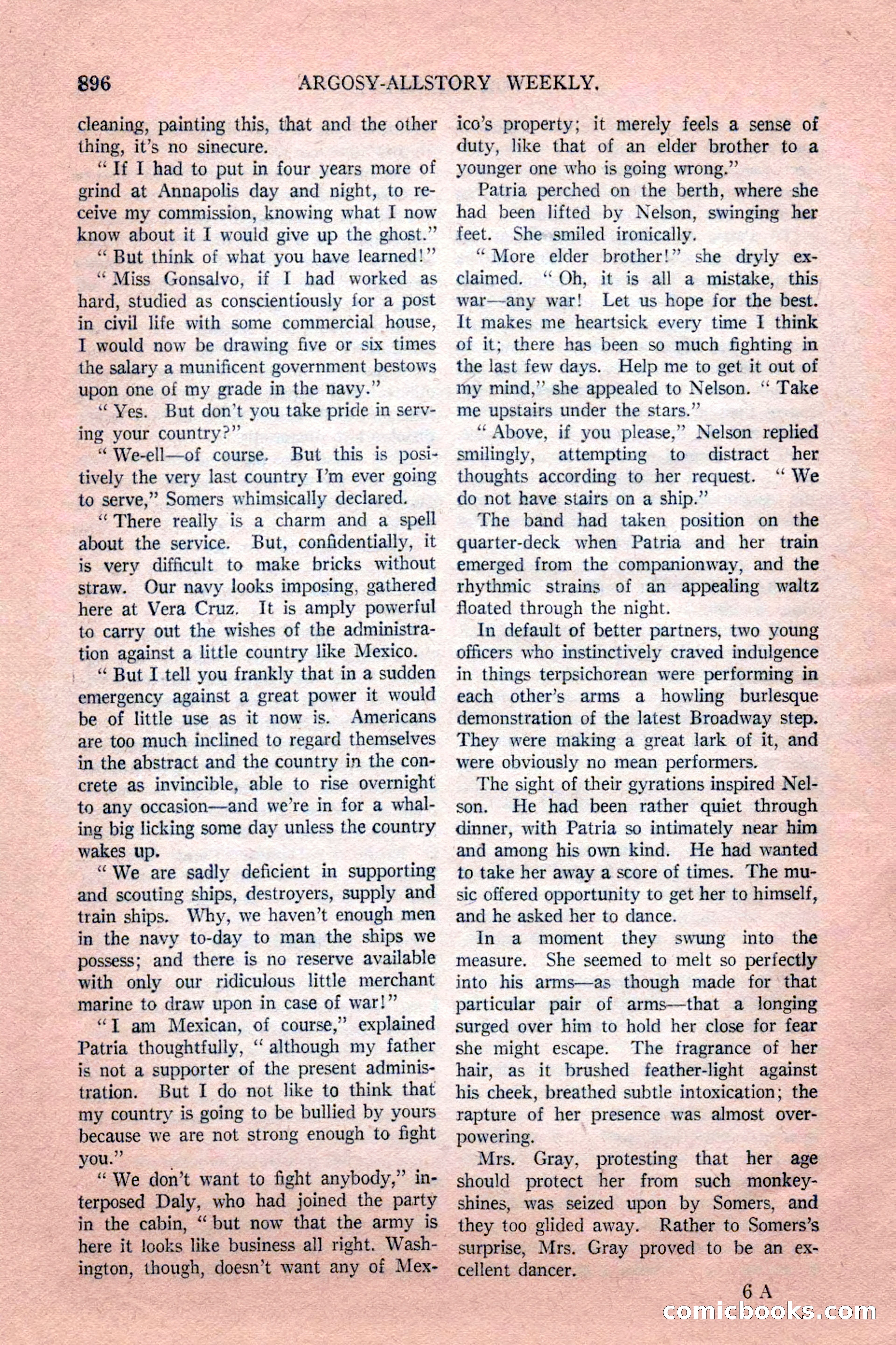
A restored page from Pulp Fiction, 1928. Page through the whole issue in the reader above.
📄 Transcribed text from this page (OCR, searchable)
Machine-transcribed from the original scan — historical spelling and the odd misread are preserved.
896 cleaning, painting this, that and the other thing, it’s no sinecure. “Tf I had to put in four years more of grind at Annapolis day and night, to re- ceive my commission, knowing what I now know about it I would give up the ghost.” ** But think of what you have learned!” ‘‘ Miss Gonsalvo, if I had worked as hard, studied as conscientiously for a post in civil life with some commercial house, I would now be drawing five or six times the salary a munificent government bestows upon one of my grade in the navy.” “Yes. But don’t you take pride in serv- ing your country?”’ “ We-ell—of course. But this is posi- tively the very last country I’m ever going to serve,” Somers whimsically declared. “There really is a charm and a spell about the service. But, confidentially, it is very difficult to make bricks without straw. Our navy looks imposing, gathered here at Vera Cruz. It is amply powerful to carry out the wishes of the administra- tion against a little country like Mexico. “ But I tell you frankly that in a sudden emergency against a great power it would be of little use as it now is. Americans are too much inclined to regard themselves in the abstract and the country in the con- crete as invincible, able to rise overnight to any occasion—and we’re in for a whal- ing big licking some day unless the country wakes up. “We are sadly deficient in supporting and scouting ships, destroyers, supply and train ships. Why, we haven’t enough men in the navy to-day to man the ships we possess; and there is no reserve available with only our ridiculous little merchant marine to draw upon in case of war!” “T am Mexican, of course,” explained Patria thoughtfully, ‘‘ although my father is not a supporter of the present adminis- tration. But I do not like to think that my country is going to be bullied by yours because we are not strong enough to fight you.” - “We don’t want to fight anybody,” in- terposed Daly, who had joined the party jn the cabin, “but now that the army is here it looks like business al] right. Wash- ington, though, doesn’t want any of Mex- ARGOSY-ALLSTORY WEEKLY, ico’s property; it merely feels a sense of duty, like that of an elder brother to a younger one who is going wrong.” Patria perched on the berth, where she had been lifted by Nelson, swinging her feet. She smiled ironically. “More elder brother!” she dryly ex- claimed. ‘ Oh, it is all a mistake, this war—any war! Let us hope for the best. It makes me heartsick every time I think of it; there has been so much fighting in the last few days. Help me to get it out of my mind,” she appealed to Nelson. “ Take me upstairs under the stars.” ‘““ Above, if you please,” Nelson replied smilingly, attempting to distract her thoughts according to her request. ‘“‘ We do not have stairs on a ship.” The band had taken position on the quarter-deck when Patria and her train emerged from the companionway, and the | rhythmic strains of an appealing waltz floated through the night. In default of better partners, two young officers who instinctively craved indulgence in things terpsichorean were performing in each other’s arms a howling burlesque demonstration of the latest Broadway step. They were making a great lark of it, and were obviously no mean performers. The sight of their gyrations inspired Nel- son. He had been rather quiet through dinner, with Patria so intimately near him and among his own kind. He had wanted to take her away a score of times. The mu- sic offered opportunity to get her to himself, and he asked her to dance. In a moment they swung into the measure. She seemed to melt so perfectly into his arms—as though made for that particular pair of arms—that a longing surged over him to hold her close for fear she might escape. The fragrance of her hair, as it brushed feather-light against his cheek, breathed subtle intoxication; the rapture of her presence was almost over- powering. Mrs. Gray, protesting that her age should protect her from such monkey- shines, was seized upon by Somers, and they too glided away. Rather to Somers’s surprise, Mrs. Gray proved to be an ex- cellent dancer. | 6A JOO comi (E Ss (E(0)