
Pulp Fiction, 1928 · page 134 of 160
Argosy All-Story Weekly, April 7, 1928 — page 134: what you’re looking at
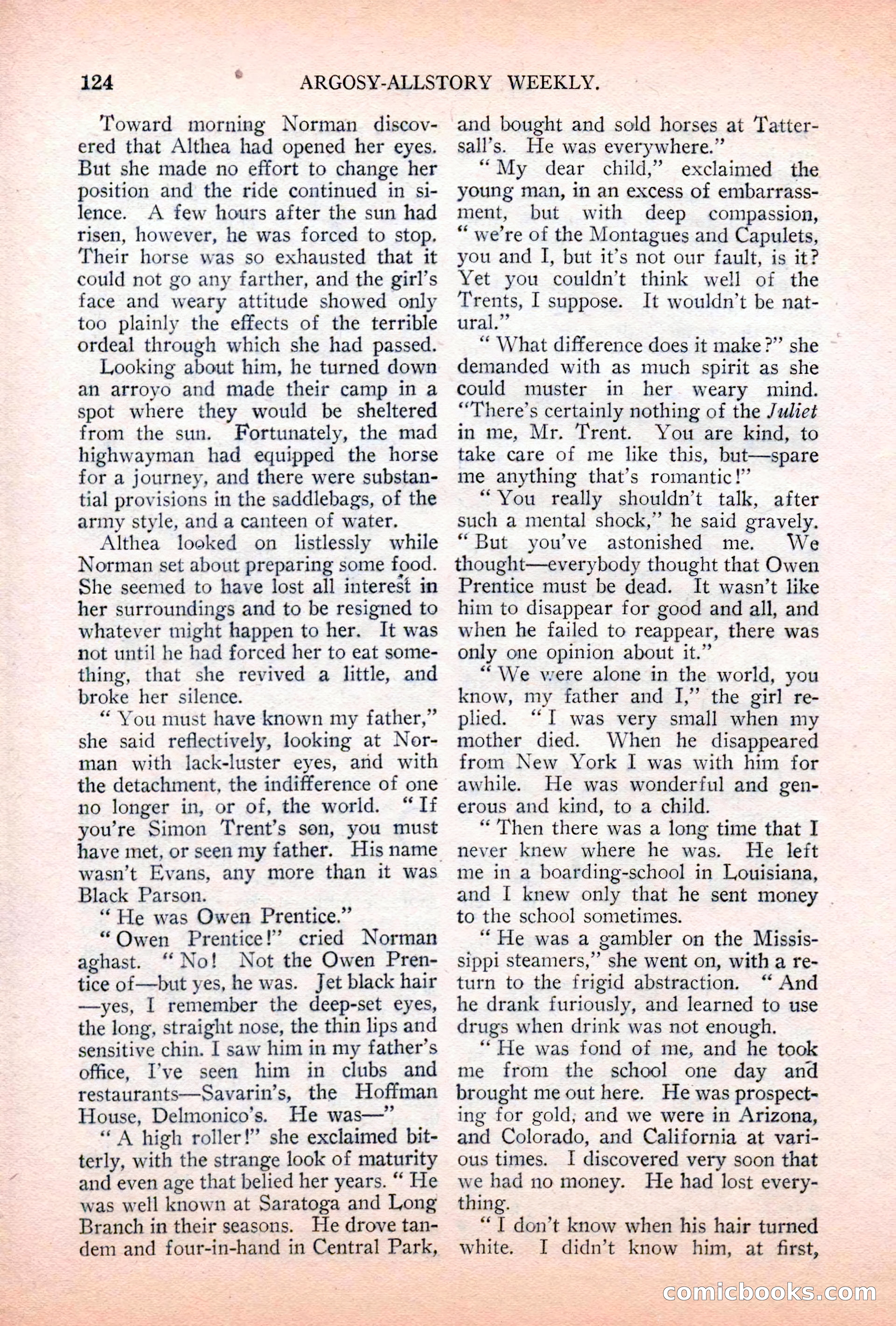
A restored page from Pulp Fiction, 1928. Page through the whole issue in the reader above.
📄 Transcribed text from this page (OCR, searchable)
Machine-transcribed from the original scan — historical spelling and the odd misread are preserved.
124 . Toward morning Norman discov- ered that Althea had opened her eyes. But she made no effort to change her position and the ride continued in si- lence. A few hours after the sun had risen, however, he was forced to stop, Their horse was so exhausted that it could not go any farther, and the girl’s face and weary attitude showed only too plainly the effects of the terrible ordeal through which she had passed. Looking about him, he turned down an arroyo and made their camp in a spot where they would be sheltered from the sun. Fortunately, the mad highwayman had equipped the horse for a journey, and there were substan- tial provisions in the saddlebags, of the army style, and a canteen of water. Althea looked on listlessly while Norman set about preparing some food. She seemed to have lost all interest in her surroundings and to be resigned to whatever might happen to her. It was not until he had forced her to eat some- thing, that she revived a little, and broke her silence. “ You must have known my father,” she said reflectively, looking at Nor- man with lack-luster eyes, and with the detachment, the indifference of one no longer in, or of, the world. “If you’re Simon Trent’s son, you must have met, or seen my father. His name wasn’t Evans, any more than it was Black Parson. “He was Owen Prentice.” “Owen Prentice!’ cried Norman aghast. “No! Not the Owen Pren- tice of —but yes, he was. Jet black hair —yes, I remember the deep-set eyes, the long, straight nose, the thin lips and sensitive chin. I saw him in my father’s office, I’ve seen him in clubs and restaurants—Savarin’s, the Hoffman House, Delmonico’s. He was—” “ A high roller!” she exclaimed bit- terly, with the strange look of maturity and even age that belied her years. “ He was well known at Saratoga and Long Branch in their seasons. He drove tan- dem and four-in-hand in Central Park, ARGOSY-ALLSTORY WEEKLY. and bought and sold horses at ‘Tatter- sall’s. He was everywhere.” “My dear child,” exclaimed the young man, in an excess of embarrass- ment, but with deep compassion, “we're of the Montagues and Capulets, you and I, but it’s not our fault, is it? Yet you couldn’t think well of the Trents, I suppose. It wouldn’t be nat- ural.” “What difference does it make?” she demanded with as much spirit as she could muster in her weary mind. “There’s certainly nothing of the Juliet in me, Mr. Trent. You are kind, to take care of me like this, but—spare me anything that’s romantic!” “You really shouldn’t talk, after such a mental shock,” he said gravely. “But you’ve astonished me. We thought—everybody thought that Owen Prentice must be dead. It wasn’t like him to disappear for good and all, and when he failed to reappear, there was only one opinion about it.” “We were alone in the world, you know, my father and I,” the girl re- plied. “I was very small when my mother died. When he disappeared from New York I was with him for awhile. He was wonderful and gen- erous and kind, to a child. “Then there was a long time that I never knew where he was. He left me in a boarding-school in Louisiana, and I knew only that he sent money | to the school sometimes. “He was a gambler on the Missis- sippi steamers,’’ she went on, with a re- turn to the frigid abstraction. “ And he drank furiously, and learned to use drugs when drink was not enough. “He was fond of me, and he took me from the school one day and brought me out here. He was prospect- ing for gold; and we were in Arizona, and Colorado, and California at vari- ous times. I discovered very soon that we had no money. He had lost every- thing. “T don’t know when his hair turned white. I didn’t know him, at first, EO LMIEL OOO (E S (E@)