
Pulp Fiction, 1928 · page 135 of 160
Argosy All-Story Weekly, April 7, 1928 — page 135: what you’re looking at
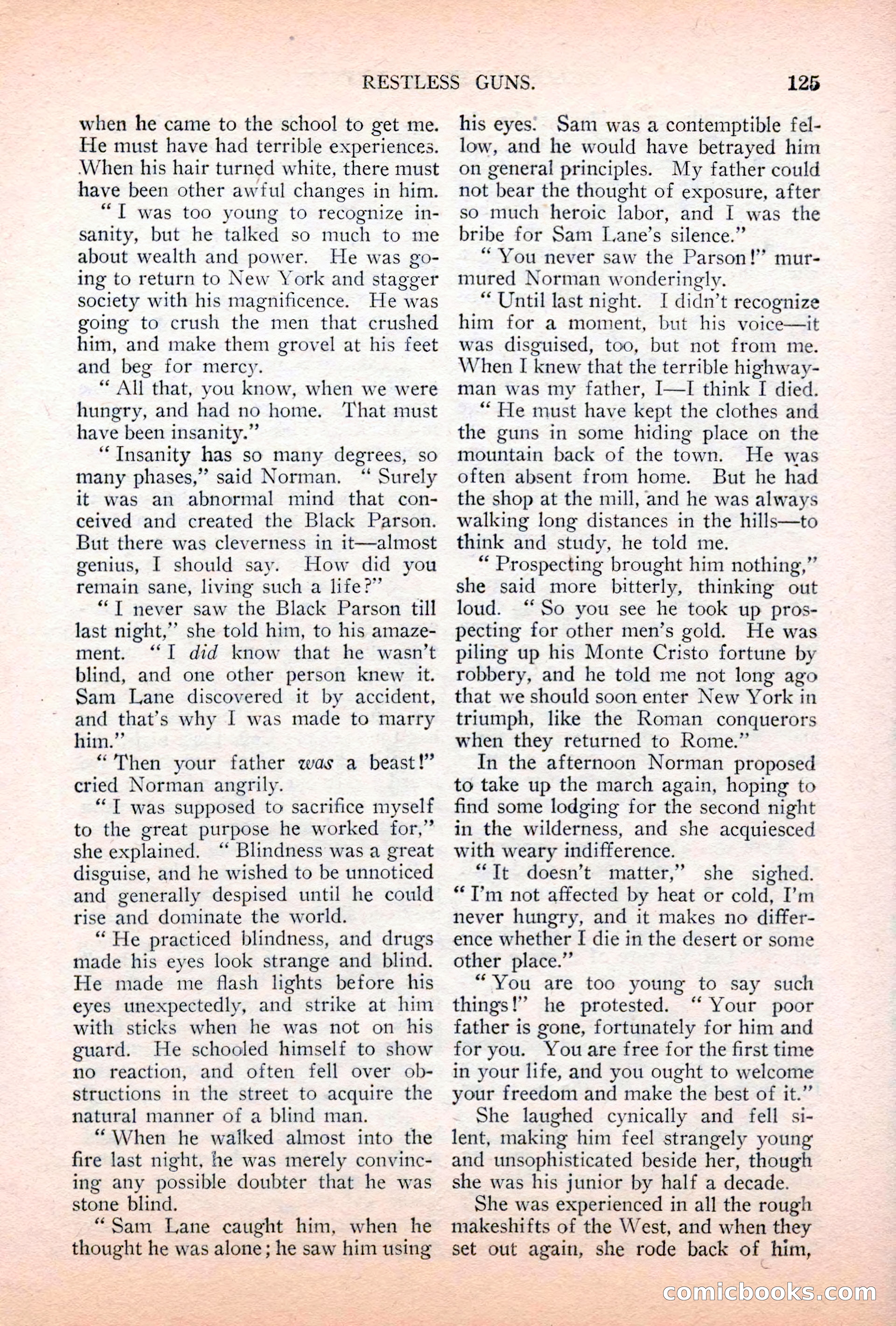
A restored page from Pulp Fiction, 1928. Page through the whole issue in the reader above.
📄 Transcribed text from this page (OCR, searchable)
Machine-transcribed from the original scan — historical spelling and the odd misread are preserved.
RESTLESS GUNS. when he came to the school to get me. He must have had terrible experiences. When his hair turned white, there must have been other awful changes in him. “[ was too young to recognize in- sanity, but he talked so much to me about wealth and power. He was go- ing to return to New York and stagger society with his magnificence. He was going to crush the men that crushed him, and make them grovel at his feet and beg for mercy. * All that, you know, when we were hungry, and had no home. That must have been insanity.” ‘Insanity has so many degrees, so many phases,” said Norman. “ Surely it was an abnormal mind that con- ceived and created the Black Parson. But there was cleverness in it—almost genius, [| should say. How did you remain sane, living such a life?” “T never saw the Black Parson till last night,” she told him, to his amaze- ment. ‘‘I did know that he wasn’t blind, and one other person knew it. Sam Lane discovered it by accident, and that’s why | was made to marry him.” “Then your father was a beast!” cried Norman angrily. “IT was supposed to sacrifice myself to the great purpose he worked for,” she explained. “ Blindness was a great disguise, and he wished to be unnoticed and generally despised until he could rise and dominate the world. “ He practiced blindness, and drugs made his eyes look strange and blind. He made me flash lights before his eyes unexpectedly, and strike at him with sticks when he was not on his guard. He schooled himself to show no reaction, and often fell over ob- structions in the street to acquire the natural manner of a blind man. “When he walked almost into the fire last night, he was merely convinc- ing any possible doubter that he was stone blind. “Sam Lane caught him, when he thought he was alone; he saw him using 125 his eyes: Sam was a contemptible fel- low, and he would have betrayed him on general principles. My father could not bear the thought of exposure, after so much heroic labor, and I was the bribe for Sam Lane’s silence.” “You never saw the Parson!’ mur- mured Norman wonderingly. “Until last night. I didn’t recognize him for a moment, but his voice—it was disguised, too, but not from me. When I knew that the terrible highway- man was my father, I—I think I died. “He must have kept the clothes and the guns in some hiding place on the mountain back of the town. He was often absent from home. But he had the shop at the mill, and he was always walking long distances in the hills—to think and study, he told me. “ Prospecting brought him nothing,” she said more bitterly, thinking out loud. ‘So you see he took up pros- pecting for other men’s gold. He was piling up his Monte Cristo fortune by robbery, and he told me not long ago that we should soon enter New York in triumph, like the Roman conquerors when they returned to Rome.” In the afternoon Norman proposed to take up the march again, hoping to find some lodging for the second night in the wilderness, and she acquiesced with weary indifference. “Tt doesn’t matter,” she sighed. “T’m not affected by heat or cold, I’m never hungry, and it makes no differ- ence whether [ die in the desert or some other place.”’ “You are too young to say such things!” he protested. “ Your poor father is gone, fortunately for him and for you. You are free for the first time in your life, and you ought to welcome your freedom and make the best of it.” She laughed cynically and fell si- lent, making him feel strangely young and unsophisticated beside her, though she was his junior by half a decade. She was experienced in all the rough makeshifts of the West, and when they set out again, she rode back of him, GEomichbooks COL