
Pulp Fiction, 1928 · page 137 of 160
Argosy All-Story Weekly, April 7, 1928 — page 137: what you’re looking at
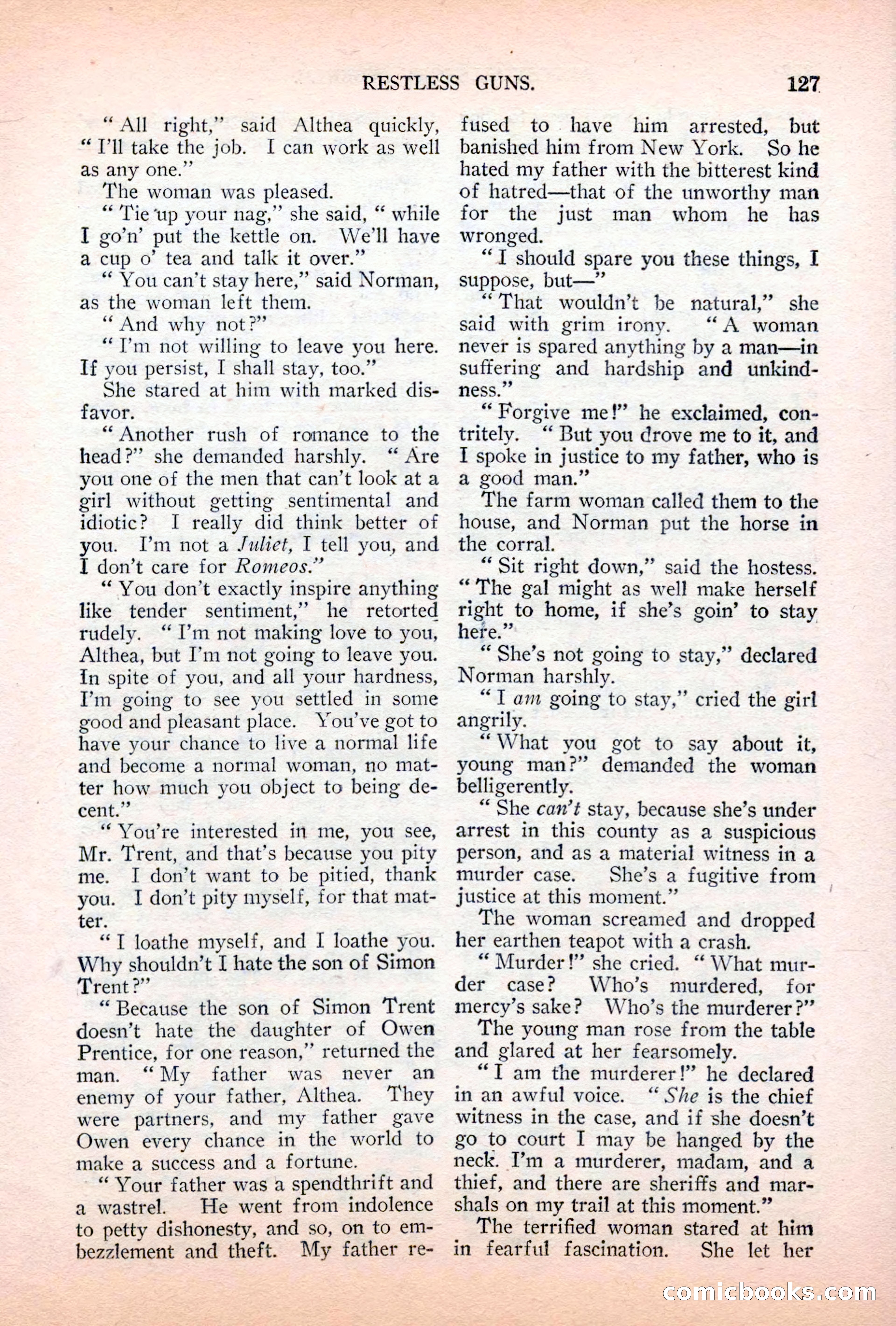
A restored page from Pulp Fiction, 1928. Page through the whole issue in the reader above.
📄 Transcribed text from this page (OCR, searchable)
Machine-transcribed from the original scan — historical spelling and the odd misread are preserved.
RESTLESS GUNS. “All right,” said Althea quickly, “Tl take the job. I can work as well as any one.” The woman was pleased. “ Tie ‘up your nag,” she said, “ while [ go’n’ put the kettle on. We'll have a cup o’ tea and talk it over.” “You can’t stay here,” said Norman, as the woman left them. “And why not?” “I’m not willing to leave you here. If you persist, I shall stay, too.” She stared at him with marked dis- favor. “Another rush of romance to the head ?’’ she demanded harshly. “ Are you one of the men that can’t look at a girl without getting sentimental and idiotic? I really did think better of you. [’m not a Juliet, I tell you, and I don’t care for Romeos.” * You don’t exactly inspire anything like tender sentiment,” he retorted rudely. “ I’m not making love to you, Althea, but I’m not going to leave you. In spite of you, and all your hardness, I’m going to see you settled in some good and pleasant place. You've got to have your chance to live a normal life and become a normal woman, no mat- ter how much you object to being de- cent.” ‘‘You’re interested in me, you see, Mr. Trent, and that’s because you pity me. I don’t want to be pitied, thank you. I don’t pity myself, for that mat- ter. “T loathe myself, and I loathe you. Why shouldn’t I hate the son of Simon Trent?” “ Because the son of Simon Trent doesn’t hate the daughter of Owen Prentice, for one reason,” returned the man. ‘“‘My father was never an enemy of your father, Althea. They were partners, and my father gave Owen every chance in the world to make a success and a fortune. “Your father was a spendthrift and a wastrel. He went from indolence to petty dishonesty, and so, on to em- bezzlement and theft. My father re- 127 fused to have him arrested, but banished him from New York. So he hated my father with the bitterest kind of hatred—that of the unworthy man for the just man whom he _ has wronged. “I should spare you these things, I suppose, but—” “That wouldn’t be natural,” she said with grim irony. “A woman never is spared anything by a man—in suffering and hardship and unkind- ness.” “Forgive me!” he exclaimed, con- tritely. “ But you drove me to it, and I spoke in justice to my father, who is a good man.” The farm woman called them to the house, and Norman put the horse in the corral. “ Sit right down,” said the hostess. “The gal might as well make herself right to home, if she’s goin’ to stay here.” “She’s not going to stay,” declared Norman harshly. “Tam going to stay,” cried the girl angrily. “What you got to say about it, young man?” demanded the woman belligerently. “ She can’t stay, because she’s under arrest in this county as a suspicious person, and as a material witness in a murder case. justice at this moment.” The woman screamed and dropped her earthen teapot with a crash. * Murder!” she cried. “ What mur- der case? Who’s murdered, for mercy’s sake? Who’s the murderer?” The young man rose from the table and glared at her fearsomely. “T am the murderer!” he declared in an awful voice. “ She is the chief witness in the case, and if she doesn’t go to court I may be hanged by the neck. I’m a murderer, madam, and a thief, and there are sheriffs and mar- shals on my trail at this moment.” The terrified woman stared at him in fearful fascination. She let her CORNICE OO KS She’s a fugitive from (E@)