
Pulp Fiction, 1928 · page 138 of 160
Argosy All-Story Weekly, April 7, 1928 — page 138: what you’re looking at
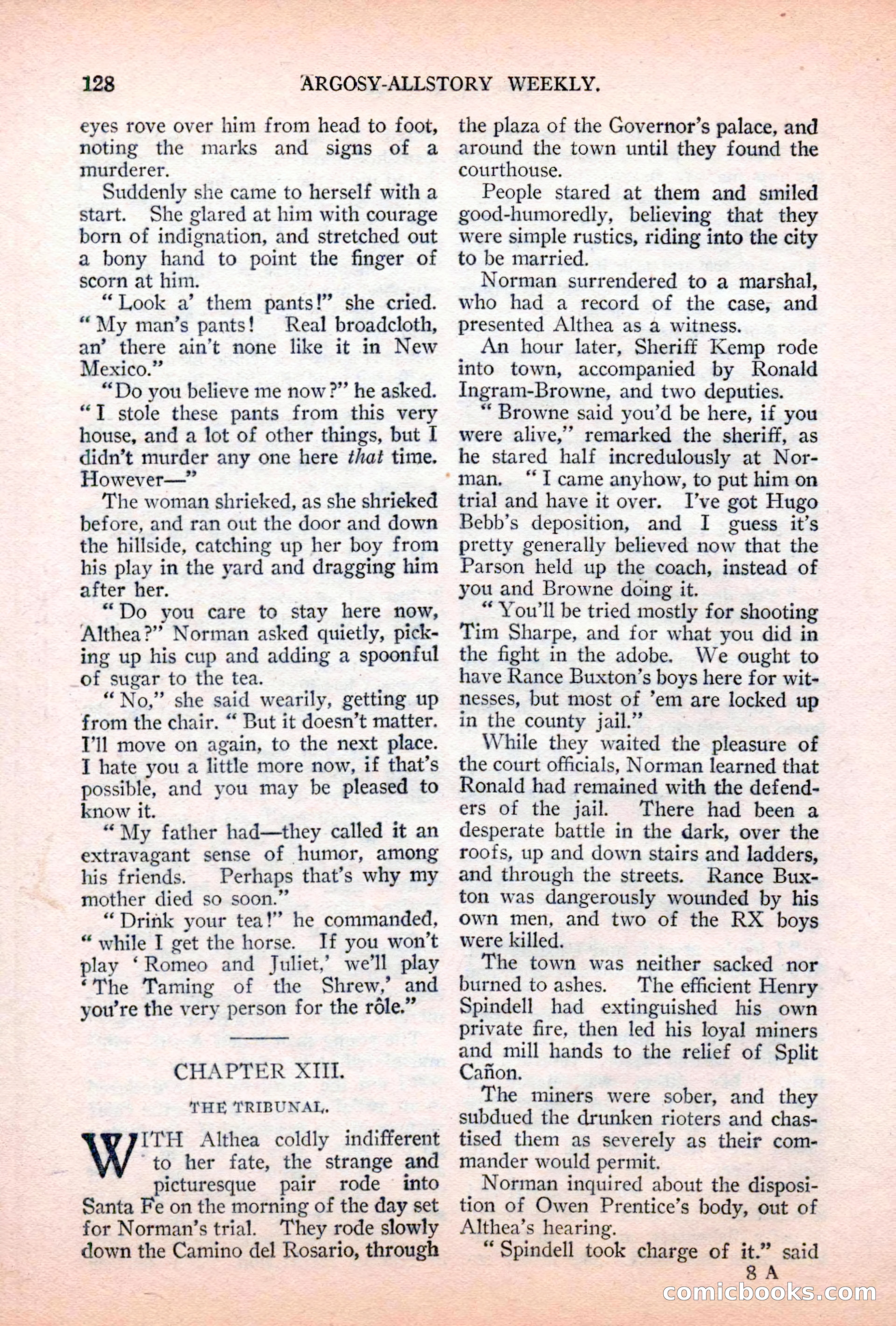
A restored page from Pulp Fiction, 1928. Page through the whole issue in the reader above.
📄 Transcribed text from this page (OCR, searchable)
Machine-transcribed from the original scan — historical spelling and the odd misread are preserved.
128 eyes rove over him from head to foot, noting the marks and signs of a murderer. Suddenly she came to herself with a start. She glared at him with courage born of indignation, and stretched out a bony hand to point the finger of scorn at him. “Look a’ them pants!” she cried. “My man’s pants! Real broadcloth, an’ there ain’t none like it in New Mexico.” “Do you believe me now ?” he asked. “T stole these pants from this very house, and a lot of other things, but I didn’t murder any one here ¢hat time. However—” The woman shrieked, as she shrieked before, and ran out the door and down the hillside, catching up her boy from his play in the yard and dragging him after her. “Do you care to stay here now, Althea?” Norman asked quietly, pick- ing up his cup and adding a spoonful of sugar to the tea. “No,” she said wearily, getting up from the chair. “‘ But it doesn’t matter. T’'ll move on again, to the next place. I hate you a little more now, if that’s possible, and you may be pleased to know it. “My father had—they called it an extravagant sense of humor, among his friends. | Perhaps that’s why my mother died so soon.” “Drink your tea!” he commanded, “ while I get the horse. If you won't play ‘Romeo and Juliet,’ we'll play ‘The Taming of the Shrew,’ and you’re the very person for the role.” CHAPTER XIII. ‘HE ‘TRIBUNAL, ITH Althea coldly indifferent ‘to her fate, the strange and picturesque pair rode into Santa Fe on the morning of the day set for Norman’s trial. They rode slowly down the Camino del Rosario, through ' man, ARGOSY-ALLSTORY WEEKLY. the plaza of the Governor’s palace, and around the town until they found the courthouse. People stared at them and smiled good-humoredly, believing that they were simple rustics, riding into the city to be married. Norman surrendered to a marshal, who had a record of the case, and presented Althea as a witness. An hour later, Sheriff Kemp rode into town, accompanied by Ronald Ingram-Browne, and two deputies. “Browne said you’d be here, if you were alive,’ remarked the sheriff, as he stared half incredulously at Nor- “ I came anyhow, to put him on trial and have it over. I’ve got Hugo Bebb’s deposition, and I guess it’s pretty generally believed now that the Parson held up the coach, instead of you and Browne doing it. “You'll be tried mostly for shooting Tim Sharpe, and for what you did in the fight in the adobe. We ought to have Rance Buxton’s boys here for wit- nesses, but most of ’em are locked up in the county jail.” While they waited the pleasure of the court officials, Norman learned that Ronald had remained with the defend- ers of the jail. There had been a desperate battle in the dark, over the roots, up and down stairs and ladders, and through the streets. Rance Bux- ton was dangerously wounded by his own men, and two of the RX boys were killed. The town was neither sacked nor burned to ashes. The efficient Henry Spindell had extinguished his own private fire, then led his loyal miners and mill hands to the relief of Split Cafion. The miners were sober, and they subdued the drunken rioters and chas- tised them as severely as their com- mander would permit. Norman inquired about the disposi- tion of Owen Prentice’s body, out of Althea’s hearing. “Spindell took charge of it.” said 8A (E(0) .OO mie S (E@)